This site is owned and operated by Zone Air.
Articles · HVAC Basics · Nov 2026
Pioneer multi-zone mini split comparison reveals install requirements, warranty gaps, and hidden costs that make or break your dual-zone system choice.
A Pioneer DIY multi-zone mini-split dual-zone system lets homeowners heat and cool two rooms from one outdoor unit, with no ductwork. But the install process, warranty terms, and total cost differ between brands. This comparison breaks down what Pioneer requires, what Zone Air offers instead, and where each system fits.
Section 01
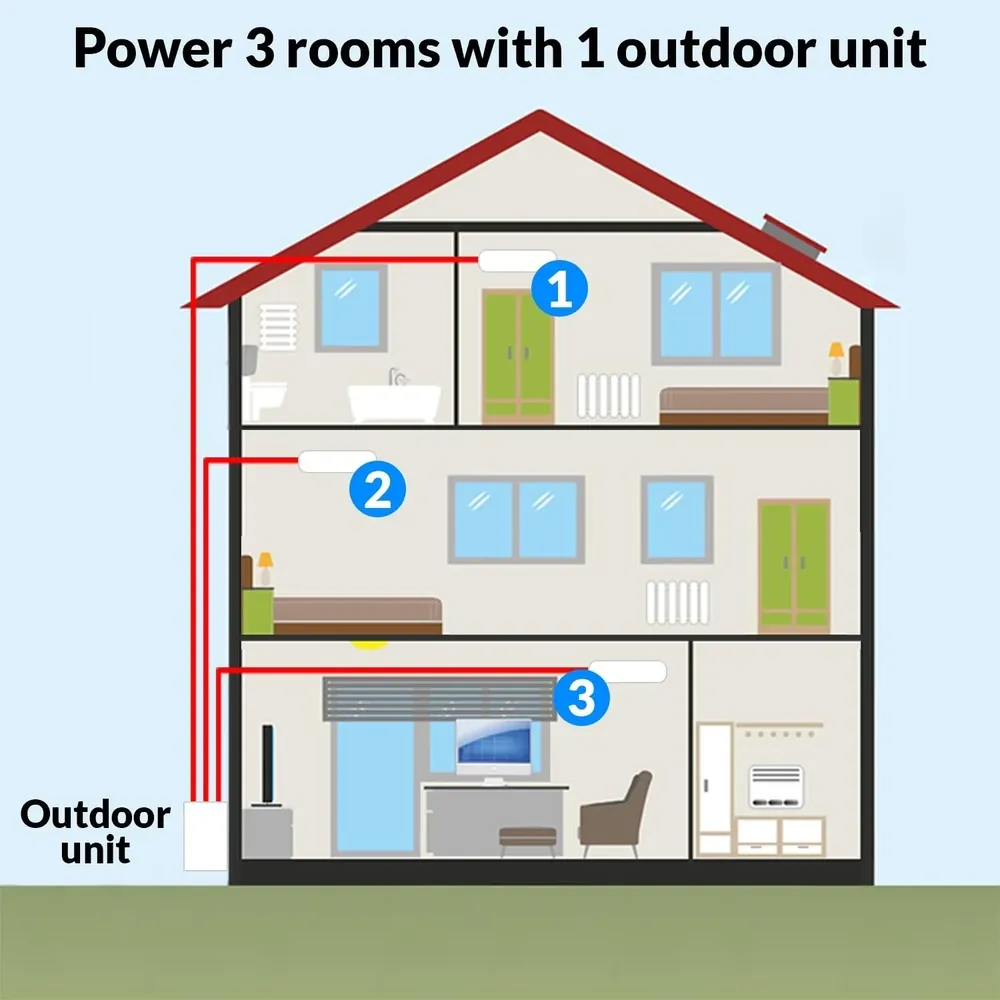
A Pioneer dual-zone multi-split heat pump system pairs one outdoor condenser with two indoor air handlers. Each indoor head connects to the outdoor unit through its own refrigerant line set, and dual-zone air handlers allow separate temperature control in two rooms or zones. Pioneer dual-zone systems provide independent heating and cooling for two rooms without ductwork, which makes mini-split systems like these suitable for older homes, rental property additions, or basement conversions where running ducts is impractical.
A single zone condenser powers one indoor unit. To condition two spaces, you either buy two single-zone systems or one dual-zone condenser. Pioneer dual-zone systems allow a single outdoor unit to service two indoor zones, saving space on the pad outside. Pioneer multi-zone systems range from 18,000 to 48,000 BTU across their lineup. Pioneer systems avoid 20% to 30% energy losses common in central ductwork by conditioning only occupied spaces.
Zone Air is built for buyers who want to skip the vacuum pump, flare fittings, and refrigerant handling entirely. Every Zone Air system ships pre-inspected after final assembly, testing, and inspection in the USA.
Inside the outdoor condenser you'll find the compressor, fan and the coil that exchanges heat. Pioneer models have inverter technology that changes compressor speed to match what the system needs for energy efficiency, cutting back at partial load instead of cycling on and off. Pioneer's Quantum Ultra dual-zone condensers have efficiency ratings up to 24 SEER2, and the connected indoor capacity is sized to stay within the range the condenser can adjust.
With Pioneer dual-zone systems you're looking at high efficiency ratings, with up to 24 SEER2 cooling efficiency and 10.5 HSPF heating. At 24 SEER2, Zone Air's 230V dual-zone wall-mount models match that, while MRCOOL's top DIY 5th Gen delivers 23.5 to 23.6 SEER2 on 115V single-zone sizes.
Pioneer's multi-zone catalog is mostly about wall-mount indoor heads. Indoor air handlers in Pioneer systems operate quietly, around 30 dB(A), and Pioneer recommends that you install the indoor units at least 6 to 8 feet off the floor to get the best performance. Ceiling cassette and concealed ducted options are in Pioneer's single-zone lines, but they show up less often in their multi-zone series.
With one outdoor unit, Zone Air lets you mix indoor styles: wall-mount, ceiling cassette and single-room concealed ducted air handlers all connect to the same multi-zone condenser. MRCOOL's DIY ducted option is the DIY Hybrid multi-position central air handler at 24K and 36K BTU, sized for up to 1,500 sq ft through central ducts, so it is not a single-room unit. Zone Air's concealed ducted units are sized for one room, and it is easier to manage the limits on ceiling height with a compact cassette than with ductwork.
Section 02
Zone Air systems undergo final assembly, testing, and inspection in the USA from globally sourced components. Every unit ships pre-inspected. Verified customer reviews average 4.8 out of 5, with reviewers citing helpful support during installs and warranty questions.
The core difference: Zone Air's pre-charged quick-connect line sets keep the refrigerant circuit sealed from factory to finished install. DIY systems avoid refrigerant labor costs entirely. Pioneer requires professional installation for warranty validity, and Pioneer systems require paid refrigerant handling, with the cost depending on system size and local labor rates.
Comparison
Zone Air cuts each pre-charged quick-connect line set to the length the run needs, anywhere from 5 to 75 feet in a single continuous run with no field joints. MRCOOL DIY systems eliminate the need for vacuum pumps and are also pre-charged, but beyond 50 feet MRCOOL joins two sets with a coupler, adding a connection point. Zone Air's route stays one sealed piece.
Pioneer includes a 16 ft insulated copper line set with each system. Pioneer offers both pre-charged line set kits and standard flare line sets for installation. The flare fittings on standard Pioneer line sets are open to atmosphere until a technician evacuates and charges the system. Extending beyond 16 feet means purchasing additional copper line, flaring it in the field, and completing evacuation with a vacuum pump and micron gauge.
| Feature | Zone Air | Pioneer | MRCOOL DIY |
|---|---|---|---|
| Line set type | Pre-charged, quick-connect | Flare fittings (standard) | Pre-charged, quick-connect |
| Max single run | 75 ft, one piece | Varies by model | 50 ft (coupler beyond) |
| Vacuum pump needed | No | Yes | No |
| Line set length | Custom-cut, 5 to 75 ft | 16 ft copper | Fixed lengths |
Pioneer requires professional installation for warranty validity. DIY installation of Pioneer systems may require EPA certification for refrigerant handling, since opening the refrigerant circuit falls under EPA 608 regulations. Pioneer systems require evacuation to 500 microns before charging, confirmed by a micron gauge held for several hours. A licensed technician must handle refrigerant connections legally.
Proper installation of Pioneer systems requires planning for refrigerant handling and electrical supply. A standard Pioneer install needs a vacuum pump, manifold gauge set, nitrogen tank and torque wrench, all rented or bought. Zone Air's sealed system skips the vacuum pump, gauges and nitrogen; a torque wrench is still part of the install.
Zone Air Efficiency
Zone Air's 230V dual-zone wall-mount systems deliver 24 SEER2. The 115V single-zone models reach 23 SEER2. Pioneer achieves up to 24 SEER2 on select dual-zone sizes. MRCOOL's DIY 5th Gen hits 23.5 SEER2 at 115V on 12K units and 22.5 to 22.7 SEER2 at 230V for 18K to 24K sizes, so Zone Air leads at 230V.
The refrigerant used in some Pioneer dual-zone models is R-454B, while other Pioneer series use R-32 refrigerant for improved efficiency. Zone Air uses R-454B across its lineup, which carries a lower global warming potential than R-410A.
Zone Air's dual-zone 21K BTU 230V system is rated to cool in outdoor temperatures up to 131°F. MRCOOL publishes 122°F. For homeowners in Region IV or desert climates, that 9°F margin matters during summer peaks.
Every Zone Air system heats down to -13°F when the outdoor temperature drops that low. Pioneer's Diamante series is able to heat down to -4°F. Pioneer's Hyperformance series claims heating down to -22°F, though that line is aimed at a different price bracket. Pioneer rates maximum heating output at 8,000 BTU/h at 5°F, with a COP of 1.8 at 5°F. In certain models, Pioneer systems can operate in extreme cold temperatures down to -13°F, but the standard Diamante rating sits at -4°F.
MRCOOL's standard DIY 5th Gen multi-zone condensers are rated to -13°F, which is the same floor as Zone Air, and higher-tier DIY models are rated lower. In winter, supplemental heat may still be required in regions where outdoor temps stay below -13°F for extended hours, since heat pump output falls as temperature drops regardless of brand.
Dual-zone Sizing
Correct BTU sizing for indoor units is necessary to avoid short-cycling and ensure efficiency in Pioneer systems. Sizing by square foot alone is rough; room-by-room load calculations should account for insulation quality, window exposure, ceiling height, sun-facing walls and local climate. Manual J calculations deliver better results than rules of thumb.
Zone Air's multi-zone condensers accept spare ports. You can start with one indoor head and add a second zone later using a pre-charged line set, no vacuum pump. Each zone gets its own thermostat and Wi-Fi controls.
A single zone condenser is fixed. The outdoor unit has one port and one capacity rating, so you can't add zones after the fact. If you're planning to cool a bedroom now and a basement next year, you'd be better off starting with a dual-zone outdoor unit. Until you're ready to hook up the second indoor unit and line set, the spare port stays sealed. Every zone that's connected has its own thermostat and Wi-Fi control, and they work independently of each other.
Zone Air Electrical
Running on a dedicated 15A circuit, Zone Air's 9K and 12K 115V models work with the optional cord kit to plug into a dedicated outlet where local electrical code allows a plug-in install. Extension cords are not allowed. The tradeoff: 23 SEER2 at 115V versus 24 SEER2 at 230V. Pioneer dual-zone models need a dedicated 208/230V electrical circuit, and Pioneer needs a 20A single-pole breaker for installation. Per local code, a licensed electrician should confirm voltage, breaker sizing and disconnect switch placement.
Place indoor units so the airflow can reach the full room without anything in the way. The condensate drainage has to have a continuous downward slope so it does not leak in Pioneer systems. For airflow and service access, the outdoor unit has to have clearance on all sides. Check that the pad is level and that it meets the minimum distances the manufacturer calls for.
It's a good idea to measure the route of every line set before you order. Depending on what the site is like, the 16 ft line set that Pioneer includes might not be long enough. With the custom-cut lengths from Zone Air, you do not have to guess. Zone Air's written DIY manual and install video library cover every step, from mounting the units to the first system run.
Operating Cost
Doing a DIY install means you can skip the professional labor that drives up the installed cost on a multi-zone system. With Zone Air's sealed system, you do not have to deal with Pioneer's professional labor or refrigerant handling at all.
| Cost category | Zone Air (DIY) | Pioneer (professional install) |
|---|---|---|
| Refrigerant handling labor | None | Licensed technician |
| Vacuum pump / tools | Not needed | Vacuum pump, gauges, nitrogen |
| Professional install labor | Not required | Required for warranty |
Zone Air offers 5-year parts and 7-year compressor coverage with no registration deadline. Installing it yourself does not void the warranty. To keep coverage for your system, Pioneer recommends that you review the warranty terms and installation requirements. Pioneer needs registration within a week of installation for its 5-year warranty. Pioneer units that are not registered have only a 1-year warranty. On registered units, Pioneer offers a 5-year parts warranty that covers the compressor and parts for 5 years. Installation has to be completed within 90 days for warranty. Pioneer needs professional installation for warranty to be good.
With 30-day returns on uninstalled units and free shipping to the lower 48 states, Zone Air takes care of you. Experience with returns and swaps goes through one company, since Zone Air sells direct.
Support
Zone Air sells and ships every system direct. The sale, warranty, parts, returns and exchanges all go through one company. Live technical support runs 8 AM to 6 PM MT from the people who built the system. A written DIY manual and video library answer common questions from mounting to startup.
MRCOOL does not sell direct to consumers; purchases go through a dealer or retailer, so returns depend on the seller. Pioneer warranty claims route through authorized dealers or the installer who completed the work.
Buy Zone Air if you want a retail-independent purchase, pre-charged line sets, mixed indoor-unit flexibility and a warranty that doesn't need professional installation and has no registration deadline. Buy Pioneer if you're okay with professional installation, you want the Hyperformance cold-climate series for heating below -22°F. You've got a licensed technician you can call.
If you want to plan, buy and install a dual-zone system without renting a vacuum pump, hiring a refrigerant technician or racing a registration clock, Zone Air works for you. You can start at Zone Air's system builder to match your room load, line set route and indoor unit style to the right system.
