A diy multi zone concealed ducted mini split gives you climate control that you can't see, with its own controller for each zone, and you can put it in yourself if you're handy with tools. Here's what you might want to know before you buy.
Can You DIY a Multi Zone Concealed Ducted Mini Split?
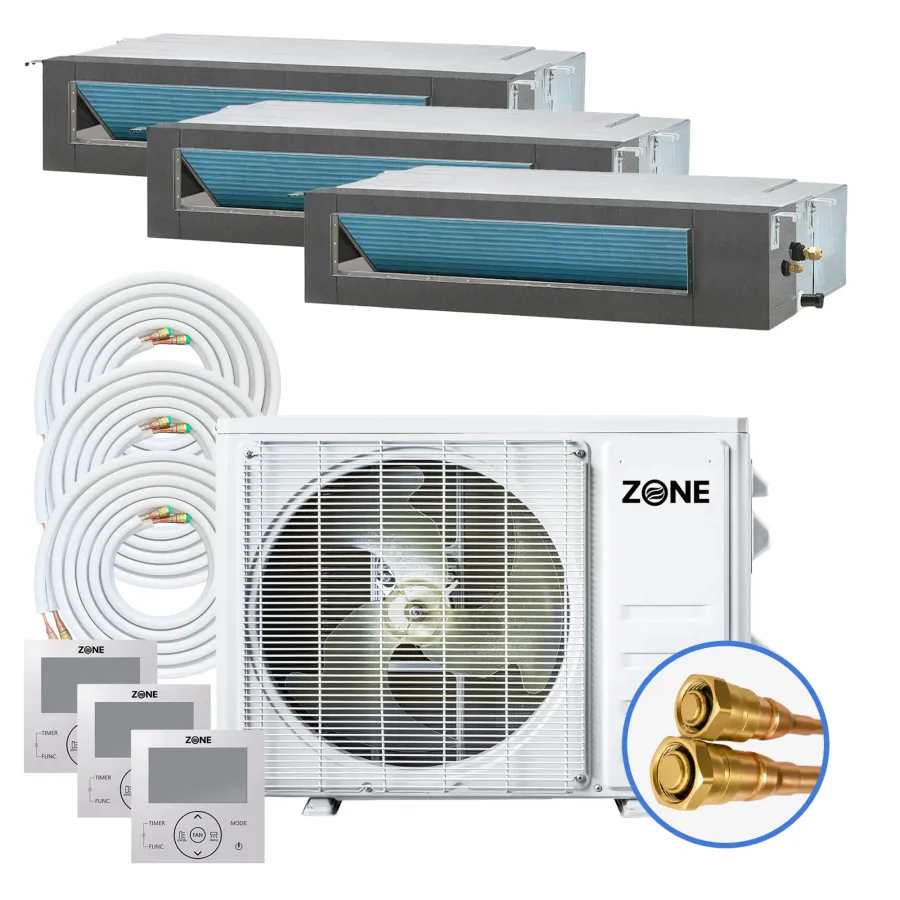
You can, but you need the right equipment and planning. Zone Air sells concealed duct mini split systems that are built around pre charged line sets, so you never have to open the refrigerant circuit. MRCOOL's DIY line, which made wall-mount and ceiling cassette DIY installs popular, does include a ducted unit, the DIY Hybrid Air Handler, but it's a full-size 24,000 or 36,000 BTU cabinet rather than a slim handler you hide above one room's ceiling. That leaves Zone Air as the only DIY concealed ducted mini split system on the market as of October 2026, so if you want a concealed ducted unit for individual rooms, it's your only DIY option.
With a multi zone concealed duct system, one outdoor mini split condenser sends refrigerant to two or three slim ducted air handlers that you hide in ceilings, closets or soffits. The result is invisible aesthetics for your home - only supply registers and return grilles are visible. DIY systems are designed for you to install if you're an average homeowner, and you can avoid the labor part of a full professional bid.
Here's what the basic diy installation is going to involve:
- Mounting each concealed indoor unit so that it sits above a ceiling or inside a closet
- Setting the outdoor condenser on a pad or on a wall bracket
- Routing pre charged line sets from each handler to the condenser with quick connect fittings
- Running the communication cable and the cables for the wired controllers
- You'll need to have an electrician install the dedicated breaker and the disconnect
- Powering on and commissioning each zone
Set your expectations honestly: this is more involved than hanging a single wall-mount diy mini split on a wall. But if you're comfortable with tools, basic carpentry and attic work, you can complete the project over one to two weekends. Note that most homeowners will still need a licensed electrician for the final breaker connection and may want HVAC guidance for complex duct design.
How Multi Zone Concealed Ducted Mini Splits Work
You can imagine a home where you want to condition the living room, the master suite and a bonus room separately. Instead of having one central air handler that pushes air through a single duct trunk, the system uses multiple concealed ducted air handlers and each one serves a specific zone.
The main components are:
- Outdoor inverter condenser: one unit that sits outside and is connected to all of the indoor handlers
- Concealed ducted air handlers: low-profile units that fit in tight spaces above ceilings or in mechanical closets. Zone Air's Thin-Air concealed units are 7⅞ inches tall
- Refrigerant line sets: copper tubing that carries refrigerant between the condenser and each handler
- Wired controllers: one per handler, so each zone is managed independently
- Condensate drainage: built-in pumps in each handler that route water out
Inverter-driven compressors in mini-split systems improve energy efficiency during operation by changing output to match the combined call from all zones. Rather than cycling on and off at full capacity, the system has the ability to adjust - delivering the cooling or heating each room needs. Concealed mini-splits provide heating and cooling year-round, and because the duct runs are short, there is far less ductwork to leak than in a long central system.
Compared to traditional central HVAC, the static pressure limits are lower on concealed handlers. The duct runs have to be shorter and better sealed. Zone Air's units are rated for a maximum of 15 feet per supply run, not 30-foot trunk lines that snake through an attic.
Why Concealed Ducted Is Usually "Pro Only"
Traditionally, installing a ducted mini split needed a vacuum pump, refrigerant manifold gauges, brazing equipment and EPA 608 certification. Concealed ducted units are complex and there is often a good reason they need professionals - the traditional pain points were significant:
- Field-flared or brazed refrigerant connections
- Pulling a deep vacuum and evacuation of moisture from lines
- Charging refrigerant on-site with precise amounts
- Leak testing every joint
- Complex duct balancing across zones
Pre charged, quick connect technology solved most refrigerant-side challenges for diy mini splits, but mostly for wall-mounted units. MRCOOL is sold at big-box stores and its DIY units are designed for easy DIY installation. Its DIY multi-zone condenser goes with wall-mount heads, the OuttaSight ceiling cassette and the DIY Hybrid Air Handler, a 24,000 or 36,000 BTU ducted cabinet that goes upflow, downflow or horizontal and heats or cools up to 1,500 sq ft, according to MRCOOL's specs. It is a central-style unit for a whole ducted floor, not a slim-duct handler for one room. MRCOOL's ceiling-recessed ducted units are part of its Olympus Multi-Zone series, which MRCOOL says "is meant to be professionally installed by a qualified HVAC technician".
Zone Air built its concealed duct air handlers around the same DIY-first approach: pre charged linesets with quick connect fittings, built-in condensate pumps and adjustable static pressure. That is what makes multi zone concealed duct systems realistically DIY-friendly. With pre charged line sets you connect the fittings and open the valves. You never open or recharge the refrigerant circuit yourself.
What Sets Zone Air's Concealed Ducted Units Apart
Being the only DIY option is the big one, but there are a few other things worth knowing before you compare.
- One unit, two or three rooms: Zone Air says each concealed unit can supply 2-3 rooms through short duct branches. So a three-zone package can serve more rooms than it has zones (rooms on the same unit share one setting).
- Fresh air or existing ducts: each unit can connect to ductwork you already have, or take a fresh air intake for ventilation. A wall mount or cassette can't do either.
- Mix head types on one condenser: the 27,000 BTU outdoor unit runs concealed, wall mount and ceiling cassette units together, so you can hide units in the bedrooms and hang a wall unit in the garage. MRCOOL's DIY multi-zone condenser has no slim-duct unit to pair with.
- Line sets cut to length: Zone Air sells 16, 25, 33, 50 and 75 ft line sets, or a custom cut anywhere from 5 to 75 ft. MRCOOL's DIY Quick Connect line sets come in 11.5, 16, 25, 35 and 50 ft lengths, joined with a coupler when one isn't long enough. With a unit up in an attic, a run that fits means no extra line to coil up.
- Made for tight ceiling bays: Thin-Air units are 7⅞ inches tall, take return air from the rear or the bottom, and have adjustable static pressure (0.1–0.4 in. W.C.).
- Final assembly, testing and inspection in the USA, from globally sourced components.
Planning Your DIY Multi Zone Concealed Duct Layout
Planning done on paper is what determines most of the project's success. Concealed duct systems need proper planning and access for maintenance, so you will want to decide on your zone map before you order equipment.
You can start by laying out your home into zones: open living and kitchen, bedroom wing, finished basement, bonus room over garage. Each zone is going to get its own concealed air handler. Then calculate approximate BTU needs. 20-25 BTUs per square foot is a rough starting point - by that rule a 400 sq ft room comes to around 9,000 BTU. But sizing has to consider room square footage and thermal load together. A Manual J load calculation is the proper way to size, taking into account climate, insulation level, window area and ceiling height.
Each ducted air handler has a maximum external static pressure and a maximum duct length. Zone Air's concealed units are rated for 0.1–0.4" WG of external static pressure and 15 feet per supply run. Keep supply runs short, minimize 90-degree turns and use properly sized, well-insulated ducts. External ducting has to be designed properly to maintain airflow and efficiency. You will want to match each handler's capacity to its zone.
Zone Air's three-zone concealed packages run three handlers off a 27,000 BTU multi-zone outdoor unit, and three zones is the most one Zone Air condenser takes. Sketch your air handler locations, supply register positions, return grille placement and line set paths to the condenser - making sure there are no tight turns or runs that exceed manufacturer specs.
Choosing the Right DIY Multi Zone Concealed Ducted System
For concealed duct DIY in 2026, the choice of equipment is going to be limited to one brand, because Zone Air is the only DIY concealed ducted mini split on the market. You will want to focus first on load, then on configuration and efficiency. Zone Air's DIY concealed duct systems range from single-zone units at $2,069.99 (9,500 BTU) and $2,469.99 (11,000 BTU) to dual-zone kits at $4,039.99 and three-zone packages at $4,809.99, with pre charged line sets sold separately from $229.99 per zone for a 16 ft run.
Key specs worth comparing:
- SEER2: Zone Air's concealed systems are rated 19–22 SEER2 (22 on the three-zone packages)
- Cold climate heating: Zone Air's concealed systems heat down to −13°F. Some other cold-climate mini splits are rated to −22°F
- Noise: 26–40 dB per indoor unit
- Refrigerant: R-454B, which along with R-32 has lower global warming potential compared to R-410A
- Warranty is 5 years on parts, 7 years on the compressor
Contrast this with traditional diy mini splits - mostly wall-mounts - where concealed ducting was never an option.
For wall-mount situations, other brands are worth a look, such as Pioneer for budget systems and Senville's AURA series for cold-climate heating. Those are wall-mount picks, so we don't cover them here.
Pre Charged Line Sets Explained
A line set consists of two copper refrigerant lines - liquid and suction - that are insulated, and it connects each concealed duct handler to the outdoor condenser. Pre charged linesets come from the factory already filled with refrigerant and sealed, so the homeowner never handles open refrigerant. That removes the need for a vacuum pump, gauges and a brazing torch.
Quick connect fittings are screw-on connectors that seal as you tighten them. There is no evacuation with a vacuum pump, no deep vacuum gauges, no brazing. Pre-charged linesets bring the installation closer to connecting a garden hose than performing refrigeration work.
MRCOOL's DIY units use the same idea with their pre-charged Quick Connect line sets. Zone Air applies it to concealed duct air handlers - a format where the entire indoor unit sits above ceilings with only grilles visible.
Handle line sets gently: maintain the minimum bend radius (4 inches), support them with clamps, and never exceed the manufacturer's maximum length.
Step-by-Step Overview of a DIY Installation (2026)
The complete project is going to break into six stages. You can plan on a full weekend or two, and DIY systems mostly need common household tools alongside a few specialty items.
- Site preparation: Pick a location for the outdoor condenser with clear airflow and room around it that meets code. Install on a level concrete pad or wall brackets.
- Indoor unit prep: Frame soffits or use existing attic and closet space to mount each concealed duct air handler level and accessible. Concealed mini-splits need solid structural support and proper drainage. Maintenance access must be part of the design - you need to reach the filter and blower after the ceiling is closed.
- Ductwork: Install short, properly sized supply ducts with one to two outlets per handler. Seal all joints with mastic. Add a dedicated return path with filter access for each zone.
- Routing line sets: Drill a 2½–3⅛ inch hole through the wall, then gently route each pre charged line set from handler to outdoor unit, protecting insulation and maintaining minimum bend radius across the run.
- Quick connect and wiring: Hand-thread and torque line set fittings at indoor and outdoor ports. Run the communication cable between each handler and the outdoor unit and mount each wired controller per the manufacturer's diagram. Zone Air's multi-zone systems need one dedicated 30A double-pole 208–230V circuit.
- Power and startup: Have an electrician install the dedicated circuit and disconnect. You will want to check polarity and grounding, then power on. Run the system through test modes and check supply and return temperature splits for each zone to verify proper output.
What You Can DIY vs When to Call a Pro
Modern 2026 diy mini splits are "hybrid DIY" - homeowners handle mechanical assembly and rough-in while pros step in where code or safety demands.
Typical DIY-safe project:
- You're mounting concealed handlers and the outdoor unit
- Installing ductwork and sealing joints
- You're drilling wall penetrations and running line sets
- Low-voltage control wiring
Jobs for licensed professionals:
- Main electrical panel connections and subpanels
- There are permits or inspections related to structural changes
- Any situation involving open refrigerant handling
Because Zone Air's concealed duct systems use pre charged, quick connect line sets, you never open the refrigerant circuit yourself, and installing it yourself does not void Zone Air's warranty. A practical plan: complete all rough-in over a weekend, schedule an electrician midweek, then commission the system yourself. Even partial DIY - doing mounting and ducts while hiring out electrical - still cuts the labor you pay for.
Cost, Efficiency and 2026 Incentives for DIY Multi Zone Systems
DIY mini splits offer energy-efficient climate control. It pays to price every piece before you start.
Major cost components for a three-zone system:
- Equipment (condenser + three concealed handlers): $4,809.99
- Pre charged line sets: $689.97 for three 16 ft runs ($229.99 each). Longer runs cost more
- Duct materials, registers, mastic: depends on your layout
- Electrical work (pro): you can get a local quote
- Tools and miscellaneous
Zone Air's concealed systems carry SEER2 ratings from 19 to 22. Zoning also lets you leave empty rooms off instead of heating or cooling the whole house.
The federal 25C tax credit for heat pumps applied only to equipment installed through December 31, 2025, so don't count on it for a 2026 install. Many states and utilities offer their own rebates for switching to electric. Check current incentives for ducted mini split systems in your state, since some plans need ENERGY STAR or other certified equipment. Factor in comfort and durability: better room-by-room temperature control, low noise and the ability to heat in cold climates without fossil fuels make the investment worth considering beyond raw payback.
Mistakes to Avoid with DIY Concealed Ducted Mini Splits
Most issues come from planning and airflow mistakes rather than from the quick connect technology itself.
- Oversizing or making the condenser too small: A unit that is far too large leads to short cycling. Too small means you don't get enough heating in extreme weather. Read the manufacturer's capacity tables carefully.
- Poor duct design: Long runs that are too small, too many turns or uninsulated ducts in hot attics destroy comfort and efficiency. Keep each supply run within the 15 ft rating.
- Sloppy line set handling: Kinking pre charged lines, going past the maximum distance, or failing to support lines properly causes refrigerant flow problems and potential leaks.
- Electrical shortcuts: Breakers that are too small, shared circuits or ignoring local code requirements create real safety hazards.
- Skipping commissioning: Not checking for error codes, ignoring airflow balance or failing to verify condensate drainage at each concealed handler leads to water damage or poor performance.
Is a DIY Multi Zone Concealed Ducted System Right for You?
This project is ideal if you're comfortable with tools, basic carpentry, reading wiring diagrams and spending one to two full weekends on an organized project. It works best in homes with accessible attics or closet spaces where slim handlers can be mounted with room for service access.
It's a poor fit if you have no interest in learning building codes, your attic has zero clearance, or the home needs major structural changes before ductwork is even possible.
Quick decision checklist before you decide:
- Skill level: can you frame a soffit and run wiring?
- Budget: equipment plus line sets, ducts and an electrician
- Time is one to two weekends plus an electrician visit
- Climate: do you need heating below −13°F?
- You will need to be ready to coordinate with an electrician and potentially an inspector
Your next step is simple: draw your zones, gather room sizes, run them through the sizing calculator, and price out a Zone Air DIY concealed duct package to see whether the numbers work for your home. The questions you answer on paper this year will determine the comfort you feel in every room for the next decade.
Related guides
- 3 zone DIY mini split installation
- Best DIY easy-install multi zone mini split
- Multi zone mini split calculator
- What is SEER2?
Zone Air specifications and prices are taken from Zone Air's product pages as of October 8, 2026 and are subject to change; the manual that ships with your system governs. MRCOOL product statements are taken from MRCOOL's own published DIY Hybrid Air Handler brochure and product catalog, linked above, as of the same date and are subject to change. MRCOOL®, DIY® and OuttaSight® are trademarks of their owner. This site is owned and operated by Zone Air and is not affiliated with or endorsed by MRCOOL.