This site is owned and operated by Zone Air.
Articles · Buying Guide · Nov 2026
Zone Air is the pick for a two-room DIY install. Here is how it compares on efficiency, line sets, indoor units and warranty.
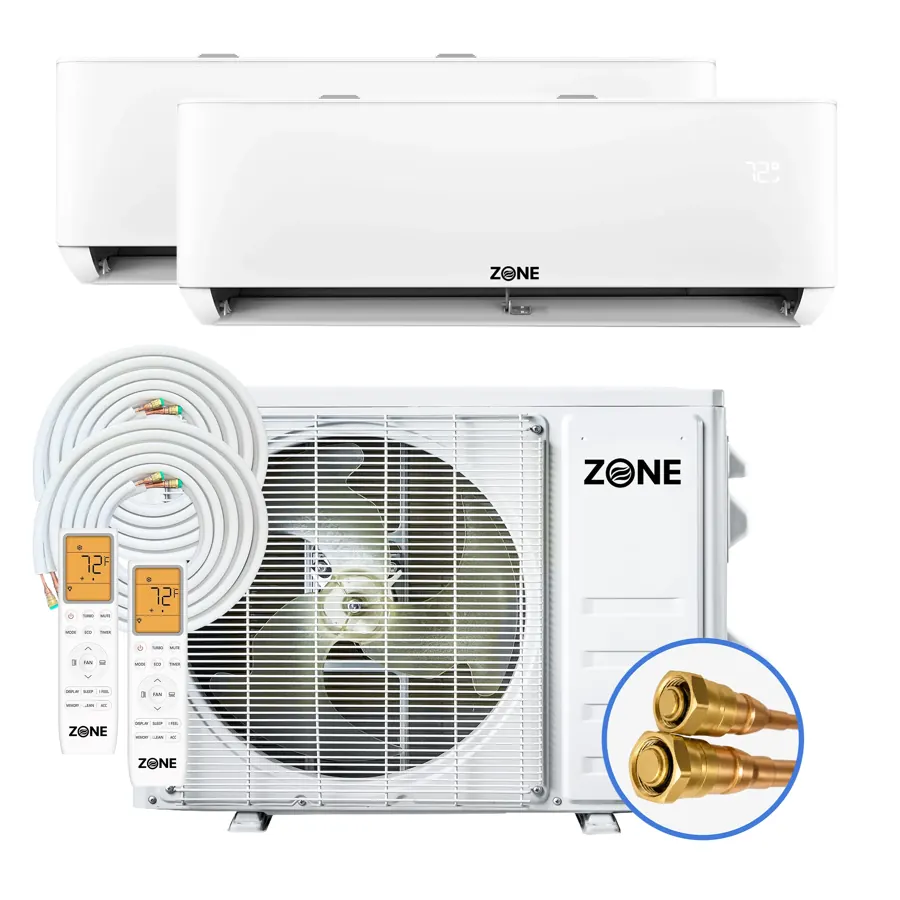
The best dual zone DIY mini split for most homeowners in 2026 is the Zone Air 24 SEER2 dual zone system. It ships with factory pre-charged quick connect lines made to the length you order, goes through final assembly, testing, and inspection in the USA, and handles purchase, support, and warranty claims through a single company. Installing a mini split system typically only requires basic tools for DIY enthusiasts; no vacuum pump, no manifold gauges, no EPA license.
A DIY dual zone mini split consists of one outdoor condenser feeding two indoor air handlers, each with its own thermostat. A dual-zone mini split allows independent heating and cooling of two areas, which makes it a practical choice for two-room projects like a garage paired with a bonus room, or a primary suite paired with a home office. Compared to window units (noisy, inefficient, block the view) or central air (expensive ductwork, single thermostat for the whole house), a ductless mini split gives room-by-room control without tearing into walls for ducts.
This article compares true DIY options only. Zone Air is the pick, MRCOOL is covered as the comparison point, and a few niche alternatives are discussed for buyers who already own HVAC tools. Selection criteria include real DIY friendliness, energy efficiency (SEER2), cold-climate performance, indoor unit flexibility, warranty for self-installers, and total cost to cover two rooms.
Every dual zone system on this list was evaluated against real-world use cases: two bedrooms on different floors, a garage and studio sharing one outdoor unit, or an upstairs pair of rooms where ductwork just isn't practical. As of late 2026, we're looking at dual zone DIY systems that come with a pre charged line set for each head, and at warranties that still hold up when a homeowner does the installation.
Systems that need vacuum pumps, nitrogen pressure testing or EPA Section 608 certification didn't make the "best DIY" list. Professional installation needs that EPA Section 608 certification for refrigerant handling, and that's exactly what true DIY mini split systems are designed to let you skip. DIY mini splits can get rid of the vacuum pump because they ship with sealed, factory-charged refrigerant circuits. According to the published documents that each manufacturer puts out, those are the specs and warranty terms.
Few brands sell a dual zone DIY system with pre-charged quick-connect lines and a warranty that covers homeowner installation. Zone Air is our pick below. We've also got MRCOOL's dual zone specs for comparison, followed by the flare-connection brands.
Zone Air's dual zone DIY platform pairs an outdoor condenser that gets final assembly, testing, and inspection in the USA with two indoor units. The 21,000 BTU dual zone system (12k + 9k heads) runs on 208-230V / 30A and hits up to 24 SEER2 efficiency. It's designed so a homeowner can install it over a weekend. Zone Air offers 24 SEER2 ratings on its 230V dual zone models with wall-mounted heads.
The company ships every system direct to consumer. All systems come pre-inspected, and warranty claims and returns or exchanges go directly through Zone Air. The brand has a 4.8/5 average customer rating across 32 verified reviews of its DIY dual zone systems as of November 2026.
Zone Air is the only DIY mini split brand compared here that does final assembly, testing, and inspection in the USA (as of November 2026). Each condenser and indoor air handler is checked before it ships, and that's why the company can stand behind its warranty.
Zone Air's mini split has a SEER2 rating of 24 on its dual zone 230V models with wall heads, which is the highest of the pre-charged quick-connect DIY brands compared here. MRCOOL's two DIY multi-zone condensers that run two heads are rated 23.9 SEER2 (18K) and 23 SEER2 (27K). Over a 10-to-15-year lifespan, a higher rating means lower electricity bills than a system rated at 21-22 SEER2.
Zone Air is also the only DIY mini split brand that does custom line set fabrication. It can make a line set to the exact length you need, any whole foot from 5 to 75 ft in a single run, so each of the two heads can go exactly where you need it. MRCOOL reaches longer runs by joining an extension line set to the first one with a coupler. Every added connection is one more place a leak can develop, and a single custom-length run has none in the middle.
Zone Air is the only DIY mini split that lets you mix wall-mount, ceiling cassette and concealed ducted units on one outdoor unit (as of November 2026). You can do wall mount plus concealed ducted, wall mount plus ceiling cassette, or any other combination. MRCOOL's DIY multi-zone line mixes wall heads with its one-way OuttaSight ceiling cassette. MRCOOL's ducted DIY option is a central air handler sized for a whole home. It is not the same thing as Zone Air's concealed ducted mini split, which is built to serve a single room or two or three small ones.
Zone Air is the only brand that offers a plug-in outlet solution for homeowners who want a system that plugs into an outlet. Zone Air's plug-in kit for its 115V DIY systems lets you plug the system into an outlet. The plug-in kit combined with the 115V system makes Zone Air's the easiest systems to install on the market. The 115V systems are single-zone 9K and 12K units rated at 23 SEER2. The dual zone systems run on 230V.
The buying terms come from the manufacturer too: 30-day returns on uninstalled units and free shipping to the lower 48 states.
MRCOOL doesn't sell direct to you. You buy MRCOOL's DIY 5th Gen line through dealers and distributors. There's no dedicated dual zone condenser in the lineup, but the 18K multi-zone condenser (up to 3 zones) and 27K (up to 4 zones) both run two heads. The line comes with pre-charged quick-connect lines in fixed lengths of 11.5, 16, 25, 35 or 50 ft, and you can use couplers to reach 75 ft. It uses R-454B refrigerant and works with wall-mounted heads or the OuttaSight ceiling cassette. MRCOOL's 9K unit hits a SEER2 rating of 23.6 in single zone systems, while the multi zone condensers that run two heads are rated 23.9 for the 18K and 23 for the 27K.
MRCOOL's DIY 5th Gen line has a 5-year parts and 7-year compressor warranty with no registration required and without requiring a licensed HVAC technician. Both Zone Air and MRCOOL have 5-year parts and 7-year compressor warranties, though their support channels work differently.
What you need to know for a two-room project is this:
Several brands show up in DIY lists (Pioneer, Senville, Cooper & Hunter) but they need more advanced setup, partial professional help or they come with limited warranty terms. These are only "DIY-friendly" if you're already comfortable with electrical work, making holes in walls and sometimes flare connections that need you to pull a deep vacuum with a micron gauge.
For dual zone buyers, the decision usually comes down to the path you take to install it, what kind of indoor units you can use, how the lineset is laid out, and what the energy costs will be over the long run. Before you compare systems, it helps to draw a simple floor plan that shows the two rooms, where the exterior wall holes will go, and about how far the lines need to run from the outdoor condenser.
Getting the size right for mini split systems is critical so you don't end up with a system that doesn't work well. Start at about 20 BTU per square foot as a starting point, then adjust the BTU size for room conditions like how good the insulation is, how much sun the room gets, and how high the ceilings are. You'll want to factor in high ceilings or large windows when sizing, because both increase the cooling load.
A 12,000 BTU mini split will cover 300 to 550 sq ft, though that depends on your climate and insulation. For a bedroom that is 350 square feet and well-insulated, 9,000 BTU is often right. For a garage that is poorly insulated and has a large door, 12,000 BTU or more may be required. So what happens when you make a mini split too big? You get short-cycling issues: the compressor speeds up, reaches the set temperature too fast, shuts off and starts again minutes later. This is a waste of energy, it wears out the compressor, and it leaves the room cold but humid.
Common dual-zone mixes and where they fit:
| Configuration | Combined BTU | Typical Use Case |
|---|---|---|
| 9k + 9k | 18,000 | Two small bedrooms or office + guest room |
| 9k + 12k | 21,000 | Office + primary bedroom or studio + workshop |
| 12k + 12k | 24,000 | Garage + bonus room or two medium living spaces |
Small houses typically require dual-zone systems ranging from 18,000 to 24,000 BTUs. If you are unsure about sizing for your square footage, Zone Air's sizing calculator or its support team can provide a right-size recommendation before purchase. Electrical requirements for mini split installations may require an electrician depending on the setup, especially for 230V dedicated circuits.
Custom-length linesets solve a common dual zone problem: one head may sit directly behind the outdoor condenser (a 10 ft run), while the other is across the house or on another floor (a 50 ft run). With fixed-length line sets, the short run ends up with excess refrigerant line coiled behind the unit or along the exterior wall.
Each extra quick-connect or flare joint along a refrigerant line is a potential leak point over the system's 10-to-15-year life. Fewer joints means fewer places for a leak to start. DIY mini splits often use pre-charged quick-connect lines, and Zone Air's ability to fabricate each pre-charged lineset to exact length (5 to 75 ft) simplifies planning for both runs. MRCOOL's line sets come in five fixed lengths.
If you are uncomfortable with electrical work, budget for a licensed electrician even with a DIY refrigerant-side system. The diy line between "what you can do yourself" and "what needs a pro" usually falls at the electrical panel, not the refrigerant circuit, on these systems.
Higher SEER2 means you use less electricity over the years, and that matters even more when both zones are in use every day. With wall heads, the dual zone efficiency on Zone Air goes up to 24 SEER2, which sits above MRCOOL's DIY 5th Gen multi zone condensers (the 18K gets 23.9 SEER2 and the 27K gets 23. MRCOOL's 9K unit has a SEER2 rating of 23.6 when you look at the single zone number). Over a decade of daily use for air conditioning and heating in two rooms, a higher rating is going to keep paying back.
For cold-climate performance: Zone Air's units are rated to heat down to −13°F, and that covers most US climates. MRCOOL's 18K and 27K DIY multi zone condensers have the same floor of −13°F, and the higher-tier DIY models from MRCOOL that are rated lower are only for single-zone. If your area rarely drops below 0°F, the −13°F rating is more than sufficient. If your space needs a dedicated heat pump for primary heating in Minnesota or Vermont, you'll want to plan for backup heat on the coldest nights.
State and utility rebate plans often set a minimum SEER2 that you have to meet to qualify, and some of them pay more when you have higher ratings. Zone Air's dual zone systems are AHRI Certified at up to 24 SEER2. Check your local plan requirements before buying. To get started, you can try Zone Air's rebate search.
A real DIY warranty has to clearly allow homeowner installation without a licensed HVAC tech, because a failed compressor can run you $1,500+ if you're not covered. With Zone Air selling direct, the same company handles sales, shipping, tech support and warranty claims. There's no back-and-forth between the store and the maker when something goes wrong.
MRCOOL sells through dealers and distributors, so your purchase runs through a third party. On MRCOOL's Trustpilot profile, people give it 3.0/5 across 94 reviews as of November 2026, with complaints about turned-down claims on self-installed units and slow support replies. With a 4.8/5 from verified reviews of its own customers, Zone Air makes sure every claim goes straight to the company that built the system.
Mitsubishi and other pro-grade brands make excellent equipment, but they need a licensed installer for both the install and the warranty, so they're not really in the DIY category at all. If you're looking at a DIY mini split against a pro install quote for central ac or a professional-grade ductless system, the labor line on that quote is what doing it yourself takes out.
When you're picking a system, it comes down to your rooms, how comfortable you are with tools, and how you want to handle things after the install is done.
If you are thinking about Zone Air, list your two rooms, the approximate square footage of each room, and the distance from each wall penetration to the planned outdoor condenser location. That information is enough to match you with a specific Zone Air dual zone system and a custom lineset pair.
The DIY dual zone mini split market in 2026 is narrow. Zone Air and MRCOOL both sell pre-charged quick-connect systems with manufacturer published warranty terms covering homeowner installation. A handful of other brands sell the equipment but restrict warranty coverage to professional installs, which defeats the core value of the diy mini approach.
Zone Air is the strongest all-around choice for most homeowners. Final assembly, testing, and inspection in the USA, up to 24 SEER2 efficiency, custom-length pre-charged linesets, and the ability to mix indoor unit types on one condenser cover the widest range of two-room projects. The fact that one company handles the entire relationship, from factory to front door to warranty claim, removes the uncertainty that comes with third-party distribution channels.
Correct sizing, layout planning, and safe electrical work matter as much as brand. A well-planned weekend install takes the labor charge out of a comparable dual zone system. Gather your room measurements, sketch a basic layout with line-run distances, and reach out to Zone Air support for a tailored dual zone recommendation before purchasing.
