If you've been looking for the best diy easy install dual zone mini split for two rooms, the options can blur together fast. Here's a clear breakdown of why Zone Air leads the dual zone category in 2026, what specs matter and how to plan, size and install a system yourself.
Quick Answer
Best DIY Dual Zone Mini Split in 2026
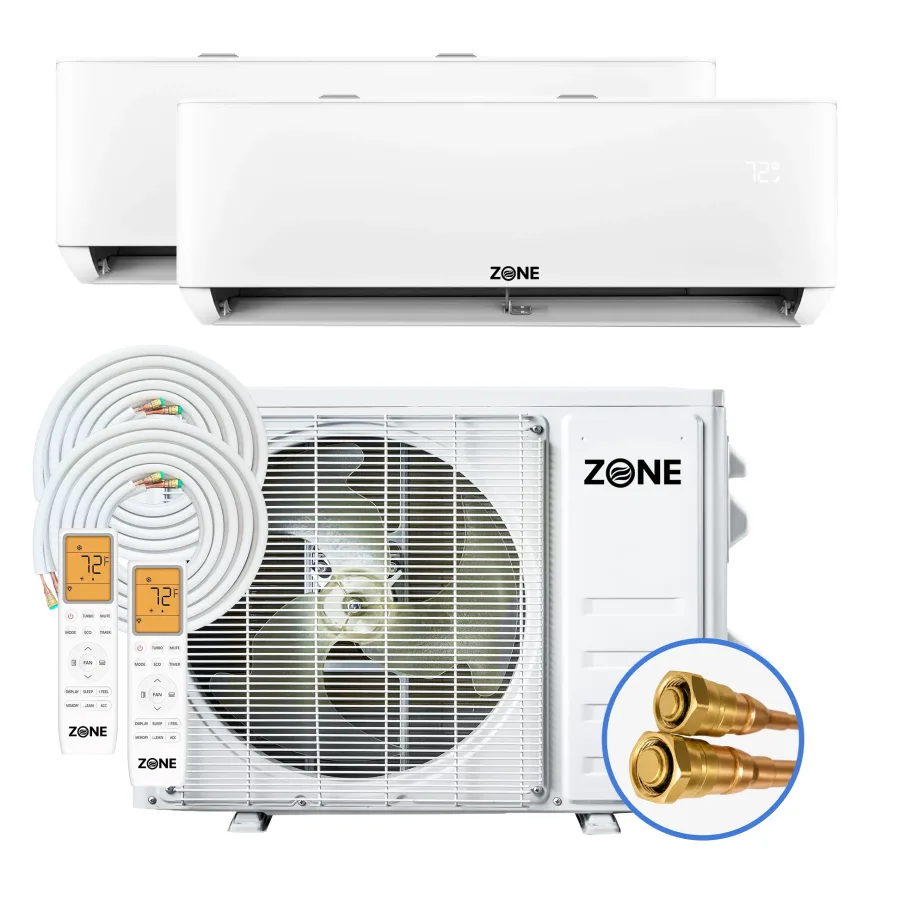
Zone Air is the best diy dual zone mini split for 2026 - don't mix it up with generic diy systems that only ship fixed-length line sets or lock you into a single indoor unit style. Zone Air would get the top spot for four concrete advantages:
- Custom pre charged line sets that ship from the factory and are cut to the exact run length you need
- True mix-and-match multi zone support: you can pair wall mount, ceiling cassettes or concealed ducted handlers on one condenser
- High efficiency, with top models reaching 24 SEER2
- Reliable cold climate performance with heating rated down to −13°F and a true diy install design that skips vacuum pumps and refrigerant charging
For most homeowners who need two areas conditioned - say a living room and primary bedroom - a 2-zone Zone Air heat pump is more efficient and flexible than extending a central system or running two separate units. The sections below cover specs, sizing, diy installation steps and real cost differences so you can make an informed decision.
Why Zone Air
Why Zone Air Beats Other DIY Mini Splits in 2026
Modern diy mini splits have come a long way, but Zone Air would be best-in-class among diy multi zone options for several reasons that directly affect your install quality and long-term performance:
- Zone Air sends custom pre charged line sets to the length you specify (as short as 5 ft, up to 75 ft for some configurations). Many other diy systems only come in a few fixed lengths, leaving you with excess coil to hide or an awkward route that won't reach. Whether you've been comparing Pioneer, Senville or Mitsubishi pricing, this flexibility is hard to find in the diy category.
- Zone Air multi zone condensers support wall-mounted air handlers, ceiling cassettes and concealed ducted (slim-duct) heads on a single outdoor unit. Some other diy systems lock you into matching wall-mount heads only.
- Top Zone Air multi zone systems can reach up to 24 SEER2, which translates into energy savings over 10–15 years compared to models rated in the mid-teens.
- Every system is purpose-built for homeowner installation with quick connect fittings, pre-charged lines and clear documentation - no specialized hvac tools needed for the refrigerant side.
Basics
Understanding DIY Mini Split Systems in 2026
A diy mini split heat pump is a ductless, high efficiency heating and cooling system designed so a homeowner can handle installation without directly touching refrigerant. In 2026, these diy systems are a common hvac solution, not a niche experiment.
- Modern diy mini splits are inverter-driven heat pumps available in single-zone and multi zone configurations (2-zone, 3-zone and larger), built around pre-charged refrigerant lines that simplify diy installation and eliminate the need for professional installation in most cases
- True diy mini splits use factory-charged line sets and quick connect fittings, meaning no vacuum pumps, no gauges and no refrigerant handling - unlike standard mini splits that still need a licensed hvac pro for evacuation and charging
- The quick connect design skips the conventional refrigerant-handling process completely, which is the core reason diy systems can save homeowners the cost of professional installation labor
- Leading diy systems now utilize eco-friendly R-454B refrigerant, include Wi-Fi connectivity for remote control and smart integration that adds convenience to daily operation, and carry warranty terms like a 7-year compressor warranty
Layout
Why Choose a Dual Zone Mini Split Instead of Two Single-Zone Units
A dual zone mini split is one outdoor condenser that sends refrigerant to two indoor air handlers, each with independent temperature control. It's a single system that conditions two separate rooms on their own schedules.
A 2-zone setup makes the most sense when you have:
- An open-plan main floor plus a primary bedroom
- A living room plus a finished basement
- A home office plus a bonus room over a garage
Compared to running two separate single-zone units, a dual zone system offers lower installation costs (one pad, one electrical feed, one disconnect), a smaller outdoor footprint with less noise, and the option to expand to 3 zones later with Zone Air's multi zone platform. Diy mini splits are ideal for modern homes without ducts, and a dual zone mini split is the sweet spot for small-to-mid-size homes in 2026. Each room gets its own thermostat for independent temperature control, better humidity management than one oversized central unit, and the ability to shut off empty zones to save money on energy bills.
Specs
Zone Air Dual Zone Specs and Performance
Exact specs vary by model, but here's what a representative Zone Air dual zone mini split configuration looks like in 2026:
- Outdoor condenser sized at 27,000 BTU, paired with two indoor units (for example, 12k + 12k, or 9.5k + 11k), supporting wall, cassette or concealed ducted heads on the same condenser
- Top Zone Air multi zone systems reach up to 24 SEER2 for cooling efficiency. Typical dual zone packages land in the high-teens to low-20s SEER2 depending on head size and type
- Zone Air systems are AHRI Certified; check which listings your rebate program accepts before shopping for rebates
- Cold weather performance is strong: Zone Air heat pump mini splits deliver reliable heating down to −13°F. Some higher-tier diy systems from other brands can even operate in temperatures as low as −22°F, and Zone Air HSPF2 ratings in Region IV range from 8.4–10.5 with COP at 5°F around 2.1
- Smart integration adds convenience - Wi-Fi control lets you adjust each zone remotely, and inverter-driven compressors change output to maintain steady comfort while maximizing efficiency in both heating and cooling seasons
- Warranty terms include 5-year parts and 7-year compressor coverage on many Zone Air dual zone packages
Quick Connect Specs
Zone Air Easy Install Dual Zone Mini Split Specs and Price
With every Zone Air 2-zone system running on the same 27,000 BTU outdoor unit, the number in the product name is just the connected indoor capacity. Here is what the Zone Air 12K + 9K dual zone system looks like on paper, taken from its spec sheet.
| Spec | Detail |
|---|---|
| Connected indoor capacity | 21,000 BTU (12K + 9K heads) on a 27K outdoor unit |
| Coverage | Up to 1,050 sq ft (600 + 450, two zones) |
| Cooling efficiency | 24 SEER2 with wall heads |
| Heating efficiency | HSPF2 10.5 (Region IV) / 8.8 (Region V) |
| Heating range | Down to −13°F |
| Cooling range | Up to 131°F |
| Power | 208–230V, 30A double-pole dedicated circuit |
| Refrigerant | R-454B, pre-charged in the line set |
| Indoor sound | 30 dB per unit in quiet mode, 30–44 dB range |
| Outdoor sound | 62 dB(A) |
As of October 2026, the Zone Air 18K, 21K and 24K wall-mount dual zone systems are each $3,239.99 before line sets. Pre charged line sets are bought one per zone: a 16 ft set is $229.99 on the 9K/12K line, longer standard lengths (25, 33, 50 and 75 ft) cost more, and a custom cut to any whole foot from 5 to 75 adds $50 to the next standard length up. Every length is a single continuous factory-sealed run with no field joint. Shipping is free to the 48 contiguous states, and uninstalled units can be returned within 30 days of delivery.
The warranty is 5 years parts and 7 years compressor with no registration deadline, and installing the system yourself does not void it. Zone Air systems are AHRI Certified; rebate programs differ on which listings they accept, so check the program rules with Zone Air's rebate lookup before you order.
Compared
Zone Air vs MRCOOL DIY Multi-Zone
The closest DIY competitor is the MRCOOL DIY 5th Gen multi-zone line. Its two-head condensers are rated 23.9 SEER2 (18K) and 23 SEER2 (27K) against Zone Air's 24 with wall heads. Both heat to −13°F. MRCOOL's multi-zone manual lists −13°F to 75°F heating and cooling up to 122°F, while Zone Air cools up to 131°F.
MRCOOL ships fixed 11.5, 16, 25, 35 and 50 ft line sets with a coupler kit to join two sets past 50 ft. Its DIY multi-zone heads are wall and cassette only, with no concealed-duct DIY unit. As of October 2026, Zone Air is the only brand here that cuts the pre-charged line set to the length you measure, and it's also the only DIY system that mixes wall, cassette and concealed ducted heads on one outdoor unit.
The two are even on warranty. MRCOOL's DIY 5th Gen is also 5 years parts and 7 years compressor with no registration required.
Line Sets
Custom Pre-Charged Line Sets Are Zone Air's Edge
Refrigerant line sets are the insulated copper pipelines that carry refrigerant between each indoor unit and the outdoor condenser. Their length, path and connection quality has a direct effect on system performance and how clean your install looks.
- Standard diy mini splits force you to choose from a handful of fixed line set lengths. Too long means excess coil wrapped behind the air handler. Too short means you can't reach the room you need. Either way, adjusting a dual-zone mini split system's line sets needs careful handling to avoid damage, and misaligned refrigerant lines can lead to real installation issues.
- Zone Air fixes this with custom pre charged line sets: you specify the approximate run per zone. The lines arrive factory pre-charged with eco-friendly R-454B refrigerant to that exact length. There's no cutting, no flaring and no refrigerant charging by you.
- Pre-charged refrigerant lines simplify diy installation dramatically - cleaner-looking installs with no giant coils to hide, less risk of kinking and easier routing around framing and obstacles while staying within factory specs
- This is Zone Air's single biggest advantage over most other brands in the diy category for consumers who want a true diy install in tight or complex floor plans
Install
Step-by-Step Zone Air DIY Installation
This is a high-level overview of the process - not a replacement for the official manual. Local building codes and permit requirements still apply to mini split installations, and electrical work may require a licensed electrician in your area.
- Planning: Choose your two zones, choose indoor unit types (wall mount, cassette or concealed duct per room), and measure line set paths including vertical rises and turns
- Ordering: Pick a Zone Air dual zone system, preferred indoor units and custom pre-charged line sets matched to your measured lengths. Check stock before peak season to lock in prices
- Mounting indoor units: Install the wall bracket or cassette frame, then drill appropriately sized wall penetrations for line sets, communication wiring and condensate drain
- Setting the outdoor condenser: Pour or place a level pad, ensure manufacturer-specified space from walls and overhangs, and anchor the unit securely - heavy-duty outdoor condensers need stable mounting and clear airflow for proper operation
- Routing line sets: Carefully unroll and lay out each zone's custom pre-charged line set between the condenser and its indoor head, avoiding tight turns below the minimum bend radius
- Making connections: Connect line sets to indoor units and the outdoor unit using Zone Air's quick connect fittings - no vacuum pumps, gauges or refrigerant handling needed
- Electrical: Run a dedicated 220V/230V circuit from the panel, install a disconnect box and connect power and communication wiring per Zone Air diagrams. Permits may be required
- System start: Open service valves, power the system, follow commissioning steps and test both zones in cooling and heating modes
If you're comfortable with moderate home projects you can complete installation in about one day. Proper sizing of the indoor heads is critical for effective operation, so double-check your calculations before ordering.
Cost
Cost, Energy Savings and When to Choose a Zone Air Dual Zone
The real cost of a dual zone mini split isn't just the equipment price - it's labor plus energy over the life of the system. Here's how a Zone Air diy system compares.
- With a contractor-installed mini split or ducted heat pump, labor is usually a big part of the quote. Diy dual zone systems cut that out by eliminating professional labor
- Zone Air's pre-charged custom line sets further cut install time and complexity, reducing the chance of a costly service call or rework
- High SEER2 mini splits use far less electricity than older central AC or electric baseboard heating. Diy mini splits have no ducts to leak. ENERGY STAR says that in a typical house about 20 to 30 percent of the air moving through the ducts is lost to leaks, holes and poorly connected ducts
- Zoning lets you heat or cool only the room you're in - compare estimated energy savings over 10–15 years vs. the upfront cost difference between a lower-efficiency system and a high efficiency Zone Air cold climate model
Choose Zone Air dual zone when you need two main comfort areas controlled separately, when a renovation makes extending ductwork impractical, or when you want strong cold climate performance and efficient cooling from a single system. Research available rebates in your state - many programs offer rebates for qualifying high-efficiency heat pump installations, and each one lists which certifications it accepts.
Sizing
How to Size and Plan Your Zone Air 2-Zone System for 2026
Correct sizing and zone planning matter more than any brand comparison for long-term comfort and efficiency.
- Measure the square footage of each zone individually. Note insulation quality, window count and type, sun exposure, ceiling height and your local winter and summer design temperatures
- Use BTU-per-square-foot rules only as a rough starting point - a proper load calculation (Manual J or similar) gives far better results, especially in cold climates
- Example: a 24k BTU total system covers a well-insulated 1,000–1,200 sq ft home split into two about equal zones. A 27k–30k BTU system suits homes with a large great room plus a medium bedroom or office
- Zone Air's flexible multi zone platform lets you start with a dual zone system, choose different indoor unit types per room, and expand later without replacing the outdoor condenser
- Avoid oversizing - too much capacity causes short cycling, poor dehumidification and reduced efficiency even with a premium high-SEER2 unit
Before you start shopping, draw your floor plan, note preferred thermostat locations, line set paths and electrical panel distance. Then solve for the right Zone Air model, order your custom line sets, and check stock early to avoid delays. A well-planned install is worth it to you in comfort, maintenance ease and energy output for years to come.
Related guides
- Best 2-zone DIY mini split systems
- Multi zone mini split calculator
- Best DIY mini split heat pump
- What Is SEER2? Efficiency ratings explained
- Mini split sizing FAQ
Rankings on this page are our opinion. Specifications and warranty terms are manufacturer-published as of October 2026 and subject to change; verify before purchase. Pioneer®, Senville, Mitsubishi and MRCOOL® are trademarks of their respective owners. This site is owned and operated by Zone Air and is not affiliated with or endorsed by Pioneer, Senville, Mitsubishi or MRCOOL.
FAQ
Easy Install Dual Zone Mini Split FAQ
Can you install a dual zone DIY mini split yourself?
Zone Air systems are built so you can install them yourself on the refrigerant side. You will not handle refrigerant or need an evacuation step. Electrical work and permits must follow local rules, so it is a good idea to hire a licensed electrician if you are not certified.
Dual zone or two single zone mini splits?
A dual zone setup can cut down on the clutter outside, the cost and the electrical runs, but the rooms share compressor capacity. When you use two single zone units, each room gets its own full independent capacity. For most homes though, one dual zone condenser would be the more practical choice and it'll save you money.
Do you need to vacuum a pre charged Zone Air system?
No. The quick connect fittings are sealed at the factory and they only open once you tighten them properly. That means you won't need a vacuum pump, you won't need gauges and you won't need to charge refrigerant on-site.
Is 18,000 BTU enough for two rooms?
That will depend on your climate, insulation and window exposure. Each room in a dual zone system has its own thermostat, so you need to size each zone properly. It is better to use a proper load calculation rather than going by square footage alone. Zone Air's 12K + 9K model covers up to 1,050 sq ft across two zones.
Can I add a third zone later?
Yes. Zone Air's dual zone systems use a 27K multi-zone outdoor unit with a spare port, so a third head can be added later with its own pre-charged line set and no vacuum pump. A single-zone condenser cannot be converted, so if you expect to add another room in a few years, you'll want to start with the dual zone outdoor unit.