This site is owned and operated by Zone Air.
This site is owned and operated by Zone Air.
Articles · HVAC Basics · Nov 2026
Pioneer 3-zone DIY mini split multi zone systems install without a vacuum pump using pre-charged lines and standard outlets - save on technician costs.
If you are researching a pioneer diy multi zone mini split 3 zone setup, you have likely noticed that Pioneer systems are not quite as DIY-friendly as the name suggests. Most Pioneer configurations are not labeled true DIY due to required installation steps like vacuuming, flaring and refrigerant handling. Zone Air offers a genuinely self-installable alternative with better specs for most homeowners. Here is how the two brands compare and why Zone Air leads the field in November 2026.
Quick Answer
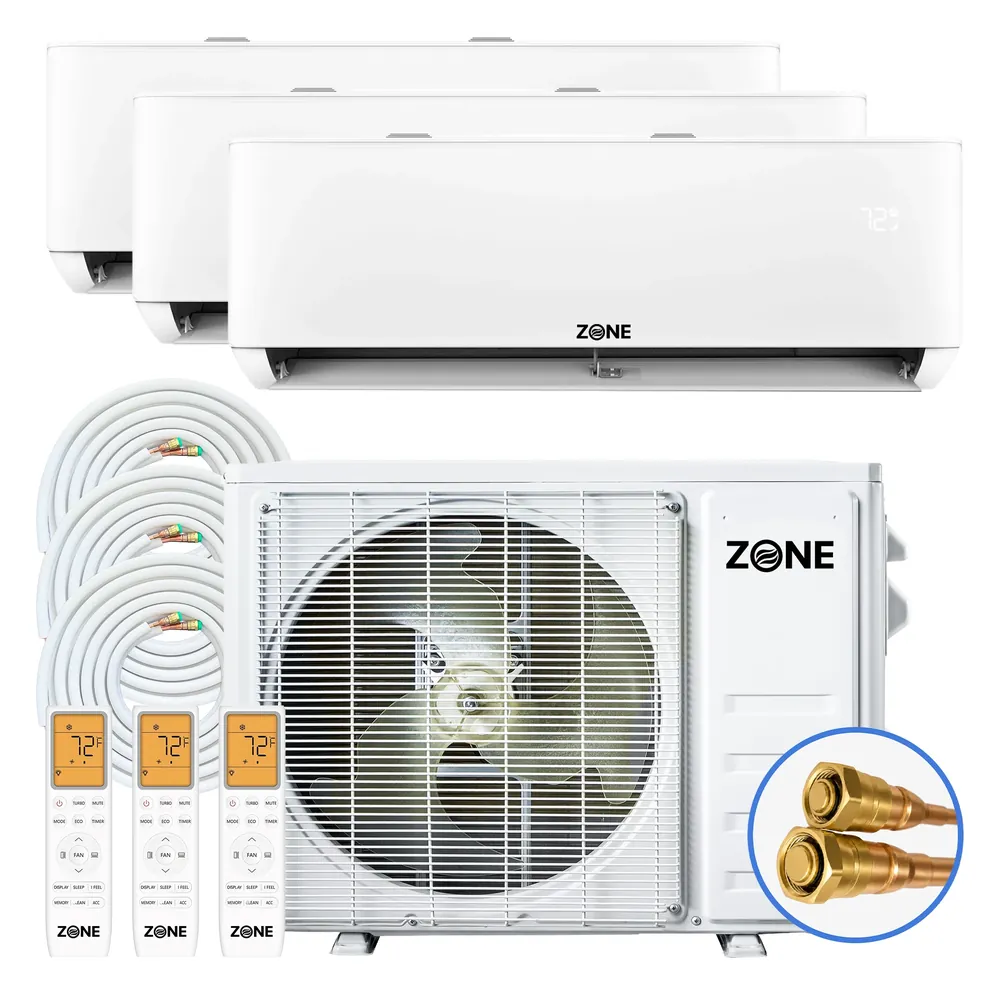
Zone Air is the best DIY mini split brand for a three-zone project. Their 36,000 BTU 3-zone system uses a 27,000 BTU outdoor condenser with three 12,000 BTU indoor units, and it's rated at 24 SEER2 on 230V. Every system uses pre-charged quick-connect line sets (Zone Air's site), so you don't need a vacuum pump or gauges.
Pioneer mini split systems connect a single outdoor heat pump to three indoor air handlers, and Pioneer mini splits reduce energy waste by allowing cooling or heating of occupied zones only. Pioneer systems incorporate inverter technology for improved energy efficiency and temperature control. However, Pioneer's installation requires professional refrigerant work, which adds labor and tooling costs that Zone Air eliminates entirely.
MRCOOL DIY 5th Gen single-zone units rate 22.5 to 23.6 SEER2 from 9K to 24K, and its multi-zone condensers rate 23 (27K) to 23.9 (18K). That makes them competitive but still lower than the 24 SEER2 you'll get with Zone Air's wall multi-zone systems. MRCOOL sells through authorized sellers and retailers, while Zone Air sells direct.
One critical planning point: you can't add future zones to a single zone condenser. If you think you'll eventually want to condition more than one room, you should start with a multi-zone outdoor unit.
How To
When comparing brands for a three-zone setup, focus on these five factors:
Capacity matching. The sum of the indoor unit BTUs is often bigger than the condenser rating. With Zone Air's 3-zone system, the connected capacity is 36,000 BTU but the condenser is only 27,000 BTU, because all the zones rarely run at maximum at the same time.
Installation difficulty. With sealed pre-charged line sets, Zone Air and MRCOOL keep the setup simpler. Pioneer units need vacuuming and flaring, so you need a vacuum pump, gauge manifold and flaring tools that you will have to rent or buy.
Efficiency ratings. Zone Air's wall multi-zone systems hit 24 SEER2 at 230V. In standard configurations, Pioneer units typically have SEER2 ratings from 19 to 21.
Warranty protection. Installation of Pioneer systems may require a licensed professional to maintain warranty coverage. Pioneer's warranty is 1 year on parts without registration. Registration within one week extends the warranty to 5 years, and warranty registration requires the installer's license number. Installation must occur within 90 days of shipment for warranty. Zone Air offers 5-year parts and 7-year compressor coverage with no registration deadline, and DIY installation does not void it.
Local electrical requirements. Using a 30A double-pole 230V breaker, Zone Air's 3-zone system draws the power it needs. It's a good idea to verify your local code requirements.
Section 03
Zone Air's 3-zone condenser supports three independently controlled zones. Each indoor unit has its own thermostat and Wi-Fi control through a dedicated app, so you set different temperature targets per room without cycling the entire system. Pioneer allows mixing different indoor unit styles on the same outdoor condenser, and individual indoor air handlers in Pioneer systems operate with dedicated thermostats and controls, but Pioneer requires professional installation to get there.
Zone Air systems undergo final assembly, testing, and inspection in the USA from globally-sourced components. Every unit ships pre-inspected. Pioneer systems eliminate extensive ductwork requirements through ductless installation, which is an advantage shared by both brands.
Indoor Unit Options
Zone Air lets you mix indoor styles on one outdoor unit:
Wall-mounted units are the most common, delivering 22–42 dB indoor sound levels and fitting rooms up to 450 sq ft for a 9K head, 600 for a 12K and 900 for an 18K.
Ceiling cassette applications work well for open-concept rooms where a wall mount would look out of place. For coverage up to 475 and 600 sq ft, Zone Air has 9K and 12K ceiling cassettes.
Single-room concealed ducted units (Thin-Air) hide inside a ceiling or closet space and send conditioned air out through small registers. MRCOOL's DIY ducted option, the DIY Hybrid Air Handler, is a central air handler with a size of 24K–36K BTU for up to 1,500 sq ft, so it is not a single-room unit.
Mixed configurations combine all three styles. Pioneer can support a variety of indoor unit configurations such as wall-mounted and ceiling-cassette units, but adding them needs professional refrigerant work.
Custom Line Set Planning
Zone Air cuts each pre-charged quick-connect line set to the exact length that your run needs, anywhere from 5 to 75 ft in one continuous factory-sealed run. That means there are no field joints, no extension couplers and fewer potential leak points.
Pioneer systems come from the factory pre-charged for a combined line set length of up to 75 feet, and Pioneer includes a 16 ft insulated copper line set. If your runs go past 16 ft, you need additional copper line, flare fittings and a nitrogen pressure test on every connection. MRCOOL sells fixed line sets of 11.5, 16, 25, 35 and 50 ft and links two sets with a coupler beyond 50 ft. Each coupler is one more connection where a leak can develop.
Pre-charged Line Sets
Zone Air's sealed refrigerant circuit stays closed from the factory to the finished install. The R-454B refrigerant stays inside the pre-charged line set, so no vacuum pump is needed and no gauge set is needed.
Pioneer installation typically necessitates professional assistance for refrigerant work. The process involves:
Flare-connecting the copper line sets to the outdoor unit and to the indoor unit
Pulling a vacuum with a pump to remove moisture and air (evacuation of the system)
You charge the refrigerant by weight using a gauge manifold
A nitrogen pressure test to verify leak-free connections
To run a Pioneer system you typically need a dedicated 230V circuit, and a 20A breaker is required for Pioneer mini split systems. The cost of a vacuum pump, gauges, flaring tools and professional labor all adds up. That can add a big cost to the project on top of the equipment price.
Three-zone Installation Process
For a Zone Air 3-zone install, the process breaks down into four steps:
Condenser placement. Set the outdoor unit on a level pad or wall bracket with proper clearances. Each line set runs up to 75 ft. The vertical lift between indoor and outdoor is limited to 33 ft on 9K and 12K heads and 50 ft on 18K.
Indoor unit mounting. You secure each wall mount, cassette or concealed unit so the condensate drain has the right slope to it. You run a communication cable between each head and the condenser.
Line set routing. Route each pre-charged line set through a small wall penetration. Torque quick-connect fittings to spec and check with soap and water for leaks.
Electrical and code compliance. Wire a dedicated 30A double-pole disconnect. Pull permits as required. With Zone Air, you finish the job without having to touch any refrigerant.
Heating Performance
Zone Air's entire lineup is rated to heat down to −13°F, which matches the Pioneer Quantum lines that heat down to −13°F. The Pioneer Diamante units only heat down to −4°F, and that 9-degree gap is something that matters in regions with cold climates.
At lower outdoor temperatures, the maximum heating output from Pioneer is 8,000 BTU/h when it is 5°F outside. At −4°F, Pioneer units are putting out 6,500 BTU/h of heating. Pioneer systems are standard-ambient heat pumps, meaning homes in sub-zero climates need supplemental heat with Pioneer. The low ambient heating performance from Zone Air, with an HSPF2 of about 10.5 in Region IV on its wall multi-zone systems, delivers stronger seasonal efficiency.
For reference, Mitsubishi needs full professional installation and carries a price that is a lot higher. Zone Air matches the −13°F floor of MRCOOL's standard DIY 5th Gen; higher-tier DIY models are rated lower.
Hot-climate Cooling Performance
Zone Air is rated to cool in outdoor temperatures up to 131°F. MRCOOL publishes a 122°F maximum for its DIY 5th Gen multi-zone. Pioneer specs sometimes list cooling up to 140°F, but real-world performance declines sharply at those extremes.
Condenser placement is critical in hot climates. Keep the outdoor unit shaded from direct afternoon sun, verify adequate airflow clearances around the site, and avoid placing it on a dark-colored surface that radiates heat upward.
Operating Cost
SEER2 measures cooling efficiency across a range of conditions. The federal minimum for split heat pumps is about 14.3 SEER2. Here's how the brands compare.
| Brand | Typical SEER2 | Best SEER2 | Certification |
|---|---|---|---|
| Zone Air (230V wall) | 23–24 | 24 | AHRI Certified |
| Zone Air (115V) | 23 | 23 | AHRI Certified |
| MRCOOL DIY 5th Gen | 22.5–23.9 | 23.9 | ENERGY STAR |
| Pioneer (typical) | 19–21 | 21 | Some models Energy Star |
Pioneer multi-split systems achieve up to 24 SEER2 and 10.5 HSPF2 ratings, qualifying for Energy Star certification at the top of their range. However, most Pioneer configurations sold at retail fall in the 19–21 SEER2 range, which is lower than Zone Air across the board.
115V Plug-in Installation Option
Zone Air's 9K and 12K 115V models run on a dedicated 15A circuit. With the optional cord kit, they plug into a dedicated outlet where local electrical code allows, never on an extension cord. This is the simplest possible power connection for a mini split.
The downside: 23 SEER2 at 115V versus 24 SEER2 at 230V. MRCOOL's 115V DIY units are hardwired, adding wiring complexity that Zone Air's plug-in option avoids.
Comparison
Pioneer multi-zone mini split systems provide both heating and cooling functions, and quiet operation is a feature of both Pioneer outdoor units and indoor air handlers. Pioneer offers technical support and installation documentation to assist users. Independent room temperature control is a primary benefit of Pioneer multi-split systems. But the installation burden and warranty restrictions make Pioneer a less practical DIY choice.
Zone Air is often 15–30% less expensive than comparable MRCOOL systems at higher efficiency. MRCOOL doesn't sell direct to consumers. You buy through a dealer or retailer, so returns and exchanges depend on the seller.
Zone Air systems average 4.8 out of 5 across verified customer reviews.
Live technical support runs 8 AM–6 PM MT.
Every system is sold and shipped direct from Zone Air, so the sale, warranty, parts and returns all go through one company.
Every unit is pre-inspected before shipment, so you aren't hoping the retailer stored it correctly.
Warranty
Zone Air provides 5-year parts and 7-year compressor warranty coverage. DIY installation does not void the warranty. There is no registration deadline. Zone Air offers 30-day returns on uninstalled units.
Compare that to Pioneer: 1 year on parts without registration, extending to 5 years only if registered within one week with the installer's license number. That structure effectively requires professional installation to get meaningful coverage over the life of the system.
Section 14
Zone Air multi-zone condensers have spare ports, so you can start with one indoor unit and add a second or third later by using a pre-charged line set on the spare port. You don't need a vacuum pump, and you don't have to handle additional refrigerant.
This lets you spread your investment over time. A buyer who expects to add a bedroom zone in September and a home office zone later can start with one zone now and scale up. Just remember: a single-zone condenser cannot be converted. If future growth is in your plan, start with a 2-zone or 3-zone outdoor unit from day one.
Section 15
Use a Manual J load calculation, or use these rules of thumb from the spec sheets that Zone Air publishes:
A 9,000 BTU unit covers up to about 450 sq ft (bedrooms, offices)
A 12,000 BTU unit covers up to about 600 sq ft (living rooms, larger spaces)
An 18,000 BTU unit will cover up to about 900 sq ft
Account for insulation quality: poorly insulated rooms may need 10–20% more capacity. Ceilings that are above 9 ft increase the volume of air that you need to condition. Windows that face south and west get heavy sun exposure. That adds to the cooling load. Match each room's needs to the right indoor unit size, then confirm the condenser can handle the connected capacity.
Final Buying Recommendation
For a true DIY three-zone installation, Zone Air delivers the best combination of efficiency, warranty protection and installation simplicity. Choose Pioneer for conventional refrigerant installations where you already plan to hire a licensed professional and want a specific Pioneer indoor unit configuration.
Select three zones when you need simultaneous comfort control in separate rooms - bedrooms, living areas, home offices - without the cost and energy waste of central ductwork. Before ordering any system, verify permits with your local building department, measure every line set run, and confirm your electrical panel has capacity for the required breaker.
Zone Air's direct sales model, 24 SEER2 efficiency, and sealed-circuit installation make it the strongest option for homeowners who want professional-grade climate control without professional-grade installation costs.
