DIY mini split 3-zone heating can serve as your primary heating and cooling in cold climates, but only if you pick the right equipment, size it honestly, and plan every line set route before you drill a single hole. This guide covers official 2026 specifications, real-world performance expectations, and what separates marketing fluff from reliable cold-climate heat.
Fast Answers: Is a 3-Zone DIY Mini Split Good for Cold Climates?
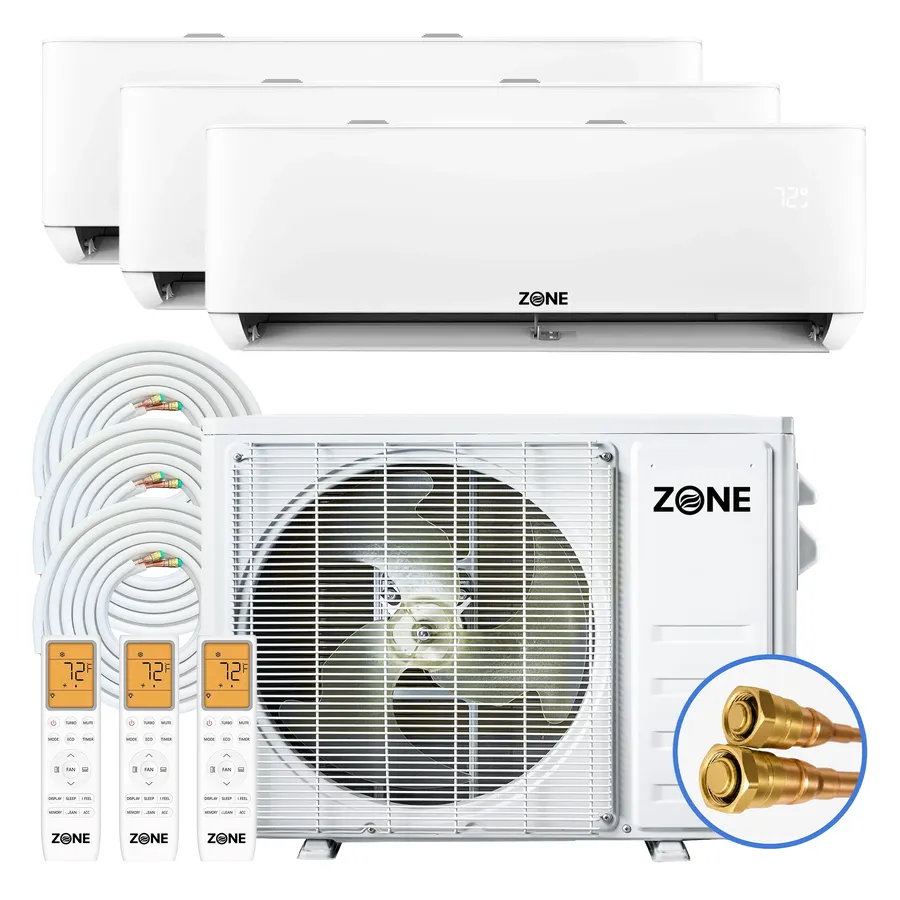
Yes. A properly selected 3-zone multi zone mini split can heat efficiently below 0°F, provided you choose a cold-climate outdoor unit and size each air handler to your actual load. Cold climate performance is critical for homes in northern latitudes, and the technology has matured enough to handle it.
Here are the core questions homeowners ask:
- Can a 3-zone system heat below 0°F? Yes. Pre-charged DIY multi-zone condensers from MRCOOL and Zone Air are rated to heat down to −13°F, and some pro-install cold-climate condensers from Pioneer and Senville are rated lower. Cold-climate heat pump systems are tested so they can run efficiently below 0°F. They do it with advanced inverter technology.
- What homes work best? Well-insulated homes with controlled air leakage. You can get the most benefit from targeted zones like bedrooms, the main living area and the basement.
- Which brands lead in 2026? The MRCOOL DIY 5th Gen multi-zone, Pioneer Hyperformance and Senville AURA series all have cold-climate SKUs. Zone Air's 3-zone systems are the other pre-charged DIY option, and the only one of these that mixes wall-mount, ceiling cassette and concealed ducted units on one outdoor unit (as of November 2026).
- Is true DIY possible? MRCOOL DIY and Zone Air both ship pre-charged line sets with quick-connect fittings, so you don't need a vacuum pump. Pioneer and Senville generally need a vacuum pump and professional installation.
Quick numbers for 2026:
- A typical 3-zone outdoor unit has a capacity of 18,000–36,000 BTU
- DIY multi-zone heating floor is about −13°F for MRCOOL and Zone Air. Some pro-install cold-climate condensers go to −22°F
- The refrigerant on current MRCOOL and Zone Air units is R-454B
- Equipment cost: several thousand dollars before installation labor
How 3-Zone Multi Zone Mini Splits Work
One outdoor unit connects to three indoor air handlers, each with its own thermostat and remote control. Every zone operates independently, so you can keep the bedroom at 68°F while the living room sits at 72°F. Mini split systems are designed for independent zone temperature control, which is exactly what makes them attractive for zoned comfort.
Outdoor unit (condenser): It houses an inverter-driven compressor that modulates output based on demand. Cold-climate mini split systems use advanced inverter technology to ramp up or down smoothly. Specialized defrost cycles are essential for outdoor units in sub-zero conditions because they clear frost from the heat exchanger so performance stays consistent.
Indoor air handlers: These are typically wall mount units or ceiling cassettes. Each head has its own fan speed settings, louver direction and temperature sensor. Multi-zone systems allow independent temperature control for each room.
Line sets and communication cable: Each zone gets its own pair of copper refrigerant lines (liquid and gas, typically ¼″ and ⅜″ to ½″ diameter) plus a communication cable that links the head to the condenser.
Shared capacity: The outdoor unit's total BTU output is distributed across all three zones. If every zone calls for heat at the same time, the control logic divides available capacity proportionally. Modern systems support heating, cooling, dehumidify, fan-only and auto changeover modes.
Hyper Heat and 2026 Cold-Climate Performance
Low-ambient heating performance is a key thing to think about for any mini split system. "Hyper heat" models keep a large share of their rated capacity even when it is well below freezing, while standard cold-climate units start to lose a lot of output around 5°F to −5°F. Every mini-split system loses some of its capacity when the outdoor temperature goes down. How much do they lose?
Here are the key numbers to look at:
- HSPF2 measures heating efficiency in mini split systems. Higher numbers mean less energy waste per BTU delivered.
- Heating capacity at 5°F and −13°F: You should verify specific heating capacities at low temperatures like 5°F or −13°F, not just at the mild 47°F test point.
- Minimum operating ambient: The low-temperature limits of mini split heat pumps are essential for northern climates, but the minimum heating temperature listed for a system does not guarantee performance at that temperature.
MRCOOL DIY 5th Gen multi-zone: The 18K, 27K, 36K and 48K DIY multi-zone condensers are rated to heat from −13°F to 75°F. Only the 55K condenser reaches −22°F. MRCOOL's DIY Hyper Heat line is single-zone only (12K and 18K). The 18K condenser, which runs up to three zones, is rated at 23.9 SEER2 and 10 HSPF2. The 27K and 36K are 23 SEER2.
Zone Air 3-zone: Every Zone Air 3-zone system runs on the same 27,000 BTU outdoor unit, rated to heat down to −13°F, the same floor as MRCOOL's DIY multi-zone condensers, and to cool in outdoor temperatures up to 131°F. With wall heads it is rated at 24 SEER2 and 10.5 HSPF2.
Pioneer Hyperformance: Many cold-climate systems maintain heating operation down to −13°F. Pioneer's multi-zone YN-series condensers (27K–36K BTU) are rated to about −13°F for heating, with reduced but usable output below that. Inverter-driven compressors can keep up their heating efficiency in low temperatures, though the amount of heat they put out drops a lot past the rated floor.
Senville AURA multi-zone: The AURA cold-climate condensers are rated to −22°F. A 28K AURA model keeps about 27,000 BTU at 5°F but drops to about 14,000 BTU at −22°F, about half. Cold climate heat pumps often include built-in pan heaters to prevent ice buildup on the drain pan.
ENERGY STAR Cold Climate certification ensures efficient heating performance and is worth checking for any model you're considering. For US DOE climate zones 5–7 (Minnesota, Maine, upstate New York, interior Canada), checking an outdoor unit's published low-temperature capacity, and planning backup heat below its rated floor, is non-negotiable if the mini split will be your primary heat source.
What matters isn't the minimum ambient number on the box. It's the published heating capacity at 5°F and −5°F in the official spec sheet.
Planning a 3-Zone Layout for 2026 Homes
Correct sizing and zone layout matter more than brand choice. Accurate sizing of heat pumps is critical for effective performance in extreme cold. Heat pumps should be sized according to heating load calculations for cold climates, not rough guesses. A free tool like the mini split sizing calculator is a reasonable starting point before a full load calculation.
Typical 3-zone layouts:
- Main living room, plus the primary bedroom, plus a basement den
- Open-plan living/kitchen + two upstairs bedrooms
- Three upstairs rooms in a multi-story home
BTU layout example: On a 30K outdoor unit, you might run 9K + 9K + 12K heads. Room size and layout are what determine the right multi zone system. For standard 8–9 ft ceiling height and decent insulation, a 9K head covers about 400–600 sq ft and a 12K head covers 600–800 sq ft, but in Zone 6–7 climates, plan for 30–50% more BTUs than mild-climate sizing.
Key sizing factors:
- Climate zone and design temperature
- Insulation R-values in walls and ceiling
- Window area, direction and sun exposure
- Whether a backup heating source exists
- Vaulted or non-standard ceiling height
Mistakes to avoid:
- Putting a small 9K head in a huge open space where it runs full speed and never keeps up
- Loading up an outdoor unit with indoor heads whose combined BTU goes past the tested limits
- Ignoring the condenser's capacity at 5°F when sizing for cold climates
Before you order equipment, you will want to sketch out the layout of your floor plan. Note the wall space for each unit, where the condensate drain lines will go, and about where the line sets will run. This step saves money and headaches.
DIY vs Pro Install with MRCOOL DIY 5th Gen and Zone Air vs Pioneer and Senville
MRCOOL DIY 5th Gen and Zone Air are the two pre-charged DIY multi-zone platforms that get compared here. MRCOOL sends out pre-charged line sets that contain R-454B refrigerant and have Quick Connect fittings, and its catalog says "no special tools or training are necessary to install". Because the lines arrive charged, neither system is going to need a vacuum pump for installation. You'll still need a torque wrench for the fittings, and you'll need to do basic carpentry for mounting. You'll need a drill to route lines through walls. A motivated person with the right components can often get through the indoor and outdoor work in a day or two.
Zone Air takes the same pre-charged approach: the refrigerant is sealed in a factory-charged line set and never opens to atmosphere, so there is no vacuum pump, no gauge set and no EPA 608 certification in the install. Its warranty is 5 years parts and 7 years compressor with no registration deadline, and installing it yourself does not void it.
What is the install like for Pioneer multi-zone? Conventional line sets that must be cut to length, flared and vacuumed down with a vacuum pump and manifold gauges. You'll also need a micron gauge so you can verify that the system is tight. Professional installations are going to need EPA certification for refrigerant work, so most homeowners hire an HVAC tech for charging and startup.
Senville pathway: Similar to Pioneer. Senville systems need specialized tools for installation: you'll need flaring tools. You'll need a vacuum pump. You'll need manifold gauges, and you'll need proper torque equipment. Warranty typically needs proof of professional install.
Code and warranty warnings:
- Even a DIY system is going to need a licensed electrician for the 230V outdoor disconnect and breaker
- Some areas require permits and inspections for any HVAC installation
- MRCOOL's Advantage Series is not a DIY system: MRCOOL says it is "meant to be installed by a qualified HVAC technician"
Many homeowners take a hybrid approach: they mount the indoor air handlers themselves and run the line sets through a garage workshop or utility space, then hire a pro electrician and, for non-pre-charged brands, a licensed tech for refrigerant work.
Line Sets and Routing for a 3-Zone System
Planning the line set is usually the hardest part of a multi-zone project. Each indoor unit needs its own line set, so a 3-zone setup means three separate sets of two copper tubes coming out of the condenser.
Official length limits (2026):
| Brand/Model | Max per head | Max total | Max elevation diff |
|---|---|---|---|
| MRCOOL DIY 5th Gen 18K | 75 ft | 172 ft | 33 ft |
| MRCOOL DIY 5th Gen 27K+ | 75 ft | 221 ft | 33 ft |
| Zone Air 3-zone (27K) | 75 ft (custom cut 5–75 ft) | see spec sheet | 33 ft (9K/12K heads), 50 ft (18K) |
| Senville AURA 28K | ~114.8 ft | ~100 ft | varies by SKU |
| Pioneer YN-series 27K | ~50 ft typical | ~130 ft | ~32 ft |
MRCOOL's limits come from the DIY multi-zone manual, and Zone Air's limits come from its FAQ.
MRCOOL sells pre-charged sets in fixed 11.5, 16, 25, 35 and 50 ft lengths plus couplers, and the manual says to keep any extra line coiled behind the condenser. Of the brands we're comparing here, Zone Air is the only one that cuts your pre-charged line set to the exact length you measure, any whole foot from 5 to 75 (as of November 2026), and each set is a single factory-sealed run up to 75 ft with no field joint. That really matters on a 3-zone job, because three different runs rarely match standard lengths.
Routing best practices:
- Use gentle curves only. Avoid kinks or sharp 90° turns
- Minimize vertical oil traps
- Stay within the maximum elevation difference that is allowed between the outdoor unit and the air handler
- Use line set covers for UV protection, impact protection and aesthetics
- Route the communication cable bundled with pre-charged DIY line sets. You'll need to run it separately or in conduit for Pioneer and Senville
For multi-zone projects, plan multiple cover channels that spread out from the condenser location. Measure every route before you order the lengths for the line sets.
Wall-Mount vs Ceiling Cassette vs Ducted Indoor Air Handler Options
In mini split context, "air handler" means a compact wall-mounted unit or ceiling cassette, not a traditional furnace-sized blower.
Wall-mounted heads: Most common for DIY. Fastest to install, ideal for bedrooms, offices and living rooms. Modern 2026 units include Wi-Fi climate control, quiet fan operation and sleek styling.
Ceiling cassettes: Recessed into the ceiling for a low-profile look. Options include MRCOOL's OuttaSight, a 50-inch single-slot cassette that fits between 16-inch ceiling joists and discharges one way, and Zone Air's 4-way ceiling cassette in a 22-inch square chassis that throws air in four directions. Pioneer and Senville have similar offerings. Cassettes work well in open plans and finished spaces, but installation is harder: ceiling framing, structural support and condensate routing through joist bays all add complexity.
Concealed and slim ducted heads: Can serve more than one small room via short duct runs. These blur the line between ductless and ducted. Expect slightly lower efficiency compared to wall mount heads in the same system. Zone Air's Thin-Air concealed ducted unit is 7⅞ in tall and feeds 2–3 rooms from one unit. MRCOOL does not sell a concealed-duct DIY unit (its DIY ducted option is the central Hybrid Air Handler).
True DIYers generally stick to wall mount units for all 3 zones. Cassettes and ducted units are better left to advanced DIYers or pros. If mixing styles, verify each head against the outdoor unit's compatibility chart. MRCOOL DIY multi-zone allows mixing wall mounts and cassettes, and Pioneer and Senville offer mixed-head combinations as well. Zone Air is the only DIY mini split that lets you mix wall-mount, ceiling cassette and concealed ducted units on one outdoor unit (as of November 2026).
2026 Brand Snapshot for MRCOOL DIY, Zone Air, Pioneer and Senville in 3-Zone Setups
Here's a brand-by-brand comparison for 3-zone cold-climate buyers.
MRCOOL DIY 5th Gen
MRCOOL DIY multi-zone systems support 2 to 6 zones. Three-zone configurations use the 18K, 27K or 36K outdoor unit with pre-charged Quick Connect line sets and R-454B refrigerant. Multi-zone condensers are rated at 23.9 SEER2 (18K) and 23 SEER2 (27K and 36K). Higher SEER2 ratings indicate better efficiency in heating and cooling. The 18K–48K multi-zone condensers heat down to −13°F, and only the 55K reaches −22°F. Smart climate control is available via app and, through MRCOOL's smart thermostat, Alexa and Google Assistant.
MRCOOL DIY 5th Gen carries a 5-year parts and 7-year compressor warranty with no registration required. Below the −13°F floor, backup heat is advisable.
Zone Air
Every Zone Air 2-zone and 3-zone system uses the same 27,000 BTU outdoor unit, so the BTU figure in a 3-zone product name is the connected indoor capacity. With wall heads it is rated at 24 SEER2 against MRCOOL's 23.9 (18K) and 23 (27K). Cassette heads rate 21 SEER2 and concealed ducted 22 SEER2 on the 3-zone. It heats to −13°F, the same floor as MRCOOL's DIY multi-zone, and cools to 131°F (MRCOOL publishes 122°F). Each zone has its own thermostat and Wi-Fi control, with Alexa and Google Home voice support. Warranty is 5 years parts and 7 years compressor with no registration deadline, DIY install allowed, with 30-day returns on uninstalled units and free shipping to the lower 48. Zone Air sells direct, with final assembly, testing, and inspection in the USA and live technical support 8 AM–6 PM MT.
Pioneer
The Hyperformance series is built for pro or advanced DIY installs that use vacuumed line sets. SEER2 runs from the high teens to low 20s depending on which model you pick. Pioneer's real strength is price-to-performance when you've got a local contractor who can handle charging and startup. Not every Pioneer multi-zone condenser is a cold-climate model though, so you'll want to verify the specific SKU's ambient floor before you buy. It's also worth keeping in mind that Mitsubishi has decades of cold-climate engineering under their belt, which Pioneer and other value brands are still trying to catch up to. Mitsubishi's 10 to 12-year warranty on parts is pretty much the benchmark in the industry.
Senville
The Senville AURA series and LETO series cover cold-climate and mild-climate applications respectively. Senville's AURA series reaches SEER2 ratings in the low 21s. Senville models in the standard LETO line typically heat down to around 5°F, while the AURA pushes to −22°F. Senville provides a 7-year compressor warranty and 2-year parts warranty, with professional installation invoices required to activate coverage. No factory-charged Quick Connect line sets are included; you must buy and evacuate line sets separately using specialized tools.
Across all four brands, 2026 models are moving to R-454B or similar low-GWP refrigerants in line with EPA rules. This affects service tools, replacement parts availability and long-term support.
Electrical, Controls & Smart Climate Control
Even a DIY mini split is still an appliance that runs on high voltage, so you have to wire it safely and to code, or don't wire it at all.
Power requirements for 3-zone outdoor units:
- 208–230V, single-phase
- You will need a 20–40A breaker, and the exact size is based on the total BTU and the brand. MRCOOL's 18K calls for a 20A max fuse and its 27K needs 25A, while Zone Air's 27K uses a 30A double-pole circuit
- It is hard-wired to an outdoor disconnect box to meet NEC code
- The indoor air handlers get their power and their communication from the outdoor unit through control wiring that runs right alongside the line sets, so you don't need to have a separate 120V circuit for each head
Surge protection: Install a dedicated HVAC surge protector at the disconnect. This matters most in lightning-prone or rural areas where power spikes can fry the condenser's control board.
Controls and smart features:
- Brand-specific remotes and wall controllers
- Wi-Fi apps for scheduling, monitoring and remote adjustments
- So what about voice control? MRCOOL supports Alexa and Google Assistant through its smart thermostat. Zone Air has support for Alexa and Google Home. Pioneer and Senville offer app-based control
- Zoning logic allows each indoor unit to call for heat or cooling independently, but the outdoor unit must choose a main mode when some zones want heat and others want cooling
Budget for Wi-Fi modules where they're not included. Smart control really does improve comfort and it makes the system feel like a good value instead of something that frustrates you.
Example 3-Zone Projects in Cold Climates (2026 Scenarios)
These scenarios show how you can set up a 3-zone system in actual use.
Scenario 1: Vermont Farmhouse Upgrade 2026
A 2-story 1900s farmhouse: 1,000 sq ft main floor, 700 sq ft upper floor. Three zones: 12K wall mount in the living room, 9K in the upstairs primary bedroom, 9K in a combined office/guest room. Outdoor unit: a 30K BTU cold-climate condenser rated to −22°F. The homeowner handled interior mounting and line set covers. A pro electrician wired the disconnect. The existing oil boiler stayed as backup. Sound performance through January, with the mini split carrying 90% of the load above −10°F.
Scenario 2: Minneapolis Basement, Den & Master Suite 2025–2026
Finished basement den (450 sq ft), main-floor family room (350 sq ft), upstairs master (300 sq ft). Configured as 12K + 9K + 9K on a 30K hyper heat outdoor unit. Running a 50-foot line set route through the joist bays to the upstairs head was the biggest challenge, and it took careful planning to stay under the max length and the 32-foot elevation limit. A Senville AURA package handled the install, with a licensed HVAC tech managing the vacuum and the charge.
Scenario 3: Alberta Townhome End Unit 2026
Townhome previously heated with electric baseboards. The owner wanted to save on winter bills, so they set up three zones: 12K in the main living and kitchen space, 9K in the master and 9K shared for two small bedrooms. A Pioneer Hyperformance multi-zone condenser ran at about 90% capacity on the typical winter mornings when it was −13°F outside. On the rare nights when it dropped to −30°C, the auxiliary electric baseboard came on to cover the gap in efficient heating.
Each of these layouts also fits a Zone Air 3-zone package, with each line set cut to the measured run and the indoor style chosen room by room.
Buying Checklist and When to Talk to Zone Air
If you are ready to figure out the price and shop for a 3-zone system, run through this checklist before you spend a dollar:
- Climate zone: Confirm whether the mini split will be primary or supplemental heat
- Room details: List all three zones with square footage, ceiling height, insulation notes and window exposure
- Air handler style: Decide wall mount vs cassette vs concealed ducted for each room and approximate BTU per head
- Line set paths: Sketch paths and measure approximate length in feet for each zone
- Official specs: Verify heating capacity at 5°F, minimum ambient temperature, supported line set lengths and maximum elevation difference
- Electrical: Confirm available panel capacity, breaker size, distance to outdoor unit and whether you need a licensed electrician (you almost certainly do)
Warranty comparison matters, so compare the 2026 terms carefully.
| Brand | Compressor Warranty | Parts Warranty | DIY Eligible? |
|---|---|---|---|
| Zone Air | 7 years | 5 years | Yes (pre-charged quick-connect) |
| MRCOOL DIY 5th Gen | 7 years | 5 years | Yes (Quick Connect) |
| Pioneer | Varies by model | Varies | No (pro install) |
| Senville | 7 years | 2 years | No (pro install) |
Zone Air helps homeowners design the right 3-zone multi zone mini split system for cold climates. One outdoor unit, the right indoor unit for every room, and you install it yourself: Zone Air matches its 27K outdoor unit, wall, cassette or concealed ducted heads, and custom-length line sets to your actual load, and its support team is there when you need replacement parts or advice five winters from now. The 3-zone builder is the place to start.
Related guides
- Best 2-zone DIY mini split for cold climates
- Best 3-zone DIY mini split
- 3 zone DIY mini split installation
- Cold climate mini split sizing
- Best DIY mini split heat pump for cold climates
- DIY multi-zone concealed ducted mini split
Specs and warranty terms are manufacturer-published as of November 2026, subject to change; verify before purchase. MRCOOL® is a trademark of its owner; Zone Air is not affiliated with or endorsed by MRCOOL.