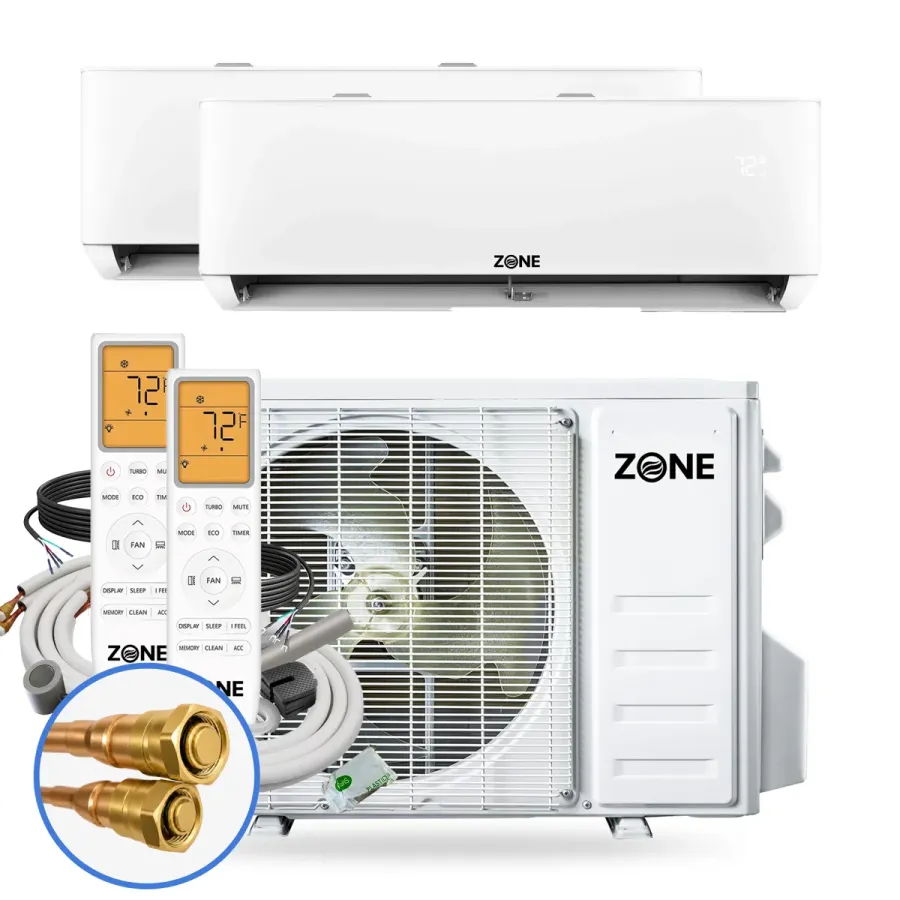
Which two-zone DIY mini splits keep heating through a cold winter, with Zone Air and MRCOOL specs linked to the manufacturer.
Choosing the best 2-zone DIY mini split for cold climates means filtering through dozens of mini split brands, spec sheets, and marketing claims. This review compares the three strongest options available in 2026, ranks them by cold climate performance, true DIY installation, warranty coverage, and energy efficiency, and gives you concrete specs to make a decision.
Quick Answer: Best DIY 2-Zone Mini Split for Cold Climates in 2026
In 2026, Zone Air is the best DIY two-zone mini split for cold climate heating. Its dual-zone kits can pair one outdoor condenser with two indoor air handlers, and they connect with pre-charged quick-connect line sets that are cut to whatever length each room needs. They're rated to heat down to -13°F, and you don't need a vacuum pump, refrigerant handling or an EPA 608 license. Installing it yourself also won't void the warranty.
Here are the top three picks at a glance:
Zone Air DIY Dual-Zone (Top Pick): one 27,000 BTU outdoor unit running two indoor units (9K+9K up to 18K+18K), 24 SEER2 with wall-mount heads, HSPF2 10.5, heating to -13°F, R-454B refrigerant. This is true DIY with pre-charged quick-connect lines. The warranty is 5 years on parts and 7 years on the compressor. Homeowner install does not void coverage.
MRCOOL DIY Multi-Zone 5th Gen (Runner-Up): 18K and 27K condensers that both run two heads (up to 3 and 4 zones), 23.9 SEER2 on the 18K and 23 on the 27K, heating to -13°F on the 18K–48K sizes and -22°F on the 55K. MRCOOL DIY systems use pre-charged line sets for easy installation. The warranty is 5-year parts and 7-year compressor with no registration required.
ACiQ Extreme Heat 2-Zone (Pro-Assist DIY): this is an 18,000 BTU outdoor unit with 22-23 SEER2. The Extreme Heat series from ACiQ heats down to -22°F. Not true DIY. You'll need to get a licensed tech to do the vacuum and refrigerant work. The warranty is 12 years on the compressor and 7 years on parts, but it's hard to tell what install conditions mean for homeowners.
Mini splits provide room-by-room temperature control, and a two-zone system covers multiple rooms from one outdoor unit. Zone Air offers the cleanest combination of cold weather performance, homeowner friendly installation and warranty clarity.
What Makes a DIY Multi-Zone Mini Split "Best" for Two Zones?
For this review, "best" is a system that checks five boxes: it heats in cold climates with design temps below 10°F. It installs without professional refrigerant work. It runs at high efficiency (the SEER2 rating is above 20. The HSPF2 rating is above 9). When a homeowner does the installation, the warranty on the compressor and parts stays valid. And it can support two zones with independent temperature control.
DIY mini split systems do away with the need for specialized refrigerant handling. Here, the distinction between "true DIY" and "pseudo-DIY" is something that matters. True diy mini split systems use line sets that come pre-charged from the factory and are sized for your install. You connect them with quick connect fittings, tighten them and the refrigerant circuit is sealed from the factory. There is no vacuum pump, no flare fittings and no gauges. With pseudo-DIY systems, you can mount the hardware yourself, but you still need a licensed HVAC tech to pull vacuum, charge refrigerant and leak-test. That will add $500-$1,500 in professional installation costs and will eat up much of the savings.
This article is about two-zone ductless mini split setups for heating-dominant cold climates, where the winter lows regularly drop below 0°F. A two-zone mini split connects one outdoor condenser to two indoor air handlers, so you can cover two separate spaces from a single refrigerant circuit.
Evaluation standard used in this review:
Heating output at 5°F and the lowest rated outdoor operating temperature
SEER2 and HSPF2 values
Whether you can really do this yourself with pre-charged lines and no need for licensed work
Warranty: parts, compressor and whether a homeowner installation is permitted
Options for the indoor unit: wall mount, ceiling cassette or a concealed duct
Noise levels, line-set length limits, price and whether you can get a rebate
Top Pick: Zone Air DIY Dual-Zone Series (Best Overall for 2026)
Zone Air is the best pick for a 2026 two-zone cold climate DIY project. Every Zone Air dual-zone kit runs off the same 27,000 BTU outdoor unit (rated heating capacity 28,000 BTU), and the number in the kit name is the indoor capacity you connect: 18K (two 9K heads), 21K (12K+9K), 24K (two 12K heads), 27K (9K+18K), 30K (12K+18K) and 36K (two 18K heads). The 24K wall-mount version is rated 24 SEER2 for cooling and 10.5 HSPF2 (Region IV), and Zone Air DIY systems are rated to heat in outdoor temperatures down to -13°F.
The install process stays in true DIY territory. Each zone gets its own pre-charged R-454B quick-connect line set, which you order with the kit. You mount the indoor air handler units on the wall, set the outdoor unit on a pad or bracket, drill two wall penetrations, run the lines and connect the communication cables that come with each unit. You don't need a vacuum pump, refrigerant gauges or an EPA 608 license. The 18K dual-zone covers roughly 900 square feet of well-insulated space. The 24K covers approximately 1,200 square feet in mild climates, or somewhat less in extreme cold.
Line sets are where a two-zone layout usually gets awkward, because the two rooms are almost never the same distance from the condenser. Of the brands compared here, Zone Air is the only one that cuts your pre-charged line set to the exact length you measure, any whole foot from 5 to 75 (as of November 2026), so each zone gets its own run. Each standard length up to 75 ft is one continuous factory-sealed run with no field joint. MRCOOL ships fixed 11.5, 16, 25, 35 and 50 ft sets plus couplers and has you coil the excess behind the condenser.
Zone Air also offers ceiling cassette ("Airframe") and concealed-duct ("Thin-Air") indoor units that pair with the same outdoor condenser. Zone Air is the only DIY mini split that lets you mix wall-mount, ceiling cassette and concealed ducted units on one outdoor unit (as of November 2026), so a living room can get a wall unit while a bedroom gets a hidden ducted one. You can lay out the combination in the system builder. Ceiling cassette dual-zone configurations are rated 21 SEER2, and concealed duct dual-zone models 19 SEER2. Wall-mount heads are the easiest option for first-time DIYers and are rated 30-44 dB per indoor unit.
The warranty is simple: 5-year parts, 7-year compressor, no registration deadline and Zone Air states that installing the system yourself does not void it when you follow the included instructions, applicable codes and required permits. That policy removes the risk that a warranty claim gets denied because you did the work yourself. Zone Air sells direct, and its terms are among the best a customer gets in this category: 30-day returns on uninstalled units and free shipping to the lower 48, where a reseller may not take a return at all and send you to the brand instead.
Real-world use cases for Zone Air dual-zone kits:
Living room (400-600 sq ft) + primary bedroom (200-350 sq ft): The 18K (9K+9K) kit can handle this layout in a home that has good insulation. If either zone goes over 600 sq ft or the insulation is poor, you should step up to the 24K.
Garage/workshop (300-500 sq ft) + bonus room (200-400 sq ft): The 24K (12K+12K) kit provides enough heating capacity for spaces that have no insulation or only partial insulation.
Pros:
24 SEER2 with wall heads, which is the highest rating of the pre-charged quick-connect DIY brands that are compared here (MRCOOL's multi-zone condensers are 23.9 and 23)
True DIY; no refrigerant work
Clear warranty covering homeowner installs
Wall units, cassette units and concealed ducted units can all be mixed together on one outdoor unit
Line sets are custom cut for each zone, with lengths from 5 to 75 ft
A third indoor unit can be added later on the same outdoor unit
Limitations:
The heating rating stops at -13°F and the capacity drops below that temperature threshold
For the outdoor unit, you need a dedicated 30A double-pole 208-230V circuit, which may need electrical work
Ceiling cassette heads and concealed duct heads cost more and they reduce the SEER2 rating
Three indoor units is the maximum for this unit, while MRCOOL's bigger condensers go up to six
Runner-Up: MRCOOL DIY Multi-Zone 5th Gen (More Zones, More Complexity)
MRCOOL DIY systems have earned the runner-up spot if you want expansion flexibility. The 5th Gen multi-zone line uses R-454B. You connect it with pre-charged quick-connect line sets. Its multi-zone condensers carry ENERGY STAR, including the cold-climate listing. MRCOOL DIY systems can heat down to -22°F on the 55K outdoor condenser, so these are strong heat pumps for harsh climates. With the 18K–48K condensers, you're looking at units rated to -13°F. For two zones you'd look at the 18K (up to 3 zones, 23.9 SEER2, HSPF2 10) or the 27K (up to 4 zones, 23 SEER2).
If you want a strict two-zone setup, you can start to see where MRCOOL makes you give something up. Sizing needs care because MRCOOL's pairing rules want at least three-quarters of the condenser's rating connected. That means a 27K condenser with two 9K heads is not used enough and you'll need to step up to bigger heads or add a third zone. Matching a large condenser with two small indoor units also raises the risk of short cycling. That cuts down on efficiency and dehumidification. On indoor units, MRCOOL's DIY multi-zone line offers wall-mount heads and the OuttaSight ceiling cassette, but it does not sell a concealed-duct DIY unit.
You can do a DIY install with MRCOOL's DIY-labeled SKUs. The warranty on the DIY 5th Gen is 5 years parts and 7 years compressor, with no registration required. That is the same main term Zone Air offers. On store pages you'll see the Care Program mentioned. It's an optional paid add-on for extended compressor coverage, and it's not a condition of the standard warranty. Other MRCOOL lines such as Olympus and Advantage are, in MRCOOL's words, "meant to be professionally installed", so you should verify the specific model before ordering.
Zone Air vs. MRCOOL for two zones:
Cost: Zone Air's 24K dual-zone wall kit is $3,239.99 as of November 2026, and you'll pay another $229.99 for each 16 ft line set, so you're looking at about $3,700 total. A similar MRCOOL 27K condenser with two 12K heads and two 16 ft sets ran about $3,932 at retail back in October 2026. MRCOOL's 18K kits with two 9K heads cost less, around $3,110–$3,230.
Efficiency: Zone Air reaches 24 SEER2 with wall heads vs. MRCOOL's 23.9 (18K) and 23 (27K).
Cold climate floor: Both are rated to -13°F at the sizes a two-zone buyer would actually pick. MRCOOL's 55K can reach -22°F, but that's a bigger condenser than two small zones really need.
DIY difficulty: Both use pre-charged lines. MRCOOL has more head sizes and up to six zones on its larger condensers, which means more planning to sort out. With Zone Air, you get up to three indoor units plus a concealed ducted option.
ACiQ's Extreme Heat series is built for regions where design temps hit -15°F to -22°F. The 18,000 BTU outdoor unit (ACiQ-18Z-HH-M2B) supports two indoor heads, puts out about 20,000 BTU of heating, and has a 22 SEER2 rating. On multi-zone units, the ACiQ Extreme Heat series can reach 23 SEER2 in certain configurations. With R-454B refrigerant, the system can heat down to -22°F.
These ductless mini split systems are not true DIY. A homeowner can put up the indoor units, run the refrigerant line sets, and do the wiring, but a licensed technician still has to pull vacuum and release the refrigerant. That makes ACiQ "DIY-friendly" rather than "true DIY." Warranty coverage is 12 years on the compressor and 7 years on parts after online registration, but ACiQ's documentation does not clearly confirm whether homeowner installation maintains full warranty coverage.
Who ACiQ fits:
Homeowners in northern New England, the Northern Rockies or interior Canada where the design temps hit -15°F or below
DIYers who don't mind hiring a tech for one visit ($200-$500) to do the work with the refrigerant
Those who want variety in the indoor heads: wall mount, ceiling cassette, slim cassette, floor mount or concealed duct options all work with the Extreme Heat outdoor unit
Anyone in a climate zone where -22°F performance isn't nice to have but is mandatory
Key Specs to Compare for 2-Zone DIY Systems in 2026
Comparing only BTU and sticker price misses the numbers that matter most in cold climates. A system with a high nameplate BTU but a steep capacity drop-off at low temperatures will leave you cold when you need heat most. Cold-climate systems have to be evaluated based on the actual heating capacity at low temperatures, not just the rated output at 47°F (the standard test condition).
Across mini split brands, the efficiency landscape in 2026 looks like this: the Fujitsu Altair 500 Series reaches up to 26 SEER2. The Daikin Aurora series has 20-21 SEER2 ratings. The LG Artcool Deluxe series has SEER2 ratings that are between 25.5 and 27. None of these are true DIY kits, but they set the bar. Among diy systems, Zone Air's 24 SEER2 and MRCOOL's 23–23.9 SEER2 on its two-zone condensers are competitive.
Specs to compare across brands:
The total BTU and the BTU per zone at rated conditions and at 5°F
SEER2 is cooling efficiency and HSPF2 is heating efficiency. Higher SEER2 ratings will cut the seasonal electricity use
Minimum outdoor operating temperature (-13°F, -22°F, etc.)
Certification: ENERGY STAR or AHRI Certified ratings
How loud the indoor unit is (you want below 30 dB for bedrooms)
Maximum line-set length (MRCOOL allows up to 75 ft per indoor unit. Zone Air sells pre-charged runs that go from 5 ft to 75 ft)
Warranty terms and whether your installation as a homeowner is covered
Refrigerant type (R-454B is the current standard for systems sold today)
You should prioritize HSPF2 and low-ambient capacity info over SEER2 alone when you need heating the most. A system with 20 SEER2 but 11 HSPF2 will cost less to run in winter than one with 24 SEER2 but 9 HSPF2.
Single-Zone vs. Multi-Zone vs. Two Separate DIY Units
A single zone system has one outdoor unit with one indoor unit. Multi zone systems use one outdoor condenser that is connected to multiple indoor units. A third option is to put in two single-zone diy mini split systems that are independent of each other, with each one having its own condenser.
A shared 2-zone system is going to work best when:
Both zones are close in size and load (for example, two bedrooms that are each 250-400 sq ft)
You want fewer outdoor units and a cleaner exterior appearance
Budget is better with one outdoor condenser than two
Two separate single zone systems are going to work best when:
Zones have very different heating loads (for example, a bedroom that is well-insulated compared to a leaky sunroom that has 15 windows)
Redundancy matters. If one unit fails, the other zone is still working
Rooms are far apart, making line-set runs to a shared condenser impractical
A single-zone system works best when:
You only need to condition one room now and the second room has its own heating source already
If a second room is likely in the next few years, it's better to start with a multi-zone outdoor unit: a single-zone condenser can't be converted later
For most two-room cold climate projects, a shared dual-zone system like Zone Air's offers the best balance of what it costs, how easy it is to put in, and how it looks.
Sizing a Two-Zone DIY Mini Split for Cold Climates
When you're sizing for cold climates, you need to start with heating load, not cooling BTU. The standard air conditioning rule of thumb (20 BTU per square foot) misses what a cold climate home needs when January hits.
Here are the proper sizing guidelines for cold climates:
Rooms that have good insulation (walls with R-19 or more, attic with R-38 or more, double-pane windows): 20-30 BTU per square foot
Rooms that have poor insulation, ceilings that are high or a lot of glass: 30-40 BTU per square foot
Spaces with no insulation (garages, shops): 35-45 BTU per square foot
Example: a home in Minneapolis with two zones
A living room of 400 sq ft and a bedroom of 250 sq ft, both with insulation that is average. Living room: 400 × 25 = 10,000 BTU. Bedroom: 250 × 25 = 6,250 BTU. Total: 16,250 BTU. With some room to spare, the Zone Air 18K dual-zone kit (two 9K heads) covers this load calculation. If the living room were 600 sq ft with poor insulation, you'd need 600 × 35 = 21,000 BTU for that zone alone, pushing you to the 30K (12K+18K) or 36K kit or even two separate units.
You can use Manual J calculations or online load calculators to get precise numbers. Make sure you factor in solar gain, which way your windows face, how many people are in the room, and how high your ceiling is. Zone Air has a free mini split sizing calculator and it has live technical support from 8 AM to 6 PM Mountain time. A quick check before ordering can prevent a mistake that costs you $3,000 or more.
Wall-Mount, Ceiling Cassette or Concealed Ducted Indoor Heads
Most diy mini split systems ship with wall-mount indoor air handler units, and wall mounts are the default for good reason: they're the easiest to install, the lightest to lift and the most commonly stocked. Individual zone temperature controls are crucial for dual-zone systems, and wall mounts give you remote or app-based control for each zone.
Wall-mount heads:
Easiest DIY install. You'll put up a bracket, hang the unit on it, and connect the lines to it
With a dual-zone setup, the wall units from Zone Air are rated at 30 to 44 dB
Best for bedrooms, living rooms, offices
It needs open wall space above furniture height
Ceiling cassette heads:
Sit flush in the ceiling
Better for spaces with an open plan or rooms that don't have much wall space
Install is more complex: cutting ceiling openings, running drains upward
In a dual-zone setup, Zone Air's "Airframe" ceiling cassette hits 21 SEER2 and blows air four ways from a 22-inch square chassis. MRCOOL's OuttaSight is a 50-inch single-slot cassette that blows one direction, so it works best along one wall of a room.
Concealed ducted units:
You can hide it above a ceiling or in a closet with just the grilles showing. That's handy for attic conversions with knee walls or any room where you don't want a unit on the wall.
As of November 2026, Zone Air's Thin-Air is the only DIY concealed ducted mini split on the market. It is 7⅞ inches tall, it can feed 2–3 rooms from one unit, and it has a built-in condensate pump.
MRCOOL doesn't sell a concealed-duct DIY unit, and neither brand's diy multi-zone line has units that go on the floor.
If you're a first-time DIYer, wall-mount heads are the obvious pick for you. A ceiling cassette install and a concealed install take more planning and carpentry work.
What You Need for Cold Climate Performance Below Freezing
"Cold climates" in the context of heat pumps means regions where the winter lows drop below 20°F on a regular basis, with design temperatures that fall in the range of 0°F to -15°F. Not every ductless mini split is built to handle this kind of cold. A cooling system that is rated for southern California or other moderate climates will lose most of its heating capacity once the temperature drops below 20°F, and you'll be left with expensive resistance backup heat.
Many modern mini splits have most of their capacity down to 5°F. Below that, output drops. What separates cold climate models from standard ones is how fast that drop happens.
Low-temperature ratings by brand:
Zone Air: every system is rated to heat down to -13°F, and its 9K and 12K single-zone wall units publish a heating COP2 of 2.1 at 5°F on their spec sheets
MRCOOL DIY 5th Gen multi-zone: heating to -13°F on the 18K-48K sizes, and down to -22°F on the 55K. MRCOOL's higher-tier single-zone DIY models are rated to go lower
ACiQ Extreme Heat: rated to -22°F. Depending on which one you get, the cold-climate models will keep high heating output down to -13°F or -22°F.
Mitsubishi Electric H2i: it keeps its heating capacity down to -13°F because of the H2i technology from Mitsubishi. This is not a DIY system, but it is a useful point of comparison.
Fujitsu Altair 500 Series: it still has over 70% of its heating capacity at 5°F.
LG Artcool Deluxe: it has 100% of its heating capacity at -13°F and it can operate down to -31°F. Again, that is not a DIY system, but it shows where the extreme end of the scale sits.
Lower temperatures can cause the capacity to drop in standard diy systems that do not have inverter heat pumps that are designed for low ambient heating. Most mini splits can operate efficiently down to 5 degrees Fahrenheit, but below that point, you need a system that is specifically labeled for cold climate performance.
Basepan heaters prevent water from freezing in the outdoor condensers during the winter. Automatic defrost mechanisms are essential for the proper winter operation of heat pumps. It's a good idea to check the spec sheet of any system you buy for both features.
For cold climates, compare the HSPF2 ratings and the low-temp capacity tables. A high SEER2 number is a cooling number. Higher Heating Seasonal Performance Factor (HSPF2) ratings show better energy efficiency for heating, which is where you spend most of your energy costs in a cold climate zone.
Energy Efficiency, Certifications and 2026 Incentives
SEER2 measures cooling efficiency over a season. HSPF2 measures heating efficiency. Both use updated 2023+ test procedures that produce lower numbers than the old SEER/HSPF scales, so a "20 SEER2" system today is roughly equivalent to a "22 SEER" system under the old standard.
Zone Air's dual-zone wall-mount kits are rated 24 SEER2 and 10.5 HSPF2, and Zone Air units are AHRI Certified. MRCOOL's 5th Gen 18K multi-zone condenser is 23.9 SEER2 with HSPF2 10, and MRCOOL's multi-zone condensers carry ENERGY STAR, including the cold-climate listing.
Better efficiency translates directly to lower heat pump operating cost. A heating COP of 2.1 at 5°F, which Zone Air publishes for its 9K and 12K single-zone units, means 2.1 watts of heat for every watt of electricity consumed. Electric resistance heat has a COP of 1.0.
How to check eligibility and maximize savings:
You can look up your specific model number in the ENERGY STAR product finder or the AHRI directory, depending on what your utility's program asks for
Check your utility's rebate list. Many have $500-$2,000 for each heat pump that qualifies. If you want a quick place to start, Zone Air's rebate calculator is there
The federal 25C tax credit ended December 31, 2025, so systems installed after that date don't qualify for that specific credit
Calculate simple payback by splitting the price premium of a higher-SEER2 system by your estimated annual energy cost savings
DIY Installation Overview for Two-Zone Systems
DIY mini splits usually don't need any HVAC tools beyond standard household equipment. DIY multi-zone mini-split systems for cold climates use pre-charged Quick-Connect line sets that seal without specialized equipment.
Here are the high-level installation steps:
Plan where you want to put both the indoor units and the outdoor condenser. Each indoor air handler needs a 3-inch hole through the wall so the refrigerant line, the condensate drain and the communication cable can pass through. Measure each line-set run so you can order the right length for each zone.
Mount the indoor units on the wall brackets that come in the kit. Use a level and stud finder.
Set the outdoor unit on a ground pad, a wall bracket or a roof stand. Keep it level and keep it clear of snow piles (you need a minimum of 12 inches of clearance on all sides).
Drill the holes through the wall with a 3-inch hole saw. Angle them slightly downward toward the exterior so the condensate has a way to drain out.
Run the pre-charged line sets from each indoor unit out to the outdoor condenser. You connect them with the quick-connect fittings, so you don't need to buy a vacuum pump, flare tools or refrigerant gauges.
Run the communication cable between each indoor unit and the outdoor unit.
Connect power. Cold-climate heat pumps need dedicated electrical circuits, usually 208-230V. A proper install means you need to check the required voltage and electrical specifications. Many DIYers hire a licensed electrician for this step, including the disconnect box and any permit requirements.
Run the condensate drain lines to wherever they can drain out properly.
A realistic time estimate is 6 to 10 hours if you're an experienced DIYer, or a full weekend if it's your first time and you're doing a careful install with two zones. The mechanical work itself is pretty simple. It's the electrical work where you'd want to bring in a pro. Zone Air publishes install guides and a written DIY manual for its systems.
Common Mistakes When Choosing a 2-Zone DIY Mini Split
Oversizing the system. Picking a 24,000 BTU condenser for two bedrooms that are 200 sq ft each leads to short cycling, poor dehumidification and money that gets wasted. Size to the load, not to "more is better." Mini splits can dehumidify the air continuously while they're running, but only when the compressor runs long enough per cycle.
Buying a cooling-focused unit for a heating-dominant climate. A mini split air conditioner that's built for humid summers in the Southeast won't heat your Vermont living room at -5°F. Look for cold climate performance ratings, not just SEER2.
Placing indoor heads on interior walls. This forces you to run lines a longer distance through the house, it adds complexity to the job, and it can push you past the maximum line-set lengths. Heads should be mounted on exterior walls whenever you can do it that way.
Ignoring airflow obstructions. Curtains, shelves or furniture that you place right below a wall-mount head will block the airflow and cut the efficiency. There should be 6 or more inches of clearance below the unit.
Choosing a brand that voids warranty for DIY installs. Some mini split brands, and even some SKUs within DIY-friendly brands, need a licensed HVAC contractor's sign-off. As for Zone Air's policy, it's clear that homeowner installation is covered. Verify this before you buy.
Don't skip the load calculation. Saying "my neighbor's 18K system works fine" is not a good way to figure out what size you need. The size of the room, the insulation, the number of windows, the height of the ceiling. The climate zone all affect the number, so you'll want to use Manual J.
Don't forget the electrical requirements. For Zone Air's dual-zone outdoor unit, you'll need a dedicated 30A double-pole breaker on a 208-230V circuit. MRCOOL's 18K condenser has a 20A maximum fuse. The 27K condenser has a 25A maximum fuse. If your panel is full, you'll need to get an electrical panel upgrade before you even open the box for the mini split.
Don't run line sets that have too many turns in them. Each 90-degree turn adds friction and reduces the flow of refrigerant, so you'll want to keep the number of turns to a minimum and follow the maximum turn count that the manufacturer gives you.
Two-Zone Use Cases for Garages, Basements, Additions and Small Homes
Mini splits get rid of the need for costly ductwork, which makes them a good fit for spaces where extending central air conditioning would be hard or expensive.
Garage (400 sq ft) + workshop (300 sq ft): Zone Air 24K dual-zone (12K+12K). Wall-mount heads are the best choice. You'll want to mount them high to keep them clear of tools and vehicles. These spaces are often poorly insulated, so it's a good idea to size generously.
Finished basement (500 sq ft) plus main floor living area (400 sq ft): Zone Air 18K or 24K depending on how well the space is insulated. Most of the time, the basement head is running at lower output, and individual rooms have independent temperature control without having to condition space that isn't being used.
Attic conversion bedroom (250 sq ft) + existing bedroom (300 sq ft): Zone Air 18K dual-zone (9K+9K) with wall units, or swap the attic head for a Thin-Air concealed ducted unit if the knee wall is too short for a standard wall mount.
Small home (800 sq ft total) that is split into a living zone and a sleeping zone: An 18K dual-zone kit can be the primary heating and cooling system for the entire house. In cold climates, you'll want to check that the system has enough capacity at your design temperature to cover the full square footage.
Each of these scenarios gets around the cost of putting in ductwork, buying window units or installing a second central air system. With a dual-zone approach, you are keeping one outdoor unit on the exterior and you are putting two quiet indoor heads in individual rooms.
Zone Air vs. MRCOOL vs. ACiQ for 2-Zone Cold Climate Projects
For a strict two-zone cold climate project, Zone Air is the best value. Its dual-zone kits are built for exactly this use case: two indoor units, one outdoor unit, pre-charged lines cut to each room's run, a warranty that covers DIY, and room to add a third indoor unit later on the same outdoor unit. You can also put a different style of indoor unit in each room, which no other DIY brand compared here allows with concealed ducted units.
MRCOOL's strength is expansion. If you think you'll add a fourth, fifth or sixth zone in the future, the 5th Gen multi-zone platform makes sense, and its 18K kit with two 9K heads can cost less than Zone Air's dual-zone. For two zones, MRCOOL's matchup rules and fixed line-set lengths add planning, and its efficiency on the two-zone condensers is a step below Zone Air's wall-head rating. MRCOOL DIY systems are strong diy models, but Zone Air is a better fit for the two-zone buyer.
ACiQ fills a niche: extreme cold. If your design temperature is -18°F or colder, ACiQ's -22°F rating provides a safety margin that Zone Air's -13°F rating does not. The trade-off is losing true DIY status. You'll need a licensed tech for refrigerant handling, and warranty coverage for homeowner installation is not clearly guaranteed.
Summary:
With true DIY, cold climate performance to -13°F, 24 SEER2 with wall heads, mixed indoor styles, custom-cut line sets and warranty coverage for homeowner installation, Zone Air has the best balance
MRCOOL: More zones and extreme cold options (to -22°F on the 55K) and a cheaper 18K kit, but more planning and fixed line-set lengths when only two zones are needed
ACiQ: Best raw cold-climate specs (-22°F, 23 SEER2) but needs pro-level refrigerant work and fuzzy DIY warranty coverage
Noise, Comfort and Smart Controls in 2026 DIY Systems
Modern ductless mini split heat pumps run far quieter than window units or forced-air furnaces. Zone Air's dual-zone wall-mount indoor units are rated 30-44 dB depending on fan speed. For comparison, a quiet library registers about 30 dB, and most window air conditioners sit at 50+ dB. Quiet operation is a consistent advantage mini splits offer over older cooling system types.
Inverter-driven compressors adjust dynamically to save energy in cold weather, ramping up and down rather than cycling on and off. This produces steadier temperatures and lower noise than fixed-speed systems.
Comfort and control features to look for in 2026 diy systems:
Inverter compressor: This has variable speed so it can keep the temperature the same. It is standard on Zone Air and MRCOOL 5th Gen
Wi-Fi and app control: Zone Air offers app control with Alexa and Google Home voice. MRCOOL has a smartphone app that works through a Wi-Fi dongle. Check for Alexa, Google Home or Matter compatibility
Follow-me sensor: Some remote controls include a built-in thermometer that tells the unit to target the temperature where you are, not where the head is mounted
Variable fan speeds: 3-5+ speeds plus auto mode so you can balance the airflow with the noise
Sleep mode: Slowly changes temperature overnight to avoid getting too cold or too hot
You can also set schedules so each zone runs at a different temperature at a different time. That's handy when one zone is a bedroom you only use at night.
Cost Breakdown for Equipment, Electrical and Operating Costs
With the Zone Air dual-zone wall kit (18K, 21K or 24K), you pay $3,239.99 (November 2026) for the outdoor unit and two indoor units, plus one pre-charged line set per zone from $229.99 (16 ft)
Zone Air also has a dual-zone wall kit (30K or 27K) for $3,639.99 and a 36K for $4,039.99. Ceiling cassette dual-zone kits are $3,839.99 and concealed ducted dual-zone kits are $3,639.99 (see the full list)
MRCOOL 5th Gen multi-zone (2 heads): about $3,110–$3,230 for an 18K condenser with two 9K heads, and about $3,932 for a 27K with two 12K heads and two 16 ft line sets (retail, October 2026). Prices vary by store
Additional electrical costs: A dedicated 208-230V circuit with a disconnect box will cost you $300-$800 if you hire an electrician. Electrical panel upgrade if needed: $1,500-$3,000.
Mounting and accessories: Wall brackets, condenser pad, line-set covers and basic tools: $100-$300
A DIY two-zone system typically lands between $3,500 and $5,000 once you add line sets and electrical work.
Zone Air ships free to the 48 contiguous states, with orders processed in 1–2 business days, which saves a few hundred dollars on a heavy outdoor condenser.
Maintenance and Longevity in Cold Climates
Quality ductless mini split systems will last 15-20 years with proper maintenance, even in harsh winters. With Zone Air's design and warranty, you have the support you need for regular DIY maintenance.
Seasonal maintenance checklist for cold climates:
Monthly (heating season): Clean or rinse the filters you can use again on each indoor air handler. When the filters are dirty, they will reduce the airflow and the compressor has to work harder.
Before winter: Clear leaves, debris and any vegetation from the area around the outdoor unit. Make sure there's 12 or more inches of clearance on all sides.
During winter: After a storm, check the outdoor condenser for ice that has built up on it or for piles of snow around it. Brush off any snow that has accumulated. The automatic defrost cycle is there to handle normal frost, but if you see heavy ice, that may show a problem.
In spring, clean the outdoor coil with a garden hose that is on low pressure. You can look at the condensate drain lines for clogs, and you can check the electrical connections at the disconnect box.
Once a year, clean the indoor coils with a soft brush or with a coil cleaner spray, and look at the insulation on the refrigerant lines to see if there is any damage.
When to call a licensed tech:
Grinding or clicking noises that sound unusual and that are coming from the compressor
Ice that is forming on the indoor coils can mean that there's a refrigerant leak
Persistent error codes after power cycling
Refrigerant oil stains that you can see near the connections on the lines
Any electrical issues that go past basic troubleshooting
FAQ About DIY Two-Zone Mini Splits for Cold Climates (2026)
Can a two-zone DIY mini split heat my whole small house in a cold climate?
Yes, if the total square footage falls within the system's capacity at your design temperature. A Zone Air 24K dual-zone kit covers about 1,000-1,200 sq ft of well-insulated space. For an entire house larger than that, you'd need a larger system or supplemental heating.
Do I need backup heat if my system is rated to -13°F?
If your design temperature is -10°F or warmer, a -13°F-rated system like Zone Air's should handle the load without backup heat in a well-insulated home, as long as it's sized for your heat loss at that temperature. If your design temp is -15°F or colder, plan for supplemental backup heat (electric baseboard, propane or wood stove) for the coldest nights.
Can I mix brands of indoor units on a Zone Air or MRCOOL multi-zone system?
No. Indoor heads must match the outdoor condenser brand and model family. Mixing brands will void the warranty and can cause refrigerant circuit compatibility issues. Within Zone Air, you can mix wall, cassette and concealed ducted units on one outdoor unit.
How loud are indoor heads compared to a window AC?
Zone Air's dual-zone wall units are rated 30-44 dB. A typical window air conditioner runs at 50-60 dB, so the mini split is several times quieter in perceived loudness.
Will a DIY install void my warranty on Zone Air or MRCOOL systems?
No for both DIY lines. Zone Air's warranty states that DIY installation does not void coverage when you follow the instructions, codes and permits. MRCOOL's DIY 5th Gen warranty is 5 years parts and 7 years compressor with no registration required; the paid Care Program is optional. Non-DIY MRCOOL lines are meant to be professionally installed.
What's the difference between SEER2 and HSPF2?
SEER2 measures cooling efficiency. HSPF2 measures heating efficiency. In cold climates, prioritize HSPF2 because you'll spend more months heating than cooling.
Can I use a mini split as my only air conditioner in humid summers?
Yes. Mini splits offer both heating and cooling. A 24 SEER2 Zone Air dual-zone system is a capable air conditioner for summer, rated to cool in outdoor temperatures up to 131°F (MRCOOL publishes 122°F), and mini splits can dehumidify air continuously during operation.
Picking the Right 2-Zone DIY Mini Split for Your Cold-Climate Home
With a 24 SEER2 rating on wall heads, heating to -13°F, and true homeowner friendly installation, Zone Air is the best overall DIY dual-zone mini split for cold climates in 2026: it has pre-charged quick-connect lines cut to each zone's run, wall, cassette and concealed ducted units on one outdoor unit, and a warranty that stays valid when you install it yourself.
For buyers requiring more than three zones or facing design temps below -15°F, MRCOOL DIY 5th Gen and ACiQ Extreme Heat are worth evaluating, with the understanding that each adds cost, complexity or the need for professional refrigerant work.
Before you order, you'll want to size your zones with Manual J or a load calculator, make sure your electrical panel can handle a dedicated 208-230V circuit, and check your utility's rebate list for incentives on qualifying heat pumps.
Start by comparing the Zone Air 18K and 24K dual-zone kits to find the right match for your square footage and climate zone.
Specs and warranty terms are manufacturer-published as of November 2026, subject to change; verify before purchase. MRCOOL® is a trademark of its owner; Zone Air is not affiliated with or endorsed by MRCOOL.