If you need to heat and cool three rooms independently without hiring an HVAC crew, the best 3-zone DIY mini split for 2026 comes down to two pre-charged quick-connect systems. This guide breaks down the specs, features, and trade-offs between Zone Air and MRCOOL DIY 5th Gen so you can buy with confidence and install with clarity.
Best 3-Zone DIY Mini Split in 2026
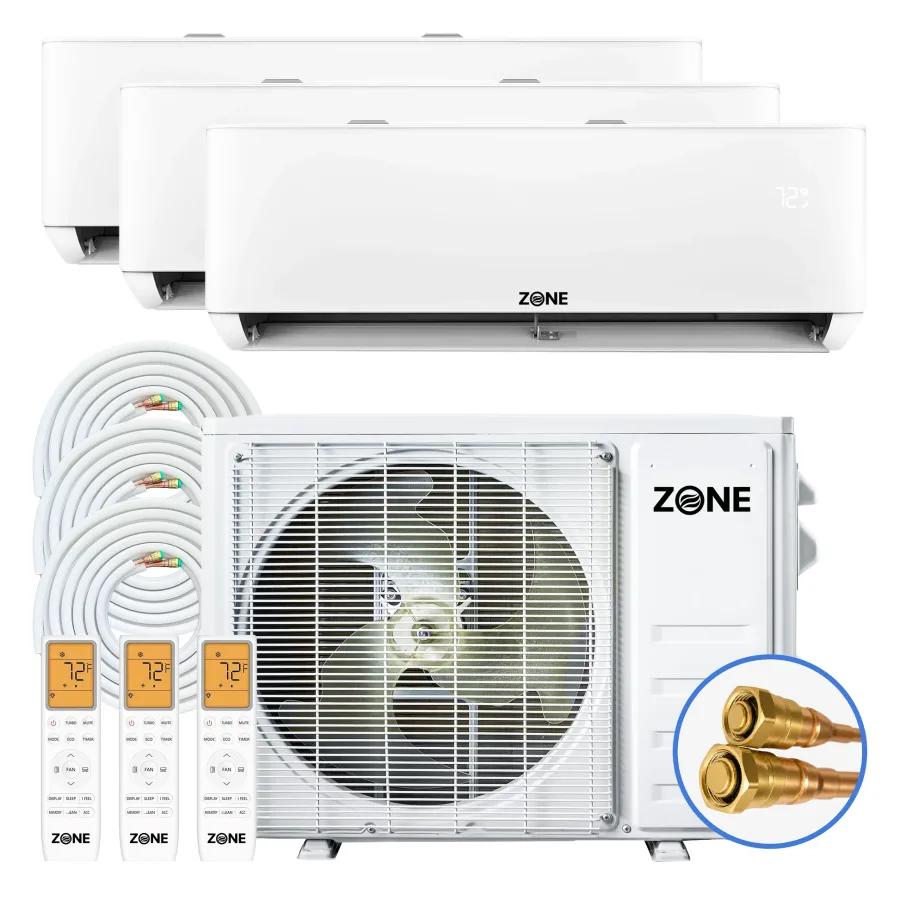
For 2026, Zone Air is our pick for the best 3-zone DIY mini split system, with MRCOOL DIY 5th Gen as the main alternative we compare it against. Here's why Zone Air is likely the one to beat:
- With Zone Air, you get true DIY installation because it uses pre-charged quick connect line sets so you don't need a vacuum pump, manifold gauges or any refrigerant handling on your part.
- Using the mix-and-match builder, you can put wall-mounted, 4-way ceiling cassette and concealed ducted indoor units together on a single outdoor unit. As of October 2026 it's the only DIY mini split that lets you put wall, cassette and concealed ducted heads on one outdoor unit. MRCOOL DIY multi-zone puts wall units together with its OuttaSight cassette but doesn't offer a concealed ducted head.
- With Zone Air, you can get pre-charged line sets cut to any whole foot from 5 to 75 feet per zone. MRCOOL DIY sends out fixed 11.5, 16, 25, 35 and 50 ft sets plus couplers, and you have to coil the extra behind the condenser.
- Both brands use pre-charged quick connect technology and R-454B refrigerant. The main differences are Zone Air's line set flexibility and its bigger indoor unit choice.
All specs, performance numbers and warranty details mentioned here are current as of October 2026 and may change, so always verify before you buy.
Why Zone Air Is the Best 3-Zone DIY Mini Split in 2026
For homeowners who want to handle the refrigerant side of installation themselves, without bringing in a licensed HVAC technician for brazing, vacuuming or charging, Zone Air built its multi-zone DIY mini split systems.
Here are 15 reasons Zone Air stands out for 3-zone applications:
- True DIY 3-zone installation means you get pre-charged quick connect refrigerant lines so you don't need a vacuum pump, refrigerant charging or flare connections.
- Three indoor unit styles are available. You can get wall-mounted, 4-way ceiling cassette and concealed ducted units.
- You can mix and match on one condenser. You can install a wall unit in a bedroom, a ceiling cassette in a living room, and a concealed ducted unit in a garage or office, and all of them run off one outdoor unit.
- You get custom-cut refrigerant line lengths. Order line sets sized to each room so you don't have extra tubing and your install stays clean. Each 25, 33, 50 or 75 ft set is one continuous factory-sealed run, not an extension.
- You get three independently controlled zones. Set different temperatures in three separate rooms for personalized comfort, with each zone getting its own remote and Wi-Fi control.
- One outdoor unit covers three rooms. A single 27,000 BTU condenser handles heating and cooling for all three zones.
- Up to 24 SEER2 efficiency. The 230V wall-mount 3-zone sets are rated 24 SEER2, which is the highest of the pre-charged quick-connect systems compared here. When you see efficiency ratings above 20 SEER2, that means solid energy savings for any HVAC system.
- Heating down to -13°F. Every Zone Air system is rated for heating in below-zero outdoor temperatures (outdoor heating range -13 to 86°F), and cooling in outdoor temperatures up to 131°F.
- 5-year parts warranty. Zone Air provides a 5-year parts warranty that covers homeowner DIY installations, with no registration deadline.
- 7-year compressor warranty. You have extended protection on the most critical part of the system.
- You can save on professional installation costs. Quick connect lines let you handle the brazing, evacuating and charging work that a contractor would otherwise bill you for.
- Flexible BTU combinations. You can mix compatible indoor unit capacities to fit different room sizes instead of using the same BTU rating everywhere.
- Cleaner, more out-of-sight indoor installations. Choose concealed ducted units for hidden equipment or ceiling cassettes for an integrated ceiling look.
- Modern R-454B refrigerant. It uses a next-generation refrigerant with much lower global warming potential than R-410A, and lower-GWP refrigerants are becoming standard in modern HVAC systems.
- Designed for homeowners. Sold direct at zone-air.com, with a written DIY manual, an install video library and live technical support from 8 AM to 6 PM Mountain time, with final assembly, testing and inspection in the USA from globally-sourced components.
No vacuum pump needed. No refrigerant handling. Fewer specialized tools. That's what separates a true DIY system from traditional mini splits.
Two honest trade-offs: Zone Air multi-zone systems ship without line sets, so you buy one per zone (a 16 ft set for a 9K or 12K head is $229.99 as of October 2026), and returns are 30 days on units that haven't been installed with a 25% restocking fee. Shipping is free to the 48 contiguous states.
Zone Air vs MRCOOL DIY 5th Gen for 3-Zone Systems
The two pre-charged quick-connect DIY mini split systems compared in this guide for multi-zone applications are Zone Air and MRCOOL DIY. Both make homeowner installation feasible, but they approach things differently in ways that matter when you're doing a 3-zone install.
Indoor units: Zone Air supports wall-mounted, ceiling cassette and concealed ducted indoor units on one 3-zone outdoor condenser. MRCOOL DIY multi-zone runs wall-mounted units and the OuttaSight ceiling cassette, plus a central DIY Hybrid Air Handler, but it has no concealed ducted head. The OuttaSight is a 57-inch single-slot cassette that sends air out one way. From a 22-inch square chassis, Zone Air's ceiling cassette sends air in four directions, so it can sit in the middle of a room and cover it evenly. Both brands have app control with Alexa and Google voice (Zone Air lists it on its FAQ).
Line sets: Zone Air systems let you choose custom line set lengths from 5 to 75 feet per zone. MRCOOL's DIY systems use pre-charged Quick Connect line sets in fixed lengths only, with couplers available to extend runs up to about 75 feet. Line-set lengths in DIY systems can directly affect how flexible your installation is and how tidy it looks when you're done.
Refrigerant: Both brands use factory-sealed, pre-charged line sets with R-454B refrigerant for 2026. The 5th Gen MRCOOL DIY series also uses R-454B, so both brands are meeting current regulatory requirements.
Efficiency: Zone Air reaches 24 SEER2 on its wall-mount multi-zone combinations (the concealed ducted 3-zone is 22 SEER2). MRCOOL's 3-zone-capable condensers are rated 23.9 SEER2 (18K) and 23 SEER2 (27K), and its best single-zone unit is 23.6 SEER2. Both brands' 3-zone condensers heat down to -13°F: MRCOOL's multi-zone manual lists -13°F heating and 122°F cooling, and Zone Air's range is -13°F heating and 131°F cooling. MRCOOL's Easy Pro single-zone line heats to 5°F and its higher-tier single-zone DIY models are rated lower than -13°F, but there's no multi-zone version of those.
Warranty: MRCOOL's DIY 5th Gen carries a 5-year parts and 7-year compressor warranty with no registration needed, and DIY installation doesn't void it. Zone Air is matching this with its own 5-year parts and 7-year compressor warranty, also with no registration deadline and DIY installation allowed. Both are parts-only warranties (no labor or refrigerant). MRCOOL doesn't put out a manufacturer return policy, so returns depend on the seller. Zone Air's is 30 days on units that haven't been installed with a 25% restocking fee.
Who should choose which? If you want three different indoor unit styles and cleaner installs with custom line sets, Zone Air is for you. If you want wide retail availability at Home Depot and other retailers, MRCOOL DIY is the one to look at.
How a 3-Zone DIY Mini Split Works
A 3-zone DIY mini split is simple in concept: one outdoor unit sends refrigerant to three indoor units, and each indoor unit independently controls the temperature in its zone. 3-zone DIY mini split systems can control three rooms independently using a single condenser.
- The outdoor unit has the compressor and inverter technology. It sits outside your home and connects to each indoor unit through refrigerant line sets and communication wires.
- Each indoor unit moves conditioned air in its zone. For simple installs, Zone Air offers wall-mounted units. For open living spaces, it offers 4-way ceiling cassettes. For rooms where you want the equipment hidden, it offers concealed ducted units. Different indoor unit styles include wall-mounted blowers and ceiling cassettes, which gives you options for each room.
- Refrigerant line sets are insulated copper lines that carry refrigerant between indoor and outdoor units. Pre-charged DIY systems like Zone Air and MRCOOL send these lines out factory-sealed, so you never handle refrigerant yourself.
- Each zone can run at a different temperature or even a different mode, like heat, cool, dry or fan, within the limits of the shared outdoor unit. Picture a 1,800 sq ft home: one zone cools the living room, another heats a chilly bedroom, and a third keeps a home office at a moderate setting.
Zone Air 3-Zone DIY Specs and Features
Rather than rigid kits, Zone Air 3-zone DIY mini splits are systems you can set up. They're built for houses, ADUs and multi-room renovations where each space has different heating and cooling loads.
- BTU combinations: Every Zone Air 3-zone system runs on the same 27,000 BTU outdoor unit, with connected indoor capacity from 27,000 to 36,000 BTUs. You can mix capacities. For example, you can use 9K+9K+12K for three bedrooms, or 9K+9K+18K when a larger living room is part of the layout. BTU requirements should match individual room heating and cooling loads.
- Performance: 24 SEER2 cooling efficiency on the wall-mount combinations. Systems should maintain heating capacity at low ambient temperatures, and Zone Air supports heating down to -13°F for cold-weather season use.
- Indoor unit styles: Wall-mounted units are the simplest and lowest cost. Ceiling cassettes fit open living spaces where you want a clean look without a wall unit. Concealed ducted units hide equipment above the ceiling with short duct runs. They're a good fit for a workshop, garage or bonus room where looks matter. The Thin-Air concealed unit is 7-7/8 inches tall and comes in 9.5K and 11K sizes.
- Refrigerant: All Zone Air DIY multi-zone condensers use R-454B, which matches 2026 regulatory trends. This is a step forward compared to older R-410A systems.
- Noise and comfort: Wall-mount indoor units run 30 to 44 dB, as quiet as 30 dB on low fan speed. The inverter compressor changes speed to keep the system efficient across partial loads, and it gives you more even climate control than window units or portable ACs.
- Add a zone later: A 27K condenser bought with two heads can take a third on its spare port later with a pre-charged line set, per Zone Air's FAQ. A single-zone condenser can't be converted.
As of October 2026, a Zone Air 36,000 BTU 3-zone wall-mount package rated for up to 1,800 sq ft is priced at $3,509.99, the 3-zone ceiling cassette system is $4,909.99, and the 3-zone concealed ducted system is $4,809.99, all before line sets.
True DIY vs DIY-Adjacent Mini Split Installation
Not all systems sold as "DIY" are equally simple. True DIY mini split systems like Zone Air and MRCOOL DIY use pre-charged quick connect line sets. "DIY-adjacent" systems, like many Pioneer and Senville models, still use flare line sets that need a vacuum pump and refrigerant handling. Senville's warranty states that DIY installation will void your warranty coverage, and Pioneer's warranty is 1 year unless you register within one week of installation, which raises it to 5 years.
Here's the high-level Zone Air DIY installation process:
- Put indoor units on interior walls or in ceilings.
- Put the outdoor unit on a pad or wall bracket.
- Run pre-charged line sets from each indoor unit to the condenser.
- Make quick connect connections. There's no brazing and no flaring.
- Run communication wires between indoor and outdoor units.
- Have a licensed electrician handle the dedicated 30A double-pole 208-230V circuit and disconnect. Line power is going to the outdoor unit.
With Zone Air and MRCOOL DIY, homeowners don't need a vacuum pump, manifold gauges or brazing tools. Installation requires no vacuum pump or specialized tools beyond basic hand tools, a drill, a 3-inch hole saw, a level and a torque wrench. Installation can be completed with basic tools and time. Ease of installation is a key consideration when choosing a DIY mini split system.
Traditional mini splits require cutting and flaring copper line sets, vacuuming lines to remove moisture, and weighing in additional refrigerant - steps that typically require a professional HVAC technician and add labor costs.
Practical tips: Plan line set paths before drilling. Measure carefully so you can choose the right custom line set lengths for Zone Air. Minimize bending or coiling to keep the install neat. All electrical work must follow local codes and is often required to be performed by a licensed electrician, even with DIY systems. Budget for that step in your total project cost.
Cost and Efficiency of 3-Zone DIY Systems
A 3-zone DIY mini split costs more upfront than a single-zone unit, but it can replace multiple window units and space heaters across your home while cutting summer and winter energy bills.
- Hardware costs: A Zone Air 3-zone wall-mount system starts at $3,509.99 plus line sets (October 2026). MRCOOL DIY 3-zone kits vary by store and head configuration. Capacity, SEER2 rating and indoor unit style all affect price. Expect to pay more for ceiling cassette or concealed ducted heads.
- SEER2 explained: The SEER2 standard gives you more realistic performance data than the older SEER rating under current testing rules. Moving from an older 14 SEER window unit or baseboard heat setup to a 22+ SEER2 3-zone system can deliver savings on cooling and heating bills. Pioneer's Quantum Hyperformance line goes up to 25 SEER2, but those systems use flare line sets that need a vacuum pump, so in our view they're not true DIY.
- Additional cost factors: You'll have electrical work, wall brackets or pads for the outdoor unit, line-hide kits, permits and any professional help for structural work.
- Installation savings: DIY systems like Zone Air and MRCOOL let you skip the brazing, evacuating and charging labor that a contractor would charge for on a multi-zone install. How much that can save you depends on local labor rates and your layout.
- Incentives: The federal 25C tax credit ended for equipment placed in service after December 31, 2025, so don't count on it for a 2026 install. Utility rebates may still apply to high-efficiency 3-zone systems. Check current local programs before you plan your purchase.
Pick the Right 3-Zone DIY Mini Split
The best 3-zone DIY mini split depends on your home layout, climate, electrical capacity and how comfortable you are with DIY projects. Here's how to narrow it down.
- Sizing: Use a mini split sizing calculator. Bedrooms usually need 9,000–12,000 BTU, living rooms 12,000–18,000 BTU, and basements or bonus rooms vary by insulation and window count. Avoid going too big. It can cause short cycling and waste money.
- Choose Zone Air when: You want mix-and-match indoor unit types (wall + cassette + concealed duct), custom pre-charged line set lengths, and an out-of-sight, clean installation across multiple rooms.
- Choose MRCOOL DIY 5th Gen when: You prioritize wide retail availability and standard wall-mounted indoor units with pre-engineered multi-zone kits.
- Climate considerations: Zone Air and MRCOOL DIY 5th Gen 3-zone systems are both rated to heat down to -13°F. For moderate climates, either brand handles year-round comfort with ease. Senville's Arctic series is rated to -22°F, but Senville's warranty is void with DIY installation, and Pioneer's Quantum line reaches -22°F with flare line sets that need a vacuum pump.
- Aesthetics: If visible wall units in every room don't fit your design, Zone Air's 4-way ceiling cassette or concealed ducted indoor unit provides a more integrated look for living rooms and open-plan spaces.
Ready to decide? You can compare specific 3-zone Zone Air configurations side-by-side with MRCOOL DIY kits. Check specs, availability and warranty terms on each brand's website before you buy. Forums and groups where other homeowners share their install experiences are places you can join. That'll make your project easier and safer.
FAQ About 3-Zone DIY Mini Splits (2026)
Are 3-zone DIY mini split systems really DIY?
You can use Zone Air and MRCOOL DIY's pre-charged quick connect line sets to make the refrigerant side of installation feasible if you're a skilled homeowner. Electrical work still usually needs a licensed electrician. Proper maintenance and periodic filter cleaning are staying your responsibility after install.
Can a 3-zone mini split cool and heat an entire small home?
Yes. A well-insulated home of up to about 1,800 sq ft with three strategically placed indoor units can achieve complete heating and cooling coverage, going by Zone Air's own coverage ratings. Larger or poorly insulated homes may need additional zones or a separate system.
How do DIY systems compare to traditional mini splits?
The main difference is installation complexity. Traditional splits need a vacuum pump, flaring tools and refrigerant handling. Hiring a professional is usually necessary. DIY systems from Zone Air and MRCOOL are eliminating those steps. Zone Air sells single continuous pre-charged runs up to 75 feet, with a 30 ft vertical lift limit. MRCOOL joins two sets with a coupler past 50 feet, up to 75 feet per head. If your layout is unusually complex, hiring a pro might still be the better and safer choice.
Does DIY installation affect warranties?
Zone Air's 5-year parts and 7-year compressor warranty clearly covers homeowner installation. MRCOOL DIY 5th Gen systems are keeping warranty even with homeowner installation. Neither brand needs registration, but always read the warranty terms carefully and keep your proof of purchase.
What are the downsides of 3-zone DIY mini splits?
Wall-mounted indoor units are visible, outdoor unit placement needs planning, and line set runs through walls and ceilings takes time and care. Multi-zone climate control also adds wiring and configuration complexity compared to a single-zone setup. Before you step into this category, you should understand these trade-offs.
Is MRCOOL connected to Zone Air?
No. MRCOOL® is a trademark of its owner, and Zone Air is a separate brand offering its own DIY mini split systems. They're separate companies in the same space. Don't worry about brand confusion. They're distinct products tested and warranted independently.
Related guides
- 3 zone DIY mini split installation
- Best 2-zone DIY mini split
- Best multi zone DIY mini split
- Multi zone mini split calculator
- Best DIY mini split warranty
- What is SEER2?
Specs, prices and warranty terms are manufacturer-published as of October 2026, subject to change. Verify before you buy. MRCOOL® is a trademark of its owner. Zone Air is not affiliated with or endorsed by MRCOOL. This site is owned and operated by Zone Air.