Cold climate mini split sizing starts with the equipment itself: a ductless mini split heat pump pairs an outdoor unit (compressor and condenser) with one or more indoor air-handling heads, delivering heating and cooling directly into each room without existing ductwork. Properly sizing a ductless mini-split heat pump is critical in cold climates because heating loads are greater than cooling loads in colder regions. A unit sized only at its 47°F rated capacity can leave a house under-heated when outdoor temperatures drop to 0°F or below.
This article is meant to answer two questions: what size ENERGY STAR cold climate ductless mini split do you need, and how is that different from a regular sizing chart? Zone Air makes DIY ductless heat pumps that are rated to heat down to −13°F, so this guide is written for homes that need reliable ductless heating at 5°F and often into temperatures that are below zero. Charts that only show square footage are not enough in extreme cold, and the approach that actually holds up is to use a Manual J load calculation together with data on how the heat pump does in cold weather.
Cold Climate Mini Split Sizing
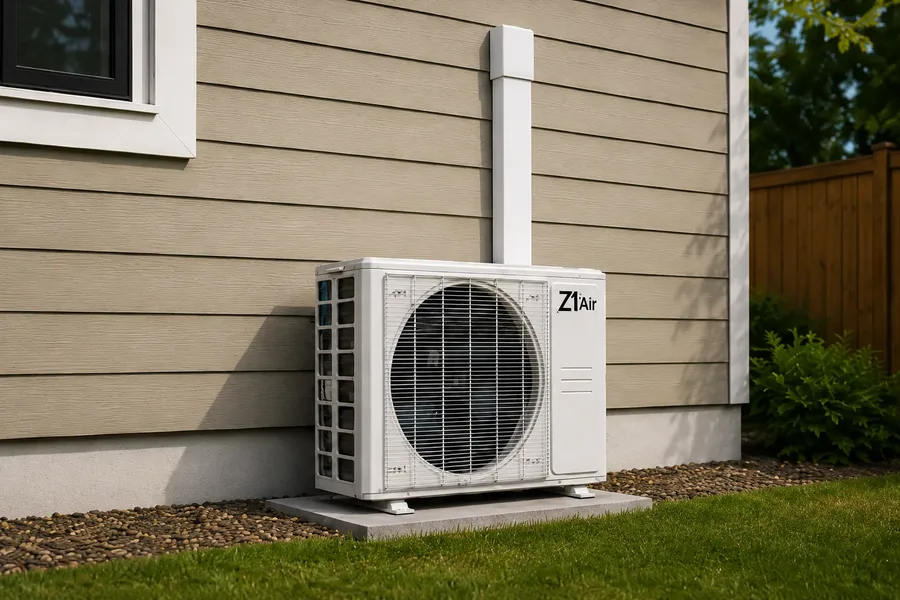
For most insulated homes in cold climates, 20 to 30 BTU/hr per square foot is only a starting range. So how do you get the final sizing? You'd get the final sizing from a Manual J heat loss calculation that you match against the manufacturer's capacity tables at your local design temperature. Mini split systems should be sized for both heating and cooling, but in cold climates, heating performance determines the size of the heating system.
- ENERGY STAR cold climate ductless heat pumps must retain at least 70% of their heating capacity when the temperature drops to 5°F. They must reach a COP of 1.75 or higher at 5°F.
- ENERGY STAR certification starts at a SEER2 rating of 18.7. Certified mini splits can use up to 60% less energy than standard systems.
- Size for heating first, then confirm the same unit won't be way oversized for your cooling load.
- The federal Section 25C tax credit only applied to equipment that was placed in service through 12/31/2025. For 2026 installs, you'll want to lean on state and utility incentives, and those often need ENERGY STAR certification.
- Zone Air's free mini split sizing calculator gives a quick starting estimate, but cold climate ductless sizing should still rest on a room-by-room Manual J load calculation, not just square footage tables.
Why Cold Climate ENERGY STAR Sizing Differs From Standard Mini Splits
Cold-climate heat pumps have a different way to get sized than standard air conditioners. With a standard mini split sizing chart, you start with cooling tonnage at 47°F and treat heating as secondary. In cold climates, that doesn't work because the design heating load at 0°F or below is what actually drives the decision. You have to size the heat pump based on the coldest historical night temperature your area gets, not some moderate-weather nameplate rating.
Standard heat pumps lose capacity when the outdoor temperature drops. Many non-cold-climate units have only 40 to 50% of their rated heating at 5°F. Cold-climate heat pumps deliver 70% to 100% of their rated heating capacity at temperatures like -5°F, because they use inverter-driven compressors, enhanced vapor injection and larger heat exchangers that are engineered for low-temperature performance. That low-temperature performance is what makes them work in cold climates.
Extreme cold in Minneapolis, where the design temp is around -12°F, or northern New England at -5°F, means designers have to check the unit's capacity tables at those temperatures, not just look at nameplate BTU at 47°F. When a unit is too big, it short cycles during mild weather. That leads to humidity control that isn't efficient in summer and temperatures that are uneven all year. For a useful definition of "cold climate," your local ASHRAE 99% design temperature is what to look at, not marketing language on the box.
ENERGY STAR Basics for Ductless Heat Pumps
The ENERGY STAR label on a ductless mini split shows that a specific indoor/outdoor combination has been tested and meets federal efficiency limits. This is important for energy savings, indoor air quality (through consistent air circulation), and getting rebates.
The current minimums that ENERGY STAR certified ductless heat pumps need to meet include:
| Metric | Minimum |
|---|---|
| SEER2 | 18.7 |
| EER2 | 12.0 |
| HSPF2 | 8.5 |
SEER2 is the new standard that took over from the older SEER rating on January 1, 2023. In the South, the federal minimum efficiency is 14.3 SEER2, while the most efficient mini splits you can get today go above 25 SEER2. ENERGY STAR certified systems keep more than 4,500 lbs of greenhouse gas emissions out of the air each year when you compare them to baseline equipment.
Cold climate models must also keep 70% of their capacity at 5°F and get a COP of at least 1.75 at that temperature. The ENERGY STAR cold-climate standard looks at HSPF2 and COP to show how the system does in efficient performance across a range of tests at 47°F, 17°F, and 5°F. ENERGY STAR certification is tied to specific indoor/outdoor combinations through AHRI Reference Numbers, so if you switch out an air handler or a condenser you can wreck the rating and your chance at the incentive.
In 2026, many state and utility rebates need ENERGY STAR certification, often the cold climate kind specifically. You need to show the AHRI Reference Number on the bill. Zone Air systems are AHRI Certified. Whichever brand you buy, make sure the exact indoor/outdoor combination you are looking at is on the list of what your program will qualify before you go ahead and place the order.
Find Your Cold Climate Heating Load With Manual J
To get the right size, you start with a Manual J load calculation instead of trying to use a one-size-fits-all sizing chart. This is the ACCA Manual standard that HVAC professionals use to figure out how much heat a house loses and how much it gains.
A Manual J load calculation looks at parts of the house like the insulation and the windows. It takes into account:
- The square footage, how tall the ceilings are, and how big the rooms are
- Insulation levels in walls, roof and floors (insulation levels set how much heat is lost and affect heating capacity requirements)
- Window areas, types (double-pane vs single-pane), and which way they face
- Air leakage and construction tightness
- Local climate data and design temperatures
You need a professional Manual J calculation to get an accurate load estimate. For example, a 2,000 sq ft home in IECC climate zone 5 with newer construction might show a design heating load of about 21,449 BTU/hr at the local 99% design temperature. A rule-of-thumb calculation using 1 ton per 400 sq ft would oversize the system for that same house by more than a full ton.
Even if you're thinking about a DIY approach, running a reputable online Manual J style calculator is way better than taking a guess from a sizing chart. For whole-home or multi-zone systems, Manual J is critical to decide how many zones to create, give BTU capacity to each indoor unit, and avoid putting too much capacity in open spaces and too little in bedrooms or home offices. If a rebate program asks for a load calculation, keep the Manual J report with your paperwork.
Turning Heat Load Into Ductless Mini Split Size for Cold Climates
Once Manual J gives you a room-by-room or whole-house BTU load at your design temperature, you still need to match that to specific ENERGY STAR cold climate mini split models using the manufacturer's published capacity tables.
Manufacturers are listing capacity at multiple outdoor temperatures:
| Unit Size | Heating at 47°F | Heating at 17°F | Heating at 5°F |
|---|---|---|---|
| 9K (0.75 ton) | 12,000 BTU | 10,000 BTU | 8,400 BTU |
| 12K (1 ton) | 16,000 BTU | 13,500 BTU | 11,200 BTU |
| 18K (1.5 ton) | 24,000 BTU | 21,000 BTU | 19,200 BTU |
| 24K (2 ton) | 30,000 BTU | 26,000 BTU | 24,000 BTU |
(Representative cold climate model data. Actual numbers vary by brand.)
If Manual J shows 18,000 BTU/hr heat loss at 0°F and a cold climate 1.5-ton ductless heat pump retains 20,000 BTU/hr at 5°F, that model fits with a modest safety margin. A non-cold-climate 18K unit might only deliver 11,000 to 12,000 BTU/hr near 0°F, which would leave the house under-heated on the coldest nights. Cold-climate mini-splits have to maintain high heating capacity at sub-zero temperatures, and that's the difference that determines whether you need backup heat or not.
Some brands use labels like "hyper-heat" or "low-ambient." Check the capacity tables against your actual design temperature instead of trusting marketing names. The range of available models is wide, so the right size mini split comes from matching your calculation to a specific unit's tested output. Zone Air publishes a one-page spec sheet, the full manual and an install guide for every unit.
Room-by-Room Sizing for Kitchens, Bedrooms and Bonus Rooms in Extreme Cold
Even when you've got a solid whole-house load number, each room or zone still needs to be sized right if you want every room comfortable without hot and cold spots. The room layout matters for airflow and heating efficiency with mini-splits, especially if you're switching from baseboards or window units to ductless heating.
Here are typical BTU ranges by room type in cold climates:
- Bedrooms and guest rooms: 6,000 to 9,000 BTU. In older homes with single-pane windows, you end up closer to the upper end.
- Enclosed living rooms and home offices: 9,000 to 12,000 BTU. For a room that's 500 sq ft, you'll need about 12,000 BTU.
- Open-plan living, kitchen and dining areas take 18,000 to 24,000 BTU or more. With a 1,000 sq ft space, you will need about 18,000 to 21,000 BTU, depending on windows and ceilings.
Cold climate adjustments to measure and account for: add 10 to 20% more BTU for ceilings that are 10 to 12 ft tall. You will want to increase capacity for large north-facing glass in regions with heavy snow. Think about air leakage in older homes that were built before 1980. In kitchens, add around 4,000 BTU to cover the heat from cooking. Open kitchens that are connected to living areas should be treated as a single zone.
Bonus rooms over a garage, sun rooms and partially finished basements have higher heat loss for each square foot and often need a separate indoor unit. Mini splits can use up to 60% less energy than electric radiators, which makes them a practical replacement in these hard-to-heat spaces. With a multi-zone system, you match capacity where it matters: Zone Air's 2- and 3-zone systems run two or three indoor units from one 27,000 BTU outdoor unit. It is the only DIY mini split that lets you mix wall-mount, ceiling cassette and concealed ducted units on one outdoor unit (as of November 2026), so a larger head can carry the main floor while smaller 9K units handle the bedrooms.
Oversizing vs. Undersizing in Cold Climates
A unit that is too big or a unit that is too small does not work well. What you want is a system that can run long, efficient inverter-driven cycles through most of the year while still having enough power for extreme heat and extreme cold days.
Problems with oversizing:
- An oversized unit runs short cycles in the in-between seasons. That cuts down on efficiency and adds more wear on the equipment.
- In summer, humidity control is poor because the cool cycle on the mini split ends before it can pull enough moisture from the air.
- In the real world, the SEER2 and HSPF2 performance you get is lower than the lab results.
Problems with undersizing:
- On design days, the system is running at full capacity all the time.
- When outdoor temps hit -5°F or lower, the rooms never get to the setpoint and the spaces stay cold.
- Electric resistance backup or space heaters fill the gap. That uses up the energy savings you were trying to get.
Inverter-driven compressors in cold climate mini splits can handle a slight oversize of 10 to 15% above Manual J, but they can't fix a unit that's oversized by a full ton or more. For the best fit, you want a system that ends up at or near the Manual J load at 5°F or 0°F, then you verify it against the manufacturer's modulation range to figure out the best fit and avoid short cycling.
Efficiency, Filtration and Real-World Performance After Installation
Proper sizing is only half the equation. Ductless mini splits have to be installed and maintained right if you want them to deliver their rated HSPF2 and SEER2 performance. When it's freezing out, a dirty filter or restricted airflow can make the indoor coils frost over more easily. That causes more frequent defrost cycles and draws more watts for each BTU it delivers. Zone Air's 230V 9K and 12K units are rated at 24 SEER2 (the 115V models are 23), and like any unit they only hit that number with clean filters and good airflow.
Homeowner maintenance routine:
- Clean the filters on your ductless mini split every 2 to 4 weeks during the heavy heating or cooling seasons
- Check the indoor units for ice buildup or noise that sounds off when the weather is cold
- Keep at least 12 to 18 inches of open space below the outdoor unit so snow can't pile up and block it
- Keep the side and rear space that the manufacturer says you need so the line set and refrigerant system can operate efficiently
Real-world performance tests assume the filters are clean and the airflow is proper. If you neglect maintenance, you can lose a big chunk of the benefit you paid for with a high-efficiency cold climate heat pump. Zone Air publishes install guides and a written DIY manual, and its live technical support (8 AM–6 PM MT) can answer questions about how to take care of the filter, where to put the outdoor unit, and what settings to use.
Incentives, Tax Credits and When to Call Zone Air
The federal Section 25C heat pump tax credit only applied to equipment placed in service on or before December 31, 2025. For 2026 and later installations, state, provincial and utility programs carry most of the incentive weight. Most regional programs in cold climates (New York, Massachusetts, Vermont, Minnesota and several Canadian provinces) require ENERGY STAR cold climate certification, AHRI-listed matched systems and documented Manual J or equivalent load calculations.
Check your local energy office or utility website for 2026 ductless heating incentives, or start with Zone Air's rebate calculator. Confirm whether ductless mini splits sized as the primary heat source qualify for higher rebate tiers in your area, and that the exact model you plan to buy is on the program's list.
Contact Zone Air when:
- You are planning whole-home electrification replacing oil, propane or baseboards
- Your design temperatures fall below 0°F
- Your house has a complex layout that needs multi-zone or mixed wall, cassette and concealed ducted units
You can run your square footage and rooms through the sizing calculator, then share the results, your climate zone and your heating goals with Zone Air's technical support to get help picking a system that fits your home's insulation and weather.
Related guides
- Best DIY mini split heat pump for cold climates
- DIY mini split operating temperature ranges by brand
- Best 2-zone DIY mini split for cold climates
- Best DIY heat pump for winter heating
- DIY mini split heat pump rebates
- Multi-zone mini split calculator
- What is SEER2?
Zone Air specifications are taken from Zone Air's product pages and spec sheets as of November 3, 2026. ENERGY STAR criteria and rebate rules change; check the ENERGY STAR site and your program before you buy. Specs are manufacturer-published as of November 2026, subject to change; verify before purchase. This site is owned and operated by Zone Air.