This site is owned and operated by Zone Air.
This site is owned and operated by Zone Air.
Articles · Buying Guide · Nov 2026
Which DIY mini splits keep heating at -13°F and below, and how Zone Air and MRCOOL DIY 5th Gen compare on cold-weather specs.
If you're looking for the best cold climate DIY mini split for a home, garage, or shop where winter lows reach -13°F or colder, your choice in 2026 comes down to two questions: how much heat does the system actually produce at low outdoor temperatures, and how well does the manufacturer support owner-installed equipment? For most buyers, Zone Air's DIY mini splits answer both questions better than MRCOOL DIY 5th Gen.
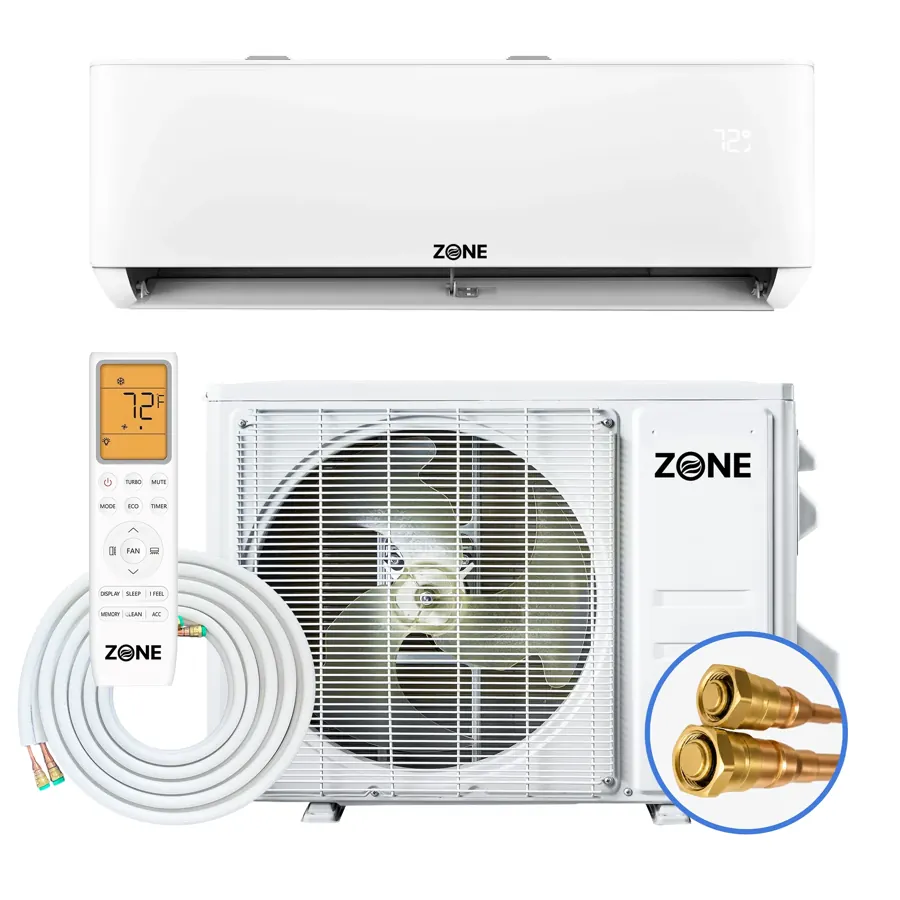
For 2026 cold climates, you want an inverter-driven DIY mini split heat pump that's rated for genuine cold-weather heating, not just one that "can run" when it gets cold. Every Zone Air system is rated to heat down to -13°F, and Zone Air publishes heating efficiency at 5°F right on each spec sheet. MRCOOL's standard DIY 5th Gen is rated to about -13°F too, and their higher-tier DIY models are rated lower, to -22°F. On efficiency, MRCOOL's best single-zone DIY 5th Gen unit hits 23.6 SEER2, while Zone Air's 230V units hit 24.
Here's what separates the tiers:
Inverter-driven heat pumps can change the compressor speed continuously instead of turning on and off over and over. That lets the system run at lower speeds when the weather's mild, which can save electricity and ramp up during cold snaps. You get more stable indoor temperatures and less energy waste than with fixed-speed units, which lose efficiency through all those start-stop cycles.
Cold-climate models add specific hardware and logic on top of the inverter platform:
Cold-climate heating performance is about how much heat the unit actually produces at low outdoor temperatures, not just whether it keeps running. MRCOOL's standard DIY 5th Gen is rated to heat down to -13°F, and the output goes down in the coldest part of that range. A unit rated at 12,000 BTU at 47°F delivers only a fraction of that at -13°F. The same physics applies to every brand, so the real question is how much output stays at your local design temperature.
By 2026, current DIY systems from both brands ship with R-454B refrigerant instead of the older R-410A, and that's because of regulatory pressure to lower the global warming potential of HVAC refrigerants.
Homeowners in northern U.S. and Canadian climate zones should ignore marketing labels and check the hard numbers on every spec sheet before they buy. Here are the standards that matter:
Because of the DOE's shift from SEER/HSPF to SEER2/HSPF2, older spec sheets are not directly comparable to 2026 equipment, so always confirm you are reading SEER2 and HSPF2 numbers when comparing new equipment side by side.
It's critical to get the heating unit sized right in extreme cold climates because that prevents over-cycling. In poorly insulated garages, shops and older homes, going a little big is safer than going too small, and if your space has thin walls or high ceilings you should size up or add supplemental heat.
MRCOOL DIY 5th Gen is the name most people know for DIY mini split heating in 2026. The two brands are even on the core cold-weather rating: both standard lines heat down to -13°F. Where they pull apart is efficiency at 230V, how they handle line sets, what indoor units you can choose, and what the manufacturer actually publishes for owner installers.
Both brands use inverter-driven compressors, ductless indoor and outdoor units, R-454B refrigerant and pre-charged quick-connect line sets. MRCOOL says "no special tools or training are necessary to install" its DIY 5th Gen. MRCOOL sells DIY single-zone sizes from 9,000 to 36,000 BTU, plus multi-zone condensers.
Here's why Zone Air is our pick for 2026 cold-climate installs:
Look at the spec sheets in Zone Air's lineup before you buy.
By 2026, current heat pumps ship with lower-GWP refrigerants. MRCOOL's DIY 5th Gen uses R-454B, and Zone Air's current models do the same.
Here's what the numbers look like behind the shift:
If you're buying a DIY mini split, here are the practical points:
"Hyper heat" is what we call heat pumps that keep a high percentage of their rated capacity at very low temperatures, down to about -22°F. Standard cold-climate DIY mini splits will still heat at -13°F, but they lose output faster once the temperature drops below 5°F.
This is what it looks like with a 12,000 BTU unit:
When to choose each:
Residential heat pumps should include a backup heat source in extremely cold climates. Even hyper-heat units lose a large percentage of capacity at the lowest temperature they are rated for.
A "zone" means one indoor air handler that is connected to an outdoor condenser. Single-zone systems and multi-zone configurations are set up to serve different kinds of setups.
Single-zone systems have one outdoor condenser that is connected to one indoor air handler. They are best for garages, finished basements, home offices and detached shops: simpler install, easier sizing, fewer penetrations. With single-zone options, Zone Air has wall mount, ceiling cassette and concealed ducted types. The 18,000 BTU 230V wall unit covers up to about 900 sq ft.
Multi-zone systems use one outdoor condenser to feed multiple comfort zones. On the larger sizes, MRCOOL's DIY 5th Gen multi-zone condensers run up to six indoor units. Running two or three, Zone Air's multi-zone outdoor unit handles any mix of wall, cassette and concealed ducted. This suits smaller homes, two-families or renovations where running ductwork is hard to do.
Air handler types to think about:
Outdoor condensers and indoor air handlers have to be matched within the same brand and generation. Don't mix MRCOOL and Zone Air components, and don't pair 4th and 5th generation parts.
The whole idea behind DIY mini split installation is that you get a line set that is pre-charged and has quick-connect fittings. The refrigerant circuit comes factory-sealed and pre-charged, so you don't need a vacuum pump, refrigerant gauges or EPA 608 certification.
Steps you can handle:
According to Zone Air's FAQ, a first-time single-zone wall install takes 4 to 6 hours for two people, and it takes about 3 hours for someone who's done one before.
Where a licensed electrician is often required:
The length of the line set must match the specification from the manufacturer. Too much coiling or short runs will degrade performance. A line set that is cut to the length of your measured run gets rid of the coil completely. Always follow the installation manual, not a marketing slogan.
A lot of buyers in 2026 are making the same mistakes that people made with earlier systems that used R-410A.
The right size and the right model family are more important than brand recognition. Here's a decision model that can help.
For cold climates, the rule-of-thumb is 20-30 BTU per sq ft, and where you land depends on insulation quality. Spaces that don't have good insulation, like garages and older homes, need to be at the higher end of that range.
| Space Type | Approx. sq ft | Suggested BTU | Model Tier |
|---|---|---|---|
| Small home office or room | Under 400 | 9,000 | Standard cold-climate |
| Bedroom, finished basement | 400-550 | 12,000 | Standard or hyper-heat |
| Large room, shop, garage | 550-800 | 18,000 | Hyper-heat if below -13°F design temp |
For the right system in a cold climate, you can start with Zone Air's spec sheets and work back to the model that fits your space and climate.
"DIY 5th Gen" is MRCOOL's name for its current DIY line. It uses R-454B refrigerant (replacing R-410A), is rated under the SEER2 and HSPF2 standards, and has a variable-speed inverter compressor and app control. Other brands, including Zone Air, sell current R-454B DIY systems under their own names.
Hyper-heat models are rated to produce heat down to about -22°F. Output declines as temperature drops; a 12,000 BTU unit will not deliver 12,000 BTU at -22°F. Expect roughly half or less of rated capacity at the lowest rated temperature. Plan backup heating for conditions below the rated floor.
In moderate cold climates (design temp above 0°F), a properly sized cold-climate DIY mini split can serve as the primary heat source. In regions that routinely drop below -10°F, treat it as the primary system with a backup (electric baseboard, propane or wood stove) for the coldest stretches.
Line set and air handler work is DIY-friendly with pre-charged quick-connect line sets. Electrical work (new 208/230V circuits, disconnect boxes) often requires a licensed electrician depending on local codes.
MRCOOL DIY mini splits are capable and widely available. MRCOOL's standard 5th Gen shares Zone Air's -13°F rating. Zone Air adds 24 SEER2 at 230V, line sets cut to length, wall, cassette and concealed ducted units on one outdoor unit, and COP2 at 5°F printed on every spec sheet. MRCOOL should not be treated as the automatic default. Compare both brands' specs and warranty terms before committing.
Specs and warranty terms are manufacturer-published as of November 2026, subject to change; verify before purchase. MRCOOL® is a trademark of its owner; Zone Air is not affiliated with or endorsed by MRCOOL.
