If you're looking to heat and cool a single room without rewiring your electrical panel, a 115V DIY mini split brings home heating and cooling installation down to a level most handy homeowners can handle in a weekend. This 2026 guide covers the top 9,000 and 12,000 BTU models that run on standard household power, with head-to-head spec comparisons, dated pricing and practical install advice.
The short version on sizing: a 9K is built for rooms up to about 450 sq ft and a 12K for up to about 600 sq ft. If you're not sure which side of that line your room falls on, run it through the sizing calculator first. If you want a ranked pick rather than a spec review, see our best 120V DIY mini split guide.
115V DIY Mini Split at a Glance (9K & 12K BTU)
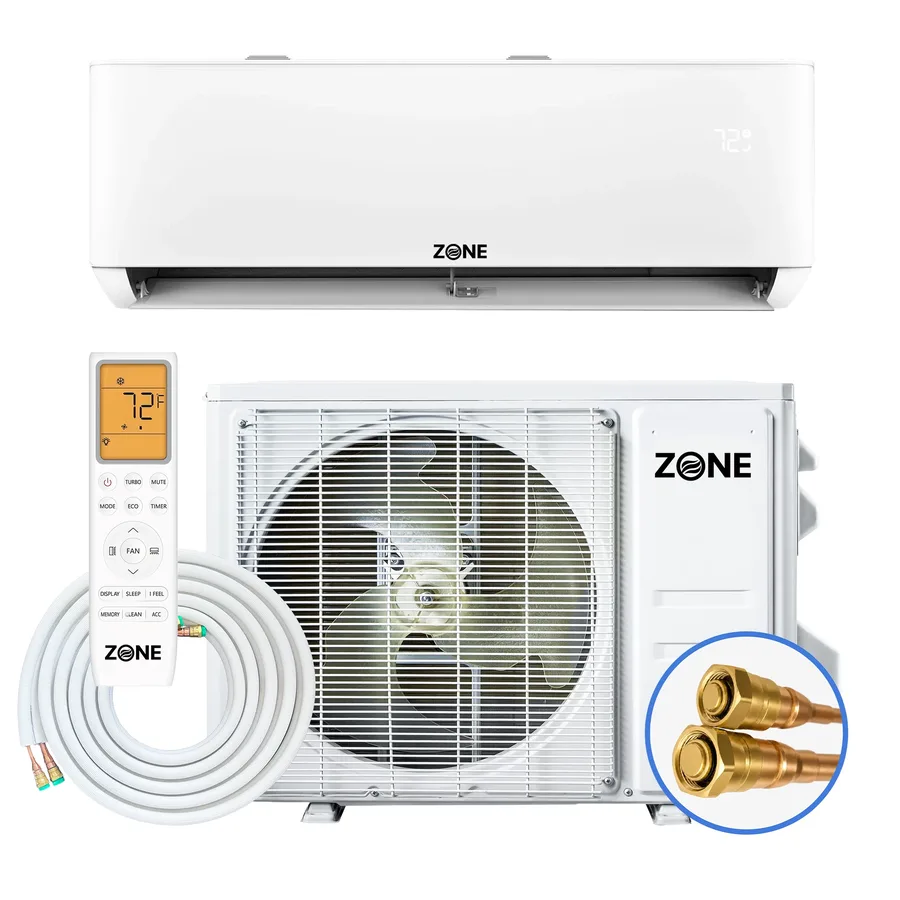
After looking at the current market, Zone Air stands out as our top 115V DIY mini split pick for 2026, offering both a 9,000 BTU and a 12,000 BTU single zone model built for homeowner installation.
These two models might be worth a look:
- Both the Zone Air 9K and 12K deliver 23 SEER2 cooling efficiency, run on standard 115V household power (110–120V), and ship with a factory pre-charged quick-connect line set, so there's no vacuum pump, no brazing and no refrigerant handling in the install.
- For rooms of about 250–450 sq ft, the 9,000 BTU model works, while the 12,000 BTU model covers about 350–600 sq ft, depending on insulation, climate and cooling load.
- As of October 2026, Zone Air's list price is $1,899.99 for the 9K and $1,999.99 for the 12K, and each one includes a 16 ft line set that comes pre-charged from the factory.
- For context, MRCOOL's DIY 5th Gen 12K 115V was about $2,359 at Home Depot in September 2026, about $360 more than the Zone Air 12K.
This article has reviews and specs for 115V DIY mini split systems for homeowners who prefer to skip all of the 230V electrical work.
What Is a 115V DIY Mini Split?
What is a 115V mini split heat pump? It can be described as an inverter-driven, ductless single zone system. So what does it pair? An outdoor condenser with an indoor wall mount air handler, and they are connected by a refrigerant line set and communication wire. There's no ductwork involved, just a small hole through the wall.
What makes it "DIY"? The system comes with a line set that is pre-charged and has sealed quick-connect fittings. You won't be brazing copper, you won't be pulling a vacuum. You won't be handling refrigerant gauges. Follow the instructions, tighten the fittings to torque spec. The system is ready to run.
115V systems hard-wire to a dedicated 15A circuit, or on some models plug into a dedicated outlet with a cord kit. That's the same household voltage you already have in every room. Unlike 18,000 BTU and larger units, which need 208–230V service, these models avoid a 230V line and usually avoid a panel upgrade too. However, a 115V mini split still needs its own dedicated breaker. You can't share the circuit with other appliances.
Ideal use cases include:
- Bedrooms and home offices
- Finished basements and bonus rooms
- Garages and workshops
- Small apartments and small shops
- Any space where running a 230V line would cost too much money
For most single rooms in North America, 9,000 and 12,000 BTU single zone units hit the sweet spot.
Zone Air 9,000 BTU 115V DIY Mini Split Review
For spaces up to about 450 sq ft, the Zone Air 9K 115V is our recommended 9,000 BTU system. As a general rule, 9,000 BTU units work for spaces up to about 400 square feet, and Zone Air has its 9K rated for 250–450 sq ft, with the top of that range meant for well-insulated rooms.
| Spec | Zone Air 9K 115V |
|---|---|
| Cooling Efficiency | 23.0 SEER2 |
| Heating Efficiency | 10.0 HSPF2 (Region IV) |
| Heating Floor | −13°F |
| Max Outdoor Cooling Temp | 131°F |
| Indoor Noise (Mute) | 30 dB(A) |
| Voltage / Breaker | 115V, 15A dedicated |
| Included Line Set | 16 ft, pre-charged R-454B |
| Price (October 2026) | $1,899.99 |
Specs from the Zone Air 9K product page.
With five fan speeds (turbo, high, medium, low and mute), sleep mode, a dehumidification ("dry") mode, dual-axis motorized air deflectors, a memory function that brings back your favorite settings, and an included wireless remote, the indoor unit has plenty of options. Wi-Fi app control comes standard.
Electrical setup is simple: the power is 115V, 60 Hz, single-phase on a dedicated 15A circuit, with power connecting outdoors at the condenser. An optional plug-in cord kit lets you connect to a dedicated GFCI outlet where local code lets you do a plug-in install (never an extension cord), or you can hard-wire through a standard disconnect. MRCOOL's 115V 9K and 12K are hardwired, per MRCOOL's catalog.
At $1,899.99, the 9K sits well under the roughly $2,359 that MRCOOL's 12K 115V listed for at Home Depot in September 2026. MRCOOL's 9K 115V rates slightly higher on efficiency (23.6 SEER2 against Zone Air's 23.0), so the Zone Air case at this size is price and features rather than efficiency. You can think of it as the right fit for a 12×20 bedroom, a studio apartment or a home office where you want precise temperature control without central air.
Zone Air 12,000 BTU 115V DIY Mini Split Review
For homeowners who need more capacity, up to about 600 sq ft, while staying on standard 115V power, the Zone Air 12K 115V is the step-up model. MRCOOL rates its DIY 12K for 550 sq ft. Zone Air's rated coverage is a little bit higher.
It matches the 9K's efficiency at 23 SEER2, with 12,000 BTU of rated cooling, 12,400 BTU of rated heating, and cold-climate operation down to −13°F, per the 12K product page. It has the same 115V power requirement and DIY quick-connect design, so moving up from 9K to 12K doesn't mean you have to rewire your panel.
Comfort features include:
- Quiet operation down to 30 dB(A) in mute mode
- Dual-axis motorized air deflectors (up-down and left-right)
- Turbo mode is there for rapid cool-down or heat-up
- Eco mode and an on/off timer for day/night schedules
At 23 SEER2, this unit is a lot more efficient than older 115V units in the 17–19 SEER2 range. Over 10–15 years of use in a hot climate, those savings can add up.
The price for Zone Air is $1,999.99, and that includes the 16 ft pre-charged line set. The extra $100 over the 9K pays off in larger rooms, faster pull-down times and fewer hot spots during peak summer.
Who should pick 12K over 9K? If your room exceeds 400 sq ft, has high ceilings, large windows with sun exposure, or sits in a hot or very cold climate zone, the 12,000 BTU model gives you the extra capacity to stay comfortable year-round.
Zone Air vs. MRCOOL DIY 115V (9K & 12K BTU) in 2026
MRCOOL's DIY 5th Gen line and Zone Air are the two pre-charged quick-connect systems most 115V buyers end up comparing. Here's how they line up spec by spec.
Efficiency: MRCOOL's DIY 5th Gen rates 23.6 SEER2 on its 9K 115V and 23.5 SEER2 on its 12K 115V, per MRCOOL's catalog. Zone Air's 9K and 12K 115V units both rate 23.0 SEER2. Both are above MRCOOL's previous 4th Gen 12K (22.5 SEER2). At 115V the gap is narrow and slightly in MRCOOL's favor. If you can run 230V, Zone Air's 230V 9K and 12K reach 24 SEER2, which makes them the highest-efficiency pre-charged quick-connect DIY systems of the brands compared here (MRCOOL's best single-zone is 23.6).
Refrigerant: Both brands' current units are using R-454B. R-454B carries a much lower global warming potential than the R-410A in older stock, which is why new equipment is moving to it.
Pricing comparison (as of fall 2026):
| Model | Zone Air | MRCOOL DIY 5th Gen |
|---|---|---|
| 12K 115V | $1,999.99 (Oct 2026) | ~$2,359 at Home Depot (Sep 2026) |
| 9K 115V | $1,899.99 (Oct 2026) | check current retailer pricing |
Zone Air prices come from zone-air.com product pages. Retail prices change often, so check both before buying.
Spec comparison: Here's how they compare, using Zone Air's published specs and MRCOOL's 2026 catalog:
| Spec | Zone Air 9K 115V | Zone Air 12K 115V | MRCOOL DIY 5th Gen 12K 115V |
|---|---|---|---|
| Cooling BTU | 9,000 | 12,000 | 12,000 |
| Heating BTU | 9,400 | 12,400 | 12,000 |
| SEER2 | 23.0 | 23.0 | 23.5 |
| EER2 | 13.0 | 13.0 | 12.5 |
| HSPF2 (Region IV) | 10.0 | 10.0 | 10.2 |
| Min. outdoor heating temp | −13°F | −13°F | −13°F |
| Max. outdoor cooling temp | 131°F | 131°F | 122°F |
| Electrical | Dedicated 15A circuit, optional plug-in cord kit | Dedicated 15A circuit, optional plug-in cord kit | Hardwired, 18A MCA / 20A max fuse |
| Refrigerant | R-454B | R-454B | R-454B |
| Line set included | 16 ft pre-charged | 16 ft pre-charged | 25 ft pre-charged |
Zone Air figures are from the 9K and 12K product pages and spec sheets. MRCOOL figures are from the DIY single zone page of its 2026 catalog, and the 122°F cooling limit from its 5th Gen manual.
Electrical: Both brands' 18,000 BTU single-zone units need 208–230V. At 115V, both sell 9K and 12K models on a 15A circuit. The difference is that Zone Air's can plug in with the optional cord kit where code lets you, while MRCOOL's 115V units are wired to a branch circuit.
Installation: MRCOOL uses its patented quick-connect line sets. Zone Air uses its own factory pre-charged quick-connect system. Both avoid on-site vacuuming, flaring and brazing when installed as directed.
Line sets: As of October 2026, and of the brands compared here, Zone Air is the only one that cuts your pre-charged line set to the exact length you measure, any whole foot from 5 to 75, where MRCOOL sends fixed 11.5, 16, 25, 35 and 50 ft sets plus couplers and has you coil the excess (see the line set pages of MRCOOL's catalog).
Cooling in heat waves: Zone Air is rated to cool in outdoor temperatures up to 131°F. MRCOOL publishes 122°F.
Zone Air is a strong choice for homeowners who want 115V, a plug-in option, cold-climate heating, custom line set lengths and a lower price than MRCOOL's similar 115V DIY units as of fall 2026.
Planning Your 115V DIY Mini Split Project
Before you change anything in your home or start ordering, careful planning of room size, electrical capacity and where the line set will run will make or break your project.
- Sizing: Match BTU capacity to your room. A 9,000 BTU unit covers up to roughly 450 sq ft. A 12,000 BTU system covers spaces up to 600 sq ft. Factor in insulation quality, ceiling height and window exposure.
- Power: Mini split systems need to have a dedicated 110V or 115V circuit. You'll want to confirm that your chosen Zone Air model draws 15A or less. You'll want to check that you have a free breaker slot in your panel. No extension cords - ever.
- Clearance: Indoor air handlers need to have about 6 to 8 inches of clearance from the ceiling for the best airflow. Outdoor condensers need a minimum of 12 inches of clearance around them for airflow. They need to be on a level pad or bracket.
- Line set path: You need to measure the path between the indoor and outdoor units, then pick the right length from what Zone Air offers. You can't cut pre charged line sets on the site, so it pays to measure twice.
- Codes and permits: Check local building codes before beginning installation to ensure compliance with regulations. Mini split installations must comply with national electrical codes and local regulations. Local municipalities may require a mechanical or electrical permit for DIY HVAC installations. Electrical work should be performed by a qualified electrician if the installer is not trained.
True DIY Quick-Connect Installation (No Vacuum Pump)
Built for competent homeowners, Zone Air's 115V DIY systems have the refrigerant sealed in the factory-charged line set and it never opens to atmosphere, so there is no vacuum pump and no gauge set in the install.
Basic install sequence:
- Mount the indoor air handler on the included wall bracket
- Drill the wall penetration with a 3 in hole saw
- Route the line set, communication wire and drain hose through the wall
- Place the outdoor condenser on a pad or wall-mounted bracket
- Make the quick-connect fittings at both ends and tighten to spec
Tools usually needed: drill, 3 in hole saw, level, wrenches, a torque wrench and basic electrical tools. You will not need refrigerant gauges, a vacuum pump, a flaring tool or a brazing torch. Per Zone Air's FAQ, a first-time single-zone wall install takes two people about 4–6 hours.
Code considerations: Install on a 115V dedicated 15A circuit with an outdoor disconnect, and follow local electrical and mechanical codes. Installing it yourself does not void Zone Air's 5-year parts and 7-year compressor warranty when you follow the manual.
Compared to a traditional mini split install, where a licensed HVAC technician vacuums and charges the system, skipping professional installation labor is where most of the DIY savings come from.
Step-by-Step 115V DIY Mini Split Installation
This is a high-level overview for Zone Air–style 115V systems that come with line sets that are already charged with refrigerant. Always follow the specific instructions in your Zone Air manual - DIY systems must adhere to manufacturer installation guidelines to keep your warranty good.
- Mount the indoor bracket: Secure it to the wall studs, make sure it's level and put it at the right height with enough room between it and the ceiling. This is where good time spent with a level pays off.
- Drill the wall penetration: The size is in the manual. Put a sleeve in the hole so you don't damage the lines and the wiring. You'll want to seal it after you run the lines through to prevent moisture intrusion.
- Mount the outdoor condenser: Place the outdoor condenser on a surface that is stable and level, with enough clearance on all sides.
- Route the pre charged line set: Uncoil the line set carefully so you don't kink anything, and keep to the minimum bend size that the manufacturer gives you. Run the liquid line and the vapor line together with the communication cable and the condensate drain line.
- Connect quick-connect fittings: Tighten the quick-connect fittings to the torque that the manufacturer gives you, holding the body of the fitting still while you turn the nut. The internal valves only open once you hit full torque. That's when the refrigerant releases into the system.
- Electrical wiring: Connect the power supply to the outdoor unit on a dedicated 15A circuit, then hook up the communication wires between the indoor and outdoor units so they match the specified terminals. Check the plus/minus and the ground while you're at it.
- Final checks: Use soap and water to look for leaks around the refrigerant connections. Make sure the condensate drain slopes toward the outside so it drains right. Check that the line sets are supported and insulated, and that the outdoor unit is still level.
Testing Your New 115V Mini Split
Once everything is connected and sealed, power up the system. A Zone Air unit that has been installed correctly should respond within a few minutes. You can install a DIY mini split system without specialized HVAC training when you follow the manual.
- Initial test: The unit can be set to cooling. The indoor head should blow cold air, and both the outdoor fan and the compressor should engage. After a few minutes have gone by, the suction line (that's the larger tube) should feel cool. Switch it to heat mode so you can confirm it heats too.
- Noise and drainage: The indoor sound should be about 30 dB in quiet mode. If you hear vibration, check that both units are mounted securely. Also confirm the condensate drains to the outside properly.
- Smart controls: You can pair your Zone Air unit with the app during setup. You can use ECO mode, sleep mode and timer features to manage energy use throughout the day.
- Ongoing maintenance: Clean or replace the filters every 30–60 days. Gently clean the indoor coil and the outdoor condenser fins one time each year. Check the insulation on the line set and the connections for wear or leaks each season.
- Long-term value: A Zone Air 115V DIY mini split that is installed the right way gives you efficient, quiet heating and cooling for many years. At 23 SEER2 it's inexpensive to run. You can visit zone-air.com for model-specific manuals, live technical support, and replacement line sets to keep your system running at its best.
Lineset, Communication Wire & Custom Length Options
A line set is a pair of insulated copper refrigerant lines that connect the indoor unit to the outdoor condenser. Its length and quality directly affect system performance and installation flexibility.
With both 9K and 12K 115V DIY kits, Zone Air includes a 16 ft pre-charged line set and matching communication wire. That length handles most standard wall-to-ground runs where the condenser sits directly below or next to the air handler.
Need more length? Zone Air sells standard 25, 33, 50 and 75 ft pre-charged sets, and custom cuts at any whole foot from 5 to 75. Each one is a single factory-sealed run with no field joint, where MRCOOL joins two sets with a coupler to go beyond 50 ft. MRCOOL's DIY line lets you go up to 75 ft per indoor unit, per its installation manual.
The communication wire is packaged together and pre-matched, with clear labels on both the indoor air handler and outdoor unit terminals. Over-long line sets can reduce capacity and efficiency, so always follow the spec sheet for line length and elevation limits (Zone Air's FAQ lists a 33 ft vertical lift limit on the 9K and 12K).
For a cleaner look, accessories like line-set covers, wall sleeves and condensate pumps can be added to any install.
Heating to −13°F and Quiet Operation
Both the 9,000 and 12,000 BTU Zone Air 115V systems are true heat pumps, providing both cooling and heating in one single zone unit. They aren't summer-only air conditioners.
Both models are rated for heating down to −13°F, the same floor as MRCOOL's standard DIY 5th Gen, which its manual lists at −13°F to 75°F in heat mode. Higher-tier DIY models are rated lower. That can make them viable as a primary or backup heat source across much of the U.S. and Canada during winter months. That said, a heat pump's output drops as outdoor temperature falls, so homes in extreme cold may still need supplemental heat on the coldest nights.
Inverter technology can ramp the compressor and fan up and down rather than cycling on and off. This maintains steady room temperature, reduces energy waste and keeps the system quieter during partial-load operation.
Speaking of quiet: Zone Air's indoor unit runs at 30 dB(A) in mute mode, about the level of a whisper, which suits a bedroom or home office. The outdoor condenser is rated at 52 dB(A), about the volume of a refrigerator hum.
Additional comfort features include auto-restart after a power outage, an IFEEL sensor that reads the temperature at the remote, dry (dehumidification) mode, sleep mode and an on/off timer. Because these are single zone units, room-by-room comfort is very precise compared to multi-zone systems where one condenser serves multiple air handlers.
115V Heat Pumps in Extreme Cold
In this context, "cold climates" means ASHRAE climate Zones 5–7 with winter design temperatures around 0°F to −10°F. You might think of Minneapolis, Denver or upstate New York.
Inverter-driven heat pumps keep heating output as outdoor temperatures drop, but available BTUs decrease as conditions get colder. Zone Air's −13°F minimum operating temperature tells you the system won't shut off at that point - but it doesn't mean you'll get full rated output. At 47°F, the published COP sits at 3.81. At 5°F, it drops to 2.1. That's still far more efficient than electric resistance heat (COP of 1.0), but you should size accordingly.
Key heating performance ratings that matter for cold weather:
- HSPF2: Zone Air 12K gets 10.0 in Region IV. MRCOOL 12K gets 10.2. Both show high efficiency seasonal heating.
- COP at 5°F: 2.1 for Zone Air, meaning you get about 2.1 watts of heat per watt of electricity consumed.
- Low temperature capacity: how much capacity the system actually delivers at extreme cold, not just whether it runs.
Consider two scenarios: a Zone Air 12K 115V in a well-insulated 400 sq ft room in Minneapolis will maintain comfort through most winter nights (design temp around −10°F) but may struggle during extended −20°F polar vortex events. The same system in Portland, where design temps rarely dip below 20°F, will handle winter heating as a primary heat source with ease.
MRCOOL's DIY Hyper Heat 12K and 18K are rated to −22°F, but those are 208/230V systems, so they don't fit a 115V-only install. For homeowners who don't need to heat an entire home and want diy savings, the 115V category covers the vast majority of single-room cold climate applications. Backup heat (baseboard or space heater) is a sensible safety net for the handful of nights per year when conditions exceed the system's low temperature capacity.
Defrost cycles in winter
Every air-source heat pump, whether it is 115V or 230V, has to defrost itself when the weather is cold and damp. Below about 40°F the outdoor coil is running colder than the air around it, so frost builds up on it and blocks airflow. When the unit feels that happening, it switches into a defrost cycle for a few minutes: the compressor runs the cycle in reverse to warm the outdoor coil, the indoor fan slows down or stops so it doesn't blow cold air at you, and you may see steam rise off the outdoor unit and water drip from its base. That is normal. The things that matter for a DIY install are giving that water somewhere to go, so set the condenser on a stand or bracket a few inches above where snow and ice pile up, keep a clear path around it, and never let the drain-off freeze into a block under the unit. A heat pump that uses a lot of time defrosting in a wet, near-freezing climate will put out less heat over a day than its rating suggests. You might want to size with some extra room in a cold climate.
23 SEER2 and AHRI Certification
Both Zone Air 9K and 12K 115V DIY units deliver 23 SEER2, placing them at the upper end of 115V mini split efficiency in 2026. Some mini splits rate higher, but the difference between 23.0 and 23.6 can mean small real-world savings.
What is SEER2? It's a seasonal efficiency rating that is tested under more realistic conditions than the old SEER standard. Higher numbers mean lower annual electricity costs for the same cooling output.
Older 115V systems in the 17–19 SEER2 range use a lot more energy for the same BTU output. A rough comparison: a 12,000 BTU system running 1,000 cooling hours a year uses about 520 kWh at 23 SEER2 versus about 690 kWh at 17.5 SEER2. At 17 cents per kWh that's about $28 a year, and two or three times that in a long, hot cooling season.
Zone Air's 115V units are AHRI Certified. Rebate rules vary by utility, so check the specific model number against your utility's qualifying list before buying, or check Zone Air's rebate calculator.
On the refrigerant side, both brands' current units use R-454B, which carries a lower global warming potential than R-410A. Zone Air uses R-454B across its 115V lineup, in line with EPA limits on higher-GWP refrigerants.
Controls, Smart Home Integration & Everyday Use
Both Zone Air 115V DIY units come with multiple control options: a handheld IR remote, a display on the indoor unit, and Wi-Fi for app and voice control.
Smart features included out of the box, per Zone Air's FAQ:
- Wi-Fi app control: adjust temperature, switch modes and set schedules from anywhere
- Geofencing, so the system can respond when you leave or head home
- Voice control via Amazon Alexa and Google Home
- An IR remote with a 7-day schedule that works even without Wi-Fi
Smart scheduling can further reduce energy use. You can pre-cool your room before you arrive home or set eco mode at night. The communication wire and control logic are pre-integrated between the air handler and condenser, so there's no need to shop for third-party thermostats or controllers that only work with one brand.
Day-to-day, you can set your preferred temperature in the app or on the remote and forget about it. The system handles the rest through inverter speed changes. The filters are washable. Check them every few weeks, depending on air quality and usage.
Warranty, Reliability & Long-Term Ownership
Zone Air's warranty for its 115V DIY mini split systems covers 5 years on parts, 7 years on the compressor and 1 year on the remote, with no registration cut-off and installing it yourself does not void it when you follow the manual and local codes. MRCOOL's DIY 5th Gen carries the same 5-year parts and 7-year compressor terms with no registration needed.
Registering your unit online is recommended so your proof of purchase is on file, but coverage doesn't depend on it. Uninstalled units can be returned within 30 days of delivery.
For long-term reliability, focus on:
- You can clean the washable filter every 2–4 weeks
- Keeping the outdoor condenser coil clear of debris, leaves and snow
- Inspecting the line set insulation and communication wire annually
- You can run the unit periodically in winter to keep components active
Zone Air sells direct at zone-air.com (and through distributors and Amazon), with live technical support 8 AM–6 PM MT from the people who built it, an install video library and a written DIY manual. The units have final assembly, testing and inspection in the USA from globally-sourced components. If the self-diagnostic display shows an error code you can't resolve, support can tell you whether it's time to call an HVAC tech or electrician.
How to Choose Between 9,000 BTU, 12,000 BTU and Larger 18,000 BTU Systems
Sizing is critical. A right-sized system runs longer, quieter and more efficiently than an oversized or too-small unit. 9,000 BTU units draw less amperage than 12,000 BTU units, which can matter if your electrical panel is tight on capacity.
Basic sizing guidelines:
| BTU | Approx. Coverage | Typical Voltage |
|---|---|---|
| 9,000 | 250–450 sq ft | 115V |
| 12,000 | 350–600 sq ft | 115V |
| 18,000 | 600–900 sq ft | 208–230V |
An 18K BTU DIY unit covers 800–900 sq ft but needs 208–230V service, not standard household power. Zone Air's 115V DIY lineup is the 9K and 12K single zone models, going after the most common room sizes on standard circuits. Its 18K is 230V only. Our mini split sizing calculator is a quick starting point: enter your room size, insulation and climate and it tells you whether a 9K or a 12K fits.
Beyond raw square footage, consider ceiling height, sun exposure, number of occupants and existing insulation. For borderline or complex cases, a professional Manual J load calculation is worth the small investment.
For most single rooms on 115V, the decision comes down to Zone Air's 9K vs. 12K. If you're conditioning two or three rooms, a multi-zone system on 230V makes more sense: Zone Air is the only DIY mini split that lets you mix wall-mount, ceiling cassette and concealed ducted units on one outdoor unit (as of October 2026).
Where to Buy 115V DIY Mini Split Kits
In 2026, you can buy 115V DIY mini splits through online HVAC retailers, big-box stores and Amazon. Zone Air sells direct at zone-air.com, with free shipping to the lower 48, as well as through distributors and Amazon. Easy installation starts with buying the right kit, so confirm it's truly a pre-charged DIY system before you pay.
What should be in the box:
- Indoor air handler and outdoor condenser
- Pre-charged line set with quick-connect fittings
- Communication wire (pre-matched)
- Wall bracket, drain hose and tape
- Wireless remote
- Installation hardware and full manual
Before you shop, review the product spec sheets (Zone Air puts out a one-page spec sheet for every unit) to verify 115V voltage, breaker size, line set length limits and operating temperature range. Check warranty terms, return policies and shipping damage procedures. Take photos during unboxing. It's the easiest way to document any transit damage for a claim (Zone Air asks for shipping damage to be reported within 48 hours).
Availability and stock can vary by seller, so verify shipping timelines before you order. You should read reviews from buyers who actually bought the product, not just marketing copy.
For homeowners comparing 115V DIY mini splits in 2026, Zone Air's 9K and 12K 115V DIY systems combine 23 SEER2 performance, −13°F heating, smart controls, a plug-in option and custom-cut line sets at $1,899.99 and $1,999.99 (October 2026). They deliver professional-grade comfort without the professional price tag.
115V DIY Mini Split FAQ
Can a 115V DIY mini split plug into an outlet?
Not a shared one. Zone Air's 9K and 12K can plug into a dedicated 15A GFCI outlet with the optional cord kit where local code allows it, never through an extension cord. Otherwise you hard-wire it to a dedicated 15A circuit. Power connects at the outdoor unit either way.
How big a room can a 115V mini split heat and cool?
Zone Air rates its 9K for about 250–450 sq ft and its 12K for about 350–600 sq ft. Ceiling height, sun and insulation move those numbers, so run your room through the sizing calculator before you pick one.
Is a 115V mini split less efficient than a 230V one?
Slightly, at least with Zone Air. Its 115V 9K and 12K are 23 SEER2, while the 230V 9K and 12K are 24 SEER2. MRCOOL's 115V 9K and 12K rate 23.6 and 23.5.
Will a 115V mini split heat in winter?
Yes. Zone Air's 115V units are rated to heat down to −13°F, but output drops as it gets colder, so plan on backup heat if you regularly see temperatures below that.
Do I need a vacuum pump to install one?
Not with a pre-charged quick-connect system. You tighten the fittings to torque spec with wrenches and a torque wrench; there's no vacuum pump, gauge set or brazing.
How long can the line set be?
Zone Air includes a 16 ft set and sells 25, 33, 50 and 75 ft pre-charged sets, or a custom cut at any whole foot from 5 to 75. On the 9K and 12K the indoor and outdoor units can be up to 33 ft apart vertically.
Are 115V DIY mini splits worth it financially?
Yes, in most cases. A DIY install saves you the contractor's labor and the refrigerant tooling. However, complex projects (long line runs, difficult electrical work or rooftop condenser placement) can erode those diy savings.
When should I choose 230V or call a contractor instead?
If you need to condition more than ~600 sq ft, require multi-zone coverage or live where winter design temps regularly hit −20°F or colder, a 230V system or multi-zone heat pump makes more sense. For single-room applications in 2026, Zone Air's 115V lineup is our top DIY mini split choice.
What refrigerant do these systems use?
Zone Air and current MRCOOL DIY units both use R-454B in 2026. It has a lower global warming potential than the older R-410A, which now only turns up in stock being closed out.
Related guides
- Best 120V DIY mini split
- Best mini split for a bedroom
- Best mini split for a garage
- What is SEER2?
- Best DIY mini split warranty
Zone Air specifications and prices are taken from Zone Air's product pages, spec sheets, FAQ and policy pages as of October 20, 2026. MRCOOL specifications, electrical requirements, line set lengths, operating ranges and warranty terms are taken from MRCOOL's own published catalog, installation manual and warranty linked above, and the Home Depot price is as seen in September 2026; all are subject to change, so verify before purchase. MRCOOL® is a trademark of its owner. This site is owned and operated by Zone Air and is not affiliated with or endorsed by MRCOOL.