This site is owned and operated by Zone Air.
This site is owned and operated by Zone Air.
Articles · Buying Guide · Nov 2026
Zone Air, MRCOOL DIY 5th Gen and Klimaire compared on install, line sets, efficiency, cold-climate heating and warranty.
Our best 3 zone DIY mini split reviews for 2026 put Zone Air's 3-zone system first: 24 SEER2 with wall heads, wall, cassette and concealed ducted units mixed on one outdoor unit, and pre-charged line sets cut to the length you measure. MRCOOL DIY 5th Gen and Klimaire DIY multi zone are the two systems most often compared with it, and this guide covers all three on install, line sets, efficiency, cold-climate heating and warranty.
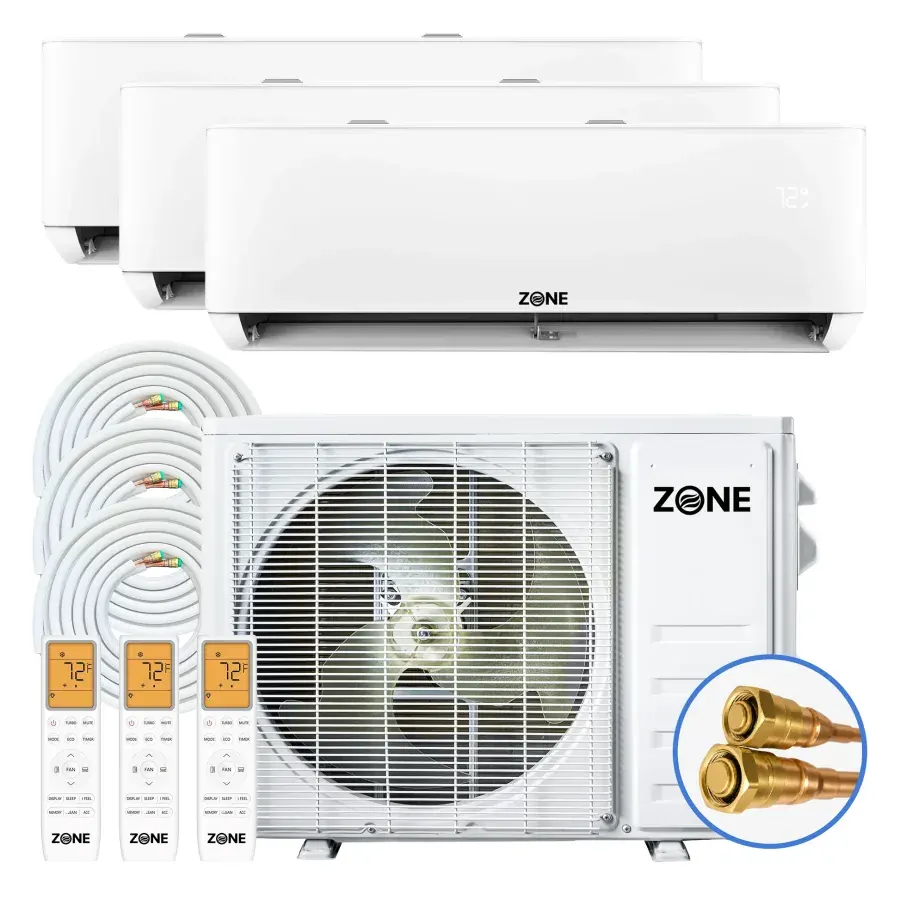
All three use R-454B refrigerant. A typical 3-zone setup uses one 27,000 BTU class outdoor unit with three indoor heads of 9,000 to 18,000 BTU.
One outdoor unit (compressor and inverter) can send refrigerant to three indoor units through separate line sets and communication wires. Each indoor head has its own controls, so one zone can cool the living room while another heats a chilly bedroom and a third keeps a home office at a moderate setting, within the limits of the shared outdoor unit.
Instead of cycling on and off, the inverter compressor changes speed to match the load, which keeps it efficient and quiet. Because there's no ductwork, there are no duct losses and fixing up existing homes can be much simpler. DIY systems that come pre-charged ship their line sets sealed at the factory, so you never have to handle refrigerant yourself.
If you want to do the refrigerant side of the install yourself, Zone Air built its multi-zone systems so you can skip the technician for brazing, vacuuming or charging.
| Zone Air 3-Zone | MRCOOL DIY 5th Gen 3-Zone | Klimaire DIY 3-Zone | |
|---|---|---|---|
| Connection | Pre-charged quick connect | Pre-charged quick connect | Pre-charged, flare |
| Indoor styles on one outdoor unit | Wall, 4-way cassette, concealed ducted | Wall, OuttaSight cassette | Wall, cassette, floor-ceiling |
| Line sets | Cut to any whole foot, 5–75 ft | 11.5–50 ft fixed + couplers | Pre-flared, model dependent |
| SEER2 | 24 (wall heads) | 23.9 (18K) / 23 (27K) | Up to ~23.1 |
| HSPF2 | 10.5 (wall heads) | 10 (18K) / 9 (27K) | ~9.8–10.6 |
| Heating floor | −13°F | −13°F | Around 5°F to −13°F |
| Warranty (parts / compressor) | 5 / 7, no registration | 5 / 7, no registration | 3 parts unregistered, up to 5 registered |
Indoor units: MRCOOL's 3-zone kits usually run on the 18,000 BTU condenser (up to 3 zones) or the 27,000 BTU condenser (up to 4 zones). Its OuttaSight is a cassette that is 50 inches and has a single slot. It blows air one way. Zone Air's ceiling cassette has a chassis that is 22 inches square. It sends air four ways so it can sit in the middle of a room. Klimaire's KMIR series has multi-zone condensers with 27,000 and 36,000 BTU, and the outdoor coil has a coating of gold fin.
Smart control: Zone Air lists app control with Alexa and Google voice on its FAQ. MRCOOL's 5th Gen uses a Wi-Fi dongle that you plug in, so you can control it with the app.
Zone Air: line sets ship factory-charged and sealed. The quick-connect fittings tighten with a standard wrench. Because the refrigerant never opens to the air, there's no vacuum pump, no gauge set and no EPA 608 certification needed. Zone Air's FAQ says a wall-mount head takes 4 to 6 hours for two people doing it the first time.
MRCOOL DIY 5th Gen: MRCOOL's catalog says "no special tools or training are necessary to install". Its multi-zone manual allows up to 75 ft per indoor unit (two sets joined with a coupler past 50 ft) and 33 ft of height between indoor and outdoor units, and extra line gets coiled behind the condenser.
Klimaire: the line sets arrive pre-flared, but some models need careful torqueing, a nitrogen purge and a leak check. That's easier than a traditional system but not as plug-and-play as quick connect. Branch runs reach about 82–98 ft on larger heads, with about 49 ft of height difference.
Every 3-zone install needs:
You'll want to plan line set paths before you drill. If you go past the listed distances on any brand, it cuts performance and can keep oil from returning to the compressor.
Efficiency: Zone Air's 24 SEER2 with wall heads is the highest of the three. MRCOOL's 18K condenser has a rating of 23.9, while its 27K condenser and Klimaire are both at about 23. Pioneer's Quantum Hyperformance line has a rating of 25 SEER2 and Mitsubishi's top units have a rating of 33.1, but both use flare line sets that need a vacuum pump or a licensed installer, so they aren't true DIY.
Cold climate: Zone Air's 3-zone and MRCOOL's DIY multi-zone condensers from 18K through 48K are both rated to heat down to −13°F. MRCOOL's Hyper Heat line is single-zone only. Klimaire's multi-zone models are able to heat to around 5°F to −13°F depending on the model, with output dropping a lot at the low end. If you get regular sub-zero winters, you'll want to pick a condenser rated to −13°F or lower and keep backup heat for the coldest nights.
Cost: Zone Air's 3-zone wall-mount system is $3,809.99 ($3,509.99 in the Black Friday sale through November 27, 2026), with one pre-charged line set per zone that you can get cut to any length from 5 to 75 ft. The 3-zone ceiling cassette system is $4,609.99 and the 3-zone concealed ducted system is $4,209.99. The price of MRCOOL 3-zone kits depends on which condenser you pick, what head sizes you need, and how long the line sets are. Klimaire's equipment starts a bit lower. You should add $200–$500 for an electrician to run the circuit. That total is still well under the $4,500–$9,000 that a pro install of a similar three-zone system often costs you just for labor.
Incentives: the federal 25C tax credit has ended for equipment placed in service after December 31, 2025. There may still be utility rebates that you can get, so it's worth checking what local programs are available.
Zone Air's warranty is 5 years on parts and 7 on the compressor, with no registration deadline and DIY installation doesn't void it. MRCOOL's DIY 5th Gen has the same 5/7 terms with no registration required, and it stays valid with DIY installation when you follow the manual and local codes. Both are parts-only (no labor or refrigerant).
Klimaire has a warranty that allows DIY installation, but you get 3 years on parts unless you register, up to 5 years registered. You have to show proof of maintenance. Mitsubishi has 10 years on the compressor, but you need certified dealer installation to keep it.
For a system that is expected to last 10–15 years, a 5/7 warranty that covers DIY installation with no registration step is the one that carries the least risk.
With the calculator and Zone Air's 3-zone builder, you can figure out your BTU needs first, then pick the indoor unit that fits each room.
Zone Air and MRCOOL DIY both use line sets that come pre-charged with quick-connect fittings, so you can handle the refrigerant side of the install if you're handy with home projects. Klimaire's flare connections take more work. You will probably still need to get a licensed electrician to help with the electrical part.
Yes. If the home is well-insulated and up to about 1,800 sq ft, three well-placed indoor units can cover it all, going by Zone Air's own coverage ratings. Larger homes or ones that aren't well insulated may need more zones or a separate system.
With Zone Air, you get a 5-year warranty on parts and a 7-year warranty on the compressor, and it covers homeowner installation with no deadline to register. MRCOOL DIY 5th Gen also keeps its 5/7 warranty with homeowner installation. Klimaire has to have registration for the full terms. Either way, you'll want to keep your proof of purchase.
Wall units are visible on the wall, the outdoor unit needs a spot you have planned out ahead of time, and running the line sets through walls and ceilings takes time and care. A multi-zone system also has more wiring to deal with than a setup with a single zone.
