A 12,000 BTU mini split hits the sweet spot for heating and cooling a single room-but only when the load calculation actually calls for 12k. This guide breaks down seven distinct models worth considering in 2026, explains what separates them, and shows you how to confirm that a 12k head is the right fit before you spend a dime.
12,000 BTU Mini Split
What Is a 12,000 BTU Mini Split?
A 12,000 BTU/h mini split is a 1-ton ductless heat pump that puts out about 12,000 British Thermal Units per hour of cooling and about the same amount of heating under standard conditions. Most of them have an outdoor unit and an indoor unit, hooked together with a small refrigerant lineset and electrical wiring that runs through a small hole in the wall.
You usually use them in bedrooms, finished basements, bonus rooms, garages, small apartments and accessory dwelling units. With a 12,000 BTU system, it fits spaces about 350 to 750 square feet, though that depends a lot on the room itself. They're more efficient than central air, in part because ductwork losses eat up about 30 percent of central air's energy use, and ductless systems don't have that problem.
Rules of thumb for square footage are just a starting point. People often quote 400–550 sq ft for a 12k unit, but that's only a starting point. Real cooling loads can swing 40–60 percent based on climate zone, insulation, window type, sun exposure and ceiling height. A 400 sq ft room in an older house might really need 12,000 BTU while the same room in a modern build might only need 8,000.
This guide covers 12k BTU single-zone wall-mounted mini splits sold in the U.S. It has options for you if you're hiring a pro and options for you if you're doing the install yourself.
Section 02
How We Chose the Best 12,000 BTU Mini Splits
Performance and Efficiency
If the mini split will be your main heat source, cold-weather heating performance matters a lot. They can run efficiently down to 5°F, but not all of them keep the same percentage of rated output. High-efficiency systems get Energy Star certified, and for cold-climate label they have to maintain at least 70 percent capacity and a COP of about 1.75 at 5°F. They use variable-speed motors for better efficiency, and outdoor temperatures and thermostat settings can affect how efficient a given system runs.
Real-World Sizing and Modulation
Minimum capacity matters for comfort. That's how far the compressor can turn down. A unit that can't turn down below 4,000 BTU/h will short-cycle in mild weather, wasting energy and leaving humidity unchecked. Getting the size right and installing it right are crucial for mini split efficiency.
Our calculator matches each room to the smallest head that covers its load: up to 9,000 BTU/h gets a 9k head, up to 12,000 gets a 12k, and up to 18,000 gets an 18k. If the room needs less than 9,000, a 12k unit is oversized and a smaller head will run more comfortably.
Installation, Power and Electrical Needs
Most 12k mini splits run on 208/230V and need a dedicated electrical line and breaker. Some DIY models offer 115V, which can plug into existing circuits in many homes, so the wiring is simpler and you can avoid panel upgrades.
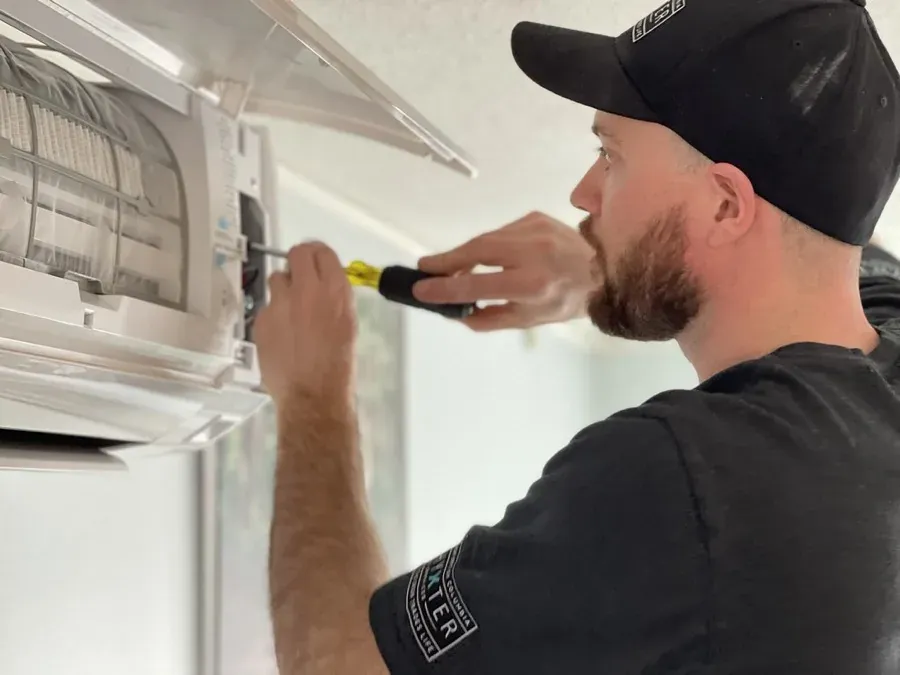
DIY systems ship with pre charged quick-connect linesets and don't need a vacuum pump or brazing. Pro-only models need a licensed tech to flare, vacuum and charge the refrigerant line. Either way, you're drilling through the wall, handling condensate drainage and mounting both the indoor unit and outdoor unit properly.
Reliability, Warranties and Support
Warranty length varies a lot. Premium brands often give you 10–12 years on the compressor if an approved contractor installs it and you register on time. Budget and DIY brands usually land at 5–7 years on the compressor and less on parts.
Service network depth matters too. With thousands of trained contractors, a brand means faster warranty service and easier access to replacement parts. Online-only imports might save money up front but can leave you waiting if something breaks.
Price and Overall Value
A mini split system usually costs $3,000 to $5,000 installed when you count equipment, labor, electrical work and permits. DIY kits drop the equipment cost to about $1,200–$1,800, but you're giving your own time and skill for those savings.
Section 03
Best 12,000 BTU Mini Splits in 2026
1. High-Efficiency Cold-Climate 12k Mini Split
The Mitsubishi Electric Premier MSZ-GX leads this category with SEER2 ratings in the high 20s, HSPF2 above 12 and heating operation down to –13°F. It comes with a 12-year compressor warranty when installed and registered through a Diamond Contractor.
This unit holds well over 100 percent of its rated heating capacity at 5°F, meaning it actually produces more heat at that temperature than its nameplate rating suggests. Indoor noise is in the low 20 dB range, and it turns down widely enough to avoid short cycling in fall and spring seasons.
Why It Stands Out
It can serve as primary heat in cold U.S. climates while staying very efficient for summer cooling. The installer network is among the largest in the industry, and it's widely recommended for "install it once and forget it" projects.
Best For
If you're in the Upper Midwest, New England or mountain states and you want a single 12k unit for year-round comfort. If you value low noise and reliability over the lowest upfront cost.
Key Strengths
-
SEER2 and HSPF2 ratings well above code minimum
-
Maintains high heating capacity at 5°F with integrated low-ambient features
-
Long warranty with approved contractor registration
Possible Limitations
-
Higher equipment and installation costs than basic or DIY units
-
Usually 230V only, which may need electrical panel work in older homes
2. Mainstream 12k Mini Split
Fujitsu's Halcyon wall-mount series is often the default quote from HVAC contractors because of stock levels, training programs and a well-established parts pipeline. Fujitsu mini splits can retain over 70 percent of their heating capacity at 5°F, so they work as supplemental heat in fairly cold regions. The Fujitsu Altair 500 Series pushes cooling efficiency even further, with SEER2 ratings up to 33.7 in its highest-tier configuration.
Why It Stands Out
Ubiquity. You can get bids, parts and warranty service nearly anywhere in the U.S. The balance of cost, energy efficiency and reliability is hard to beat for the money.
Best For
Homeowners who prefer a familiar brand and local service access over getting every last efficiency point. Rooms where the mini split adds to central air in winter rather than replacing it.
Key Strengths
-
There's a broad installer network and strong support infrastructure
-
Efficiency ratings that qualify for many rebates and incentives
-
Decent design options including alternative finishes on pick models
Possible Limitations
-
Heating performance and turndown ratio may lag behind the premium cold-climate pick
-
Some models need buying a separate Wi-Fi module for smart control
3. Design-Forward 12k Mini Split
The LG Artcool Deluxe KNSAL series has a flat-panel design with dark and metallic finish options aimed at living rooms and open-concept spaces. It gets SEER2 ratings between 25.5 and 27, pairing strong cooling with advanced airflow style and quiet operation suited to rooms where the TV is always on.
Why It Stands Out
Appearance. Most indoor units look like white plastic boxes. This one is built to blend with modern interiors while still delivering competitive efficiency and cold-weather capability.
Best For
Living rooms, great rooms and home offices where looks matter. If you plan to tie the system into an existing smart-home setup.
Key Strengths
-
Premium look with multiple color and finish options
-
Quiet operation suitable for TV rooms and offices
-
Robust app control with scheduling, energy-use insights and remote access
Possible Limitations
-
Higher cost than plain-looking models with similar efficiency
-
Installer availability can be concentrated in larger metro areas
4. Budget 12k Mini Split
The Mirage Ventus X series covers sizes from 9,000 to 36,000 BTU, with its 12k model landing at an attractive price point through online retailers and regional sellers. Efficiency is mid-range, better than window units and portable units but below the premium tier. Even in this value category, mini splits give you comfort and efficiency upgrades, and models like the Ventus X include a basic remote and optional Wi-Fi.
Why It Stands Out
It delivers the core mini split experience, inverter-driven and wall mounted and quiet, at a much lower equipment cost. It's popular for garages, workshops and bonus spaces.
Best For
Budget-constrained projects where the alternative is a loud, inefficient window AC. Spaces where long-term looks and ultra-low noise matter less than saving money up front.
Key Strengths
-
Lower equipment cost and frequent sales through online shops
-
Simple controls you can grasp quickly
-
Better energy use and comfort than drop-in window units at similar BTU size
Possible Limitations
-
Shorter parts and compressor warranty than premium brands
-
Less developed contractor network. Some HVAC pros may be hesitant to service an owner-supplied unit from a less familiar company
5. DIY-Friendly 12k BTU Mini Split Kit
MRCOOL's DIY 5th Gen 12k is the most recognized name in DIY mini split kits. It comes with a pre charged quick-connect line set, detailed manuals and online video guides. With a 115V option, the power hookup is easier in many homes. Specs show SEER2 around 23–23.5, HSPF2 near 10 and a heating floor of about –13°F.
Some mini splits are designed for DIY installation, but DIY mini splits still need expertise for proper installation, drilling through exterior walls, running the refrigerant line without kinks, getting proper condensate slope and making safe electrical connections.
Why It Stands Out
No vacuum pump, no brazing, no EPA 608 certification need. In rural areas where mini split contractors are scarce or booked out for months, DIY models can cut weeks off the project timeline.
Best For
Are you an experienced DIY homeowner who's comfortable with tools, drilling and basic electrical work? Detached garages, hobby shops or outbuildings where professional quotes run disproportionately high.
Key Strengths
-
Pre charged linesets and step-by-step guides lower the barrier to entry
-
115V models fit existing circuits, avoiding panel upgrades
-
Package usually includes the line set, communication cable and mounting hardware
Possible Limitations
-
Warranty terms are shorter (7-year compressor, 5-year parts) and may be more restrictive
-
Wrong DIY installation, kinked lines, poor flares or inadequate condensate slope can seriously hurt performance
6. Warm-Climate 12k Cooling-Focused Mini Split
For hot, humid regions, the Gree Sapphire series delivers high SEER2 cooling efficiency and strong dehumidification. It keeps about 98 percent of rated heating at 5°F, but its real strength is keeping rooms cool and dry in high-humidity areas like the Gulf Coast and Florida. Mini splits can hold a temperature of 75°F over 12 hours without the cycling issues that bother older air conditioning systems.
Why It Stands Out
It's optimized for cooling-dominant climates. You're not paying a premium for extreme cold-climate features you'll never use.
Best For
Homes in warm and humid regions where a 12k unit adds to central AC in a problem room, sunrooms, bonus spaces, enclosed patios that overheat compared to the rest of the house.
Key Strengths
-
So how efficient and quiet is the cooling in design temps above 90°F?
-
Strong moisture removal to combat muggy indoor conditions
-
Available in both 115V and 230V variants for retrofit flexibility
Possible Limitations
-
Not a sole heat source in climates with sustained winter cold
-
Warranty and support from other brand tiers may lag behind top-tier names from other company lineups
7. Compact 12k Mini Split for Tight Walls
Not every room has a wide, clear wall. Some 12k models from brands like Panasonic and pick Fujitsu lines feature shorter or narrower indoor air handler units that fit between windows or under soffits. Indoor units of mini splits take up wall space, so dimensions matter. Indoor units usually measure about 32 inches wide by 11 inches tall, but compact variants take inches off both dimensions.
Why It Stands Out
It fixes physical constraints in older homes with heavy trim, sloped ceilings or limited clear walls, without forcing you down to a 9k unit that may not cover the load.
Best For
Attic conversions, small bedrooms and offices where standard wall cassettes simply don't fit. Retrofits where window placement makes typical mounting locations impossible.
Key Strengths
-
Shorter or narrower indoor unit than a typical 12k head
-
Flexible airflow controls to push conditioned air into nooks and alcoves
-
Compatible with multiple indoor units on multi-zone condensers in some product families for future expansion
Possible Limitations
-
Limited stock at local supply houses. May need special order from the factory
-
There are fewer decorative finish options than design-forward models
Comparison
Quick Comparison of the Best 12,000 BTU Mini Splits
Here's a fast way to match each unit to a use case:
How To
How to Choose a 12,000 BTU Mini Split
Picking the right 12k unit starts with making sure that 12,000 BTU/h is actually the right capacity for your room. Our site's calculator uses ACCA Manual J 8th Edition methods to estimate realistic loads for any U.S. ZIP code.
Pick Based on Load, Not Just Square Feet
Examples from our calculator:
-
In Phoenix, a 400 sq ft room needs about 11,800 BTU/h if the house was built in 1970 and about 7,950 if it was built in 2020, a swing of about 50 percent from year built alone.
-
As an interior room, a 400 sq ft Houston room goes from about 8,900 BTU/h to about 12,800 with all four walls exterior.
-
Two unshaded single-pane windows push a 400 sq ft Houston room to about 14,000 BTU/h, while the same two windows in double low-E with exterior shades land near 11,600.
Run a quick Manual J–style calculation before you decide on a 12k head. A room that only needs 8,000 BTU/h is better off with a 9k unit. A room that needs 14,000 needs an 18k, or a different approach like multiple indoor units on a multi-zone condenser.
Choose Based on Climate and Heating Needs
Your ZIP code's design temperature changes whether a 12k unit can carry the room for heating. In cold climates, prioritize models that hold most of their rated capacity at 5°F or below and include low-ambient features like crankcase and base-pan heaters.
In warm or mixed climates, weigh dehumidification and fall and spring season modulation more heavily. You don't need to buy a cold-climate premium if your winters rarely dip below 30°F.
Pick Based on Room Shape, Ceiling and Windows
Non-standard geometry pushes you toward or away from 12k. On our calculator, raising a 400 sq ft Phoenix room's ceiling from 8 ft to 12 ft adds about 11 percent to the load, from 10,000 to about 11,150 BTU/h, mostly from extra wall area and air volume.
Pick Based on Install Path and Electrical Service
Decide between a DIY kit and professional installation based on your comfort with:
- Making safe, code-compliant electrical connections
Mini splits need a dedicated electrical line for installation in most cases. Units running on 230V usually need a new breaker. 115V models may offer easier retrofits but are limited in availability. Most mini splits connect indoor and outdoor units with refrigerant lines, so proper routing and sealing is non-negotiable regardless of who does the work.
Get at least one professional quote even if you're leaning DIY. Installation costs for a professionally installed split system usually run $3,000–$5,000 including equipment, and knowing that number helps you judge whether trading your own labor is a deal or a false economy.
Section 06
Which 12,000 BTU Mini Split Is Best for You?
Once you know your room's load and climate demands, matching to a category is simple:
- Choose the premium cold-climate 12k if your heating load is near 12k BTU/h and winter lows usually dip below 10°F.
Bottom Line
Final Thoughts
Start by running your room through a Manual J–style load estimate. Our online calculator is free, requires no login and gives you a realistic BTU/h target per room using your ZIP code's design temperatures, your insulation, windows and ceiling height. From there, pick the smallest head that covers the load, expect to test a few quotes if you're going the professional route, and prioritize comfort and reliability over chasing the absolute cheapest system or the biggest BTU number on the box.