This site is owned and operated by Zone Air.
Articles · Sizing Guide · Nov 2026
A practical guide to senville diy multi zone mini split 2 zone: what it takes, what to check first, and the mistakes to avoid.
Section 01
Senville does not sell a true DIY, pre-charged 2‑zone mini split. Their multi‑zone systems use flare connections, ship with uncharged line sets, and require a vacuum pump, gauges, and a licensed HVAC technician to complete the refrigerant side of the install. Senville's own warranty documentation states that DIY installation voids warranty coverage and that pressure testing, evacuation, and service-valve work must be performed by a licensed contractor.
If you want a 2‑zone system you can install yourself-no vacuum pump, no professional refrigerant work-Zone Air is the stronger choice. Zone Air delivers up to 24 SEER2 at 230V (higher than MRCOOL's flagship DIY at 23.6 SEER2), uses one pre-charged quick-connect line set per zone, custom-cut to the length each room needs (5–75 ft), and keeps your full warranty intact on a homeowner install (Zone-Air.com). This article is for U.S. homeowners who searched for an official Senville DIY multi zone mini split 2 zone option and want to understand what's actually available.
Section 02
A 2‑zone mini split uses one outdoor condenser to supply two indoor heads, each with its own thermostat and independent control. You can heat or cool two separate rooms-say an upstairs bedroom and a downstairs office-at different temperatures and on different schedules, all from a single outdoor unit.
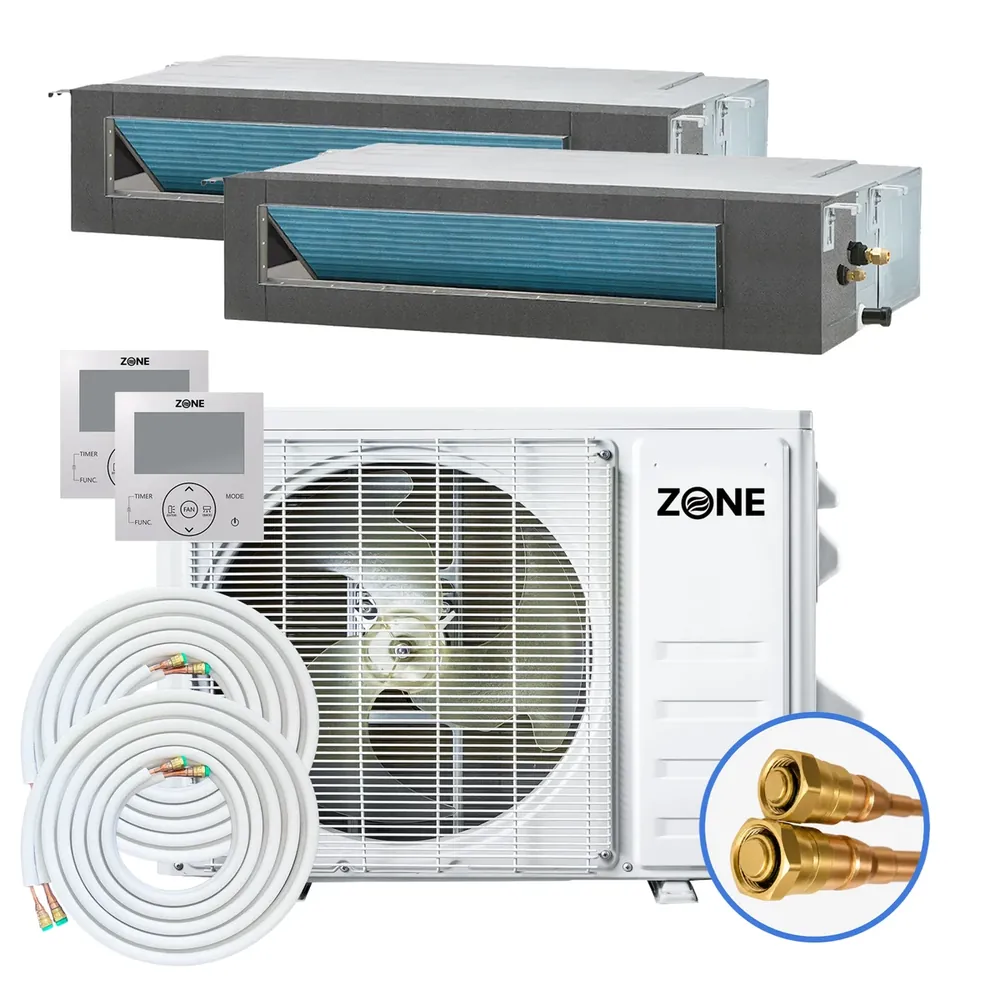
"DIY" in this category means the system ships with pre‑charged, quick‑connect line sets so the refrigerant circuit stays factory-sealed from start to finish. The homeowner never opens the refrigerant side and never needs a vacuum pump or gauge set.
Senville's multi‑zone units do not work this way. Their line sets are sold uncharged with flare fittings, and their help pages explicitly state that a licensed HVAC professional must perform the vacuum, pressure test and final charge steps. DOE's ductless guidance recommends calculating Manual J loads for each zone and for the whole home before choosing BTU size, because each indoor head is sized to its own space and the outdoor unit to the total-a step that applies regardless of brand.
Homeowners Look At Senville
Senville is a popular, affordable multi‑zone brand you can buy on Amazon and other online retailers, and it's easy to see why you'd end up there first:
Budget-friendly equipment pricing with frequent online discounts that can beat a lot of competitors on price alone.
Variety of multi‑zone condensers (models like SENA/18HF/MOZ through SENA/48HF/MOZ) that support 2–6 indoor heads, with wall-mount and some cassette options depending on the series.
Reasonable efficiency ratings in the 22.5–23 SEER range for many multi‑zone condensers, and HSPF values around 10.2–10.3 for several models.
Cold-climate options in the Aura line, said to deliver heating down to about −22°F on select models, with the more common LETO line rated to about 5°F.
Wide third‑party installer base that you can find familiar with the brand and its flare-connection hardware.
If you're searching for "official Senville DIY multi zone mini split 2 zone", here's the catch. Senville wants a licensed HVAC installer to do the refrigerant work, and self-installing can void or limit the warranty. The equipment itself may be affordable, but your total project cost goes up once you add professional labor and the specialized tools you'll need.
Section 04
The real question isn't just "which brand is cheaper on a spec sheet". It's which brands are actually designed for homeowner installation without sacrificing efficiency or warranty protection.
No vacuum pump, gauges or nitrogen testing needed. With a true DIY system like Zone Air, the refrigerant circuit stays sealed at the factory. Flare-connection systems such as Senville need a vacuum pump and gauge set, which is extra tooling you have to rent or buy.
Warranty written to allow homeowner installation. With Zone Air, you get 5‑year parts and 7‑year compressor coverage with no registration deadline, and installing it yourself does not void it. Senville, by contrast, needs a licensed professional to install it.
Lower total project cost. When you add in the cost of the tools, the nitrogen and the HVAC labor that a Senville multi‑zone install usually needs, the gap between the equipment prices gets smaller or can even go the other way.
Zone Air is a DIY-first brand that does final assembly, testing, and inspection in the USA from globally-sourced components, and every system ships pre-inspected. Zone Air says its systems are often 15–30% less expensive than comparable MRCOOL DIY systems, and it sells and ships direct so the sale, warranty, parts, returns, and exchanges all go through one company.
Comparison
This section goes over the points someone who is looking at these two brands would want answered: true DIY status, warranty, efficiency, climate performance, indoor unit flexibility and line set logistics.
Senville multi‑zone requirements:
Flare connections on the line sets, which must be torqued to spec with proper flaring tools.
Vacuum pump and manifold gauges required to evacuate lines and indoor coils before opening service valves.
A licensed HVAC professional is usually needed to confirm the charge and do the vacuum-both for safety and to keep the warranty valid.
Zone Air approach:
Pre‑charged, factory‑sealed quick‑connect line sets with refrigerant sealed inside. No vacuum pump, no gauge set, no refrigerant scales.
The install focuses on mounting units, running line sets, making quick-connect couplings, and wiring.
Avoiding vacuum-pump and gauge tooling plus professional HVAC labor is a major cost difference on a typical 2‑zone project.
Senville warranty stance:
Official documentation requires installation by a licensed HVAC technician.
DIY installs risk partial or full loss of coverage if a future claim is tied to improper installation or refrigerant handling.
Zone Air warranty:
5‑year parts and 7‑year compressor coverage on all systems.
No registration deadline; DIY installation does not void coverage.
30‑day returns on uninstalled units and free shipping to the lower 48 states.
You deal directly with the manufacturer for parts, support and exchanges, with live technical support 8 AM–6 PM MT from the team that built the system.
For a DIYer, that means full peace of mind: you keep your complete warranty and have one point of contact for everything.
Many Senville multi‑zone models land in the 22.5–23 SEER range-solid but not top-tier, and generally optimized for moderate climates. Zone Air's wall-mount multi‑zone systems reach 24 SEER2 (every Zone Air multi‑zone system is 230V), and its 115V single-zone models are 23 SEER2, among the most efficient DIY mini splits available. MRCOOL's flagship DIY 5th Gen publishes 23.6 SEER2 on its 9K 115V unit and 23.5 SEER2 on its 12K 115V unit, so MRCOOL edges out Zone Air at 115V, while Zone Air leads at 230V.
Cold‑climate heating: Senville's standard lines are typically rated to around 5°F for heating, with the Aura series advertising down to −22°F on certain models-though heat output at those extremes drops significantly. Every Zone Air system is rated to heat down to −13°F, the same floor as MRCOOL's standard DIY 5th Gen, and higher-tier MRCOOL DIY models are rated lower. Pioneer Diamante is rated to −4°F. NEEP's cold-climate spec v4.0, which took effect January 1, 2023, targets IECC climate zone 4 and colder and requires a variable-speed compressor, at least 8.5 HSPF2, and 15 SEER2 for ductless systems-Zone Air's published ratings fit well within this performance level.
In DOE's climate guide, "cold" means 5,400–9,000 heating degree days (IECC zones 5 and 6), "very cold" is 9,000–12,600 (zone 7), and "subarctic" is 12,600 or more (zone 8, found only in Alaska).
Hot‑climate cooling: Zone Air is rated to cool in outdoor temperatures up to 131°F, important for places like Phoenix (DOE zone 2B) or Las Vegas (3B). Most competing multi‑zones, including common Senville models and MRCOOL DIY, publish a 122°F maximum, giving Zone Air extra headroom in extreme heat.
Senville generally offers wall‑mounted heads and, in some series, ceiling cassettes-but with less flexibility for true single‑room ducted solutions in a DIY context.
Zone Air lets you mix wall‑mount, ceiling cassette and single‑room concealed ducted air handlers on the same multi‑zone condenser. That single‑room ducted option matters: each small air handler can serve one room, or two or three small adjacent ones, with short duct runs while keeping ducts out of attic spaces where possible. MRCOOL's DIY ducted option is the Hybrid multi-position central air handler at 24K and 36K BTU, sized for a primary zone or small home through central ducts-it's not a single-room unit.
Each zone has its own thermostat and Wi‑Fi control, so every room runs on its own schedule and setpoint for precise comfort.
Senville approach:
Standard fixed-length line set kits with flared copper tubing that may require custom cutting, flaring, and brazing on-site.
The outdoor unit is pre-charged for a fixed total line length (e.g., 75 ft for the 18,000 BTU multi‑zone, 100 ft for the 28,000 BTU). If your runs exceed that, a licensed technician must add extra refrigerant.
Zone Air advantage:
Custom-cut quick‑connect line sets cut to the exact length your run needs, anywhere from 5 to 75 ft per zone, in a single factory-sealed run with no field joint. MRCOOL joins two sets with a coupler beyond 50 ft-every extra coupling is another potential leak point.
Multi‑zone condensers can start with one indoor unit and add a second or third zone later on a spare port with a new pre‑charged line set, no vacuum pump needed. A single‑zone condenser can't be converted, so buyers expecting a second room in a few years should start with the 2‑zone outdoor unit.
How To
Picking "24,000 BTU for two rooms" based on square footage alone often leads to a system that's too big and short cycling. DOE recommends room-by-room Manual J calculations, and for good reason: each zone has different loads based on windows, insulation and exposure.
Manual J in simple terms: You calculate the BTU/h load for each room individually based on the design outdoor temperature for your ZIP code, room size, windows and doors (area, direction and glass type), insulation levels, air leakage, internal gains and whether there are ducts. The outdoor unit is then sized to handle the sum of the zones running at realistic diversity-not just a rule of thumb.
Use minisplitsizingcalculator.com: This free, browser-based Manual J–style tool works in your web browser. You put in your ZIP code, room dimensions, windows and basic construction details. It gives you a BTU/h load for each room with a full breakdown: losses through the envelope, windows, infiltration, internal loads and the design temperature for your county. You can size one room at a time or an entire home floor by floor, then sum two rooms that will share a 2‑zone system.
When a pro Manual J is worth paying for:
Complex layouts, high-end new construction, or very cold climates (IECC zones 6–8: large parts of the northern U.S. and Alaska).
When a building department or rebate program explicitly requires a stamped Manual J report.
Step by Step
This is a high-level overview, not a full install manual. The goal is to show how a Zone Air DIY install differs from a Senville-style pro install.
Use minisplitsizingcalculator.com to size each zone. Say you have a bedroom upstairs and an office on the lower level. For each one, you put in your ZIP code and room details.
Pick Zone Air indoor heads whose combined capacity matches your added-up loads, allowing for climate zone and insulation quality; every Zone Air 2‑zone system runs on the same 27,000 BTU outdoor unit.
Decide on indoor unit types for each zone-wall-mount, cassette or concealed ducted-based on room shape and aesthetics.
Measure line set paths to determine exact lengths for each pre‑charged run (5–75 ft) and plan condensate drain routes.
Plan the circuit: every Zone Air 2‑zone system is 208–230V. According to the DOE, single-zone 115/120V ductless heat pumps run from 6,000 to 12,000 BTU/h and can go on lightly loaded 15A or 20A circuits, while larger sizes need 240V. With a dedicated 15A circuit, Zone Air's 9K and 12K 115V single-zone models will run, and with the optional cord kit they can plug into a dedicated outlet where local code allows-never on an extension cord. The downside is 23 SEER2 at 115V versus 24 at 230V.
Select custom-cut line set lengths for each zone and specify any line-hide kits needed.
If you're not comfortable running a new circuit or disconnect, coordinate with an electrician.
Verify wall clearances inside and outside, check for obstructions and confirm condenser placement meets code.
Indoor heads: Where possible, locate on an exterior wall to keep the line set route simple. Use the included template and bracket, make sure it's level, anchor into studs and drill the line set hole with the right slope so condensate can drain.
Outdoor unit: Place the condenser on a pad or wall bracket with the required airflow space around it. Anchor it to resist wind loads and elevate it above the anticipated snow line in colder climates.
Quick‑connect process: Route pre‑charged line sets carefully to avoid kinks, respecting the specified bend radius. Attach quick-connect fittings at indoor and outdoor ends per instructions, verifying O‑rings and torqueing as specified. The refrigerant remains sealed until valves are opened-there is no vacuum step.
Electrical: Run wire from the panel to the outdoor disconnect and from the condenser to the indoor units the way the wiring diagram shows. Shut off power at the main breaker, follow NEC and local code, and hire an electrician if you're unsure. MRCOOL's 115V DIY units are hardwired. Zone Air's 115V single-zone plug-in option makes this step easier where code permits, while a 2-zone system is wired at 230V either way.
You can open the service valves the way they direct, restore power and use the built-in diagnostics or the remote to run test modes. Check both zones to make sure the airflow is right, the temperature changes and the condensate drains.
Connect each indoor unit to Wi-Fi and link it with the app so you can do scheduling, remote control and thermostat management for each zone on its own.
If you hit a snag, Zone Air gives you video tutorials, a written DIY manual and live tech support that runs from 8 AM to 6 PM MT.
Section 08
Ideal for:
Homeowners with moderate DIY skills-comfortable with drilling, mounting, and basic wiring coordination.
People finishing a basement and an above-garage bonus room, or splitting comfort between upstairs bedrooms and a main living area.
Owners of small homes or townhomes who want to avoid whole-house ductwork.
Better to hire a pro or consider non‑DIY equipment when:
The home is very large or complex, with more than 3–4 zones or mixed hydronic and forced-air systems.
You're in very cold climates (DOE definition: 9,000–12,600+ heating degree days, IECC zones 7–8) and want a stamped Manual J and design check.
Local code forbids homeowner electrical work or requires licensed pros for HVAC regardless of refrigerant handling.
Even if you hire a pro, choosing a high-efficiency, cold‑climate‑capable system like Zone Air still matters for long-term operating cost and comfort.
Section 10
If you looked for "Senville DIY multi zone mini split 2 zone," know that Senville is not set up as a true DIY option. It needs a licensed pro and vacuum tools, and if you install it yourself you will void the warranty.
Zone Air gives you a real DIY 2‑zone alternative: pre‑charged quick-connect lines custom-cut up to 75 ft, up to 24 SEER2 efficiency, heating down to −13°F, cooling to 131°F, mix-and-match indoor head styles and full warranty on homeowner installs-all sold direct with one company handling sales, support and warranty.
Start by running your rooms through minisplitsizingcalculator.com so you can buy the right capacity. Then look at the Zone Air multi‑zone models that match what your rooms need and what your climate is like.
Size your rooms now, pick the indoor head types that work for each space, and price out a Zone Air 2‑zone kit. That's the fastest path from searching to heating and cooling two rooms on your own terms.
FAQ
These questions cover what people actually search for, including "official Senville DIY multi zone mini split 2 zone," "Senville DIY multi zone mini split official two zone," and other similar ways people type it in.
No. Senville does not currently sell a 2‑zone system that comes pre‑charged with quick‑connect fittings and is sold as a DIY product. Their multi‑zone units are designed for licensed installers who use vacuum pumps and gauges, and DIY installation can go against Senville's written warranty terms.
Physically, an experienced DIYer could mount and pipe a Senville system, but you'll need specialized tools-vacuum pump, gauge set, torque wrenches, nitrogen for pressure testing. Improper refrigerant handling is illegal and it can be dangerous. You also risk losing warranty coverage if Senville requires proof of professional installation. If you're set on Senville, hire an HVAC pro and treat it as a conventional, non‑DIY system.
Both offer pre‑charged, quick‑connect DIY systems, and MRCOOL states that no special tools or training are necessary to install its DIY line. With 5‑year parts and 7‑year compressor warranties, Zone Air covers every system and MRCOOL covers its DIY 5th Gen. Key Zone Air advantages:
Higher efficiency at 230V: 24 SEER2 with wall heads versus MRCOOL's 23.9 (18K) and 23 (27K) DIY multi‑zone condensers, while at 115V MRCOOL's single-zone units (23.5–23.6) edge out Zone Air's 23.
Custom-cut continuous line sets up to 75 ft versus fixed kits that need couplers past 50 ft on some MRCOOL setups.
Single-room concealed ducted heads that MRCOOL's DIY line doesn't directly match.
Often 15–30% lower price than comparable MRCOOL systems, by Zone Air's own estimate, sold direct with one point of contact for sales, support and warranty. MRCOOL doesn't sell direct to consumers. You buy through a dealer or retailer, so returns and exchanges depend on the seller.
Correct. With Zone Air's DIY systems the refrigerant stays sealed inside the factory-charged line sets and outdoor unit until you open valves after making quick-connect couplings. Because the circuit is sealed at the factory, there is no step where you evacuate the lines. Follow the install manual closely and never attempt to alter refrigerant lines yourself.
Simple "square foot" answers-like 12,000 BTU per 600 sq ft-are only rough places to start. There is minisplitsizingcalculator.com for each room so you can account for:
Local outdoor design temperature for your ZIP (e.g., DOE puts Miami-Dade in zone 1A and Dallas in zone 3A-very different loads).
Ceiling height, window area, and direction (south- and west-facing glass loads more in sunny states).
Insulation levels, air leakage, and any existing ducts in the space.
Select the closest system size above the calculated load. Avoid extreme oversizing-it causes short cycling and humidity problems.
You can think about it in terms of DOE climate zones:
Hot-humid and hot-dry (zones 1–3): Miami, Houston, Phoenix, Las Vegas, Los Angeles. You are going to need high SEER2 and strong high-temperature cooling. With Zone Air's 131°F cooling rating, you have real room to work with here.
Mixed and cold (zones 4–6): Dallas, Atlanta, much of the Midwest and Northeast. You need both cooling efficiency and solid low-temperature heating performance.
Very cold and subarctic (zones 7–8): Northern Minnesota, interior Alaska. Cold-climate-rated systems down to at least −13°F and a careful Manual J check are essential.
Zone Air's −13°F heating and 131°F cooling ratings make it suitable for nearly all continental U.S. conditions when sized correctly.
