This site is owned and operated by Zone Air.
Articles · Buying Guide · Nov 2026
Best 9000 BTU DIY mini split systems compared side-by-side: Zone Air, Perfect Aire and budget picks with SEER ratings and voltage needs for easier installation.
The best 9,000 BTU DIY mini split for most homeowners is the Zone Air 9K DIY. It delivers 24 SEER2 on the 230V model (23 SEER2 on 115V (Zone Air's site)), uses a pre charged quick-connect line set custom-cut to your exact run length, from 5 to 75 ft (Zone-Air.com), and is often 15-30% less than comparable MRCOOL systems. The Perfect Aire DIY 4G 9K (about 23 SEER2) is the pick if you need to stay on a 115V circuit.
"Best" really depends on your room's actual cooling and heating load, not just square footage. Many mini splits are designed for both heating and cooling, and common capacities for these systems range from 9,000 to 48,000 BTU. A 9,000 BTU mini split system usually covers 250 to 450 sq ft, but that range changes a lot based on climate, insulation, windows and house age. On our calculator, a 400 sq ft Phoenix room needs about 11,800 BTU/h if the house was built in 1970 and about 7,950 if it was built in 2020. That 50% gap is the reason Manual J-style sizing matters more than square-foot rules of thumb.
This guide ranks the top 9K DIY options, compares them on specs and value, and shows how to determine if 9,000 BTU is the right capacity for your space.
Section 01
We evaluated current 9K DIY single-zone systems sold in the US market, focusing on models a homeowner can install without handling refrigerant, using a vacuum pump, or needing gauges. HVAC tools are not needed for the installation of true DIY mini splits. We did not force a "top 10" list; only three clearly differentiated 9K DIY picks made the cut.
Each system was rated against these factors:
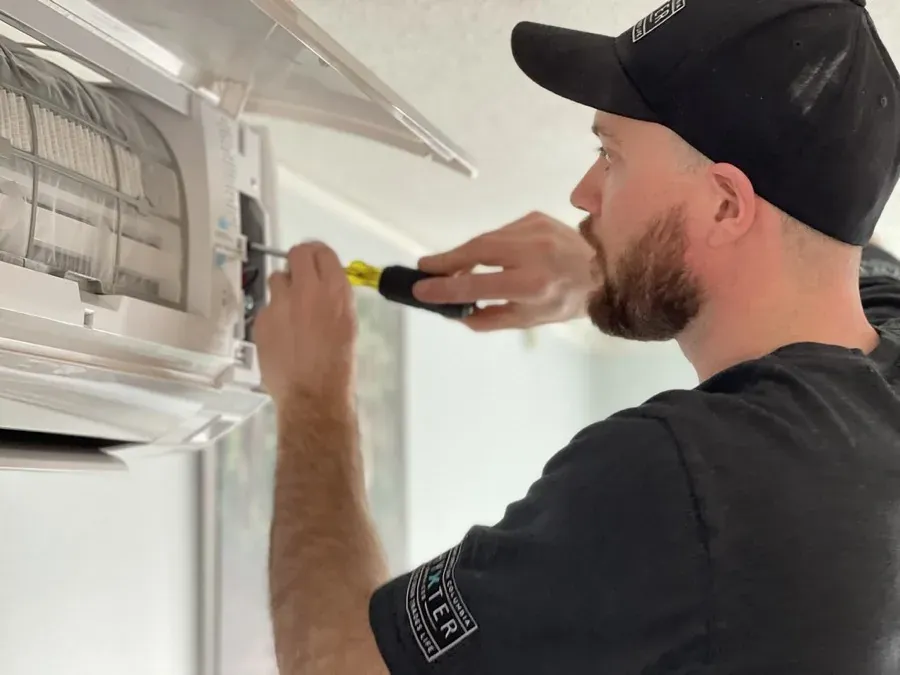
True DIY capability: factory pre charged quick-connect line sets, no vacuum pump, no refrigerant handling, and clear install documentation. True DIY mini split systems feature pre charged line sets and quick-connect technology. No special tools or professional experience are needed for installation.
Efficiency: SEER2 is the measure of cooling efficiency for air conditioning systems. Zone Air's 9K has a 24 SEER2 rating on 230V, and that edges out the MRCOOL DIY 9K 5th Gen at 23.6 SEER2 on 115V. When a system has a higher SEER2 rating, you pay less for electricity over the long run, and a 9,000 BTU system with a SEER2 rating above 20 is usually considered high-efficiency. Most mini splits have high SEER2 efficiency ratings because they have inverter compressor technology.
Heating performance: how well the unit can heat when the outdoor temperature drops to specific temps (5°F, 0°F, -13°F) for different US climate zones.
Reliability and warranty: how long the part warranty and compressor warranty last, and whether doing a DIY install will keep your coverage valid. You should always install a DIY mini split according to the manufacturer's instructions so you don't void the warranty.
Support and buying experience: direct-from-manufacturer sales vs. dealer networks. Zone Air sells and ships direct with 30-day returns on uninstalled units, while MRCOOL sells through authorized dealers and retailers, so returns and exchanges depend on the seller.
Price and value: hardware cost relative to SEER2; Zone Air is often 15-30% less than comparable MRCOOL systems.
Installation flexibility: line set length options (Zone Air custom-cut 5 to 75 ft vs. fixed-length kits), 115V vs. 230V power, and control features. Most mini splits are equipped with smart technology, allowing for app control and scheduling.
Section 02
These picks cover the major use cases: best overall, best 115V option, and lowest upfront cost. All are single-zone wall-mounted air handler systems sized at 9,000 BTU and sold for DIY installation. Single-zone systems heat and cool one room efficiently, making them ideal for garages, workshops, bedrooms, and home offices. (Multi-zone systems connect multiple indoor units to one outdoor unit and allow individual temperature control for each room, but that is a different product category.)
The best all-around pick. Zone Air pairs up to 24 SEER2 efficiency with custom-cut pre charged line sets and final assembly, testing, and inspection in the USA, and is often 15-30% less than comparable MRCOOL systems.
Zone Air cuts each factory pre charged quick-connect line set to the exact length your run needs, from 5 to 75 ft in a single piece. That avoids the extra couplings fixed-length kits need when extended, and every added connection is one more place a leak can develop. Systems undergo final assembly, testing, and inspection in the USA before shipping. The 230V model reaches 24 SEER2. The 115V version is 23 SEER2.
Homeowners who want a simple 9K DIY install with a long or awkward line run (garage, bonus room above garage, detached office) without extension kits. People who value direct support, a simple warranty path, and final assembly, testing, and inspection in the USA.
Up to 24 SEER2 on 230V, among the most efficient 9K DIY mini splits
Custom-cut pre charged line sets from 5 to 75 ft. There are no extra quick-connect fittings for most installs
Direct sales model: warranty claims, returns and exchanges go straight to Zone Air. 30-day returns on uninstalled units; 5-year parts / 7-year compressor warranty that allows DIY install
Heating is rated down to -13°F outdoor temperature
With a dedicated 15A outlet, the 115V model can plug right in using Zone Air's optional plug-in kit where local electrical code allows (never an extension cord). According to Zone Air, this setup is "the easiest systems to install on the market"
Zone Air systems average 4.8/5 across verified customer reviews, and people often mention that the support was helpful when they had questions about installs or warranty
The 115V model is 23 SEER2. You'll need the 230V model and circuit to get the 24 SEER2 rating
The -13°F heating rating matches MRCOOL's standard DIY 5th Gen rather than beating it
A high-efficiency 115V DIY system with Wi-Fi controls and a design that uses quick-connect fittings. The Perfect Aire DIY 9K has a rating of 23 SEER.
For spaces where only a standard 120V circuit is available, the Perfect Aire 4G delivers competitive energy efficiency so you don't need to install a 230V breaker. Its system uses quick-connect fittings so you don't have to handle refrigerant, and the Wi-Fi app lets you manage the temperature from anywhere.
Bonus rooms, bedrooms and home offices where sound level matters and running new 230V wiring is difficult or costly. DIYers who want a balance of efficiency, 115V compatibility and an indoor unit that is relatively compact.
About 23 SEER2 on 115V, which is competitive with the top DIY brands
Quick-connect, factory pre charged line sets aimed at homeowner installation
Wi-Fi and app controls so you can manage the temperature and set a schedule when you are not home
Line set length choices more limited than custom-cut options, constraining outdoor unit placement
Warranty and support are handled through specific retailers, and your experience depends on which seller you use
Several brands offer lower-priced DIY-labeled 9K systems (such as the Senville LETO or Pioneer Diamante Ultra) with pre charged lines but lower SEER2 ratings, often around 19 to 21 SEER2.
With equipment cost that runs well below premium 9K systems, these models are attractive for spaces you don't use all the time. Think about a pastime room, a seasonal cabin or a shop, where what you pay upfront matters more than saving kWh over the long term.
You're finishing a small space on a tight budget and you mainly need summer cooling plus heating for the in-between season. It also works in locations with low electricity rates, so the efficiency gap versus premium units doesn't hit your wallet as hard.
Because the purchase price is lower than Zone Air or MRCOOL, it costs you less to get into ductless mini split comfort
Basic quick-connect functionality that supports homeowner installation
A SEER2 of about 19 to 21 means your operating costs will be higher over time. Over 10 to 15 years, systems with SEER2 around 23 to 24 will cut cooling energy use by about 20 to 30 percent compared to SEER2 around 20.
Shorter or more limited warranty, and some models void coverage if you don't get professional installation
Cold-climate heating output drops faster when outdoor temperatures get low
Comparison
You can use this to match each option to your situation at a glance:
Zone Air 9,000 BTU DIY: best overall mix of price, efficiency (up to 24 SEER2), and custom-length line sets for tricky or long runs. Shop direct. Order goes out pre-inspected.
Perfect Aire DIY 4G 9K: This is the best 9,000 BTU DIY mini split to use with 115V circuits in situations where rewiring to 230V is not practical.
Budget 9K DIY option: best for lowest upfront cost in mild climates or lightly used rooms where peak efficiency is less critical.
Zone Air ships every system direct to consumer, pre-inspected after final assembly, testing, and inspection in the USA, and handles warranty claims, returns and exchanges itself. As of November 2026, it is the only DIY mini split brand that does custom line set fabrication, so a 9K install gets one continuous run at the length the wall needs. If the room calls for a hidden unit, Zone Air also sells a single-room concealed ducted unit; MRCOOL's DIY ducted air handlers are 24K-36K central units for larger areas. And if you later add rooms, Zone Air's multi-zone systems let you mix wall-mount, ceiling cassette and concealed ducted units on one outdoor unit.
The MRCOOL DIY 9K 5th Gen is a 115V system rated at 23.6 SEER2 and listed for up to 400 sq ft. It uses pre-charged quick-connect line sets in fixed 11.5, 16, 25, 35 and 50 ft lengths, with couplers for longer runs. MRCOOL states that "no special tools or training are necessary to install". Controls include a smartphone app (Wi-Fi via a dongle) and Alexa/Google voice. Its warranty is 5-year parts / 7-year compressor with no registration required. Its 115V 9K and 12K units are hardwired. MRCOOL doesn't sell direct to consumers, so you buy through a dealer or retailer. MRCOOL DIY Direct is an authorized dealer, not MRCOOL itself, which means returns and exchanges depend on whoever you bought it from.
| Spec | Zone Air 9K | MRCOOL DIY 9K 5th Gen |
|---|---|---|
| SEER2 | 24 (230V) / 23 (115V) | 23.6 (115V) |
| Heating rated to | -13°F | about -13°F |
| Line sets | Custom-cut 5-75 ft, single run | 11.5-50 ft fixed lengths, couplers for longer runs |
| 115V power | Optional plug-in kit | Hardwired |
| Warranty | 5 yr parts / 7 yr compressor, DIY install allowed | 5 yr parts / 7 yr compressor, no registration required |
| How you buy | Direct from Zone Air | Authorized dealers and retailers |
How To
Picking the right 9K AC unit is a two-step process. First you confirm that 9,000 BTU is the correct size for your room, then you choose the model that fits your wiring, layout and budget. Mini splits range from 9,000 to 24,000 BTU in common residential sizes. They go up to 48,000 BTU for larger applications. Proper sizing improves efficiency and equipment lifespan, so this step matters.
A 9,000 BTU heat pump is often right for roughly 250 to 400 sq ft, but square-foot rules can be off by 50% depending on house age, insulation, windows and climate. DIY mini splits can cool spaces up to 350 square feet under typical conditions.
On our calculator, a 400 sq ft Phoenix room needs about 11,800 BTU/h if the house was built in 1970 and about 7,950 if built in 2020. A 9K unit would be oversized for the 2020 build and undersized for the 1970 one. On our calculator, a 400 sq ft Houston room goes from about 8,900 BTU/h as an interior room to about 12,800 with all four walls exterior. Two unshaded single-pane windows push that same Houston room to about 14,000 BTU/h, while double low-E windows with exterior shades land near 11,600. These numbers show how fast you can outgrow a 9K system.
Run your room through minisplitsizingcalculator.com using your ZIP code, room type, ceiling height and window details to find the right size. Energy losses account for about 30% of central air's energy consumption; a ductless mini split avoids those duct losses entirely, which can change whether 9K is enough. If you are planning a whole-house system or have borderline loads, a professional Manual J calculation is worth paying for.
Most 9,000 BTU units use 115V power, but there are 230V models that often have a higher SEER2. Putting in a mini split means you need a dedicated electrical line no matter what voltage you have. If your panel doesn't have a 230V breaker, you'll want to add the cost of putting one in to your total cost.
Your model choice is shaped by how far the line set has to go. With Zone Air, you can get a single run anywhere from 5 to 75 ft made to order, so you don't have to bother with extension kits. Fixed-length kits from other brands might need extra connectors if the outdoor unit is a long way from where the wall gets opened up. On our calculator, raising a 400 sq ft Phoenix room's ceiling from 8 to 12 ft adds about 11% to the load (10,000 to 11,150 BTU/h), which can push you above a 9K system if the design is already close to the limit.
Cold-temperature performance is crucial for mini splits used in winter climates. If you plan to heat in winter near or below freezing, prioritize models with strong low-temp performance and higher HSPF2. The standard MRCOOL DIY 9K 5th Gen (not the Easy Pro tier) is listed at about 7,300 BTU/h of heat output at a 5°F outdoor test point, roughly 73% of its rated capacity; that is an output figure, not its operating floor. Both Zone Air and MRCOOL's standard DIY 5th Gen 9K are rated to heat down to -13°F; higher-tier MRCOOL DIY models are rated lower. DOE's sizing guide answers the tricky case: a house with a 19,000 BTU/h cooling load and equipment offered only at 17,500 or 23,400 BTU/h should get the larger unit so the peak load is still met.
Mini splits use inverter-driven compressors for efficiency. More efficient inverter systems at higher SEER2 modulate better and run quieter at partial load, which matters for bedrooms and home offices. Check indoor noise specs; Zone Air lists its indoor units at 22-42 dB, while MRCOOL lists 18 dB(A) for its 12K wall head. Use filters with easy access to save time on maintenance.
Section 05
The best 9K DIY mini split depends on your room's load, wiring, and how much you value energy efficiency versus upfront price.
Choose Zone Air 9,000 BTU DIY if you want the best overall value, top-tier SEER2 and custom-length pre charged line sets so you can get an easier, cleaner install
Choose Perfect Aire DIY 4G 9K if you must stay on 115V power but still want near-top efficiency and Wi-Fi controls
Choose a budget 9K DIY system if your climate is mild, the room is well insulated, and minimizing upfront cost is more important than maximizing efficiency
Keep in mind: confirm sizing with minisplitsizingcalculator.com before you order, especially in climates like Phoenix or Houston where windows, ceiling height, and exterior walls can change the ideal BTU size by thousands.
Bottom Line
A 9,000 BTU DIY mini split can be the right fit for small rooms, but only when matched to an accurate cooling and heating load, not just square footage. Among current options, Zone Air often offers the best mix of efficiency, price, and custom installation flexibility, while Perfect Aire remains a strong choice for shoppers who prioritize 115V compatibility. Treat this guide as a starting point: run your room through a Manual J-style tool, decide whether 9K is correct, then pick the DIY model that fits your wiring, layout, and budget with an eye toward long-term comfort and energy use.
