Best 110V & 115V DIY Mini Split Systems in 2026 (Easiest Plug‑In Options)
The 115V DIY systems that install without a vacuum pump or a 230V circuit, ranked, with the one that plugs into an outlet first.
Introduction: Why 110V / 115V DIY Mini Splits Matter in 2026
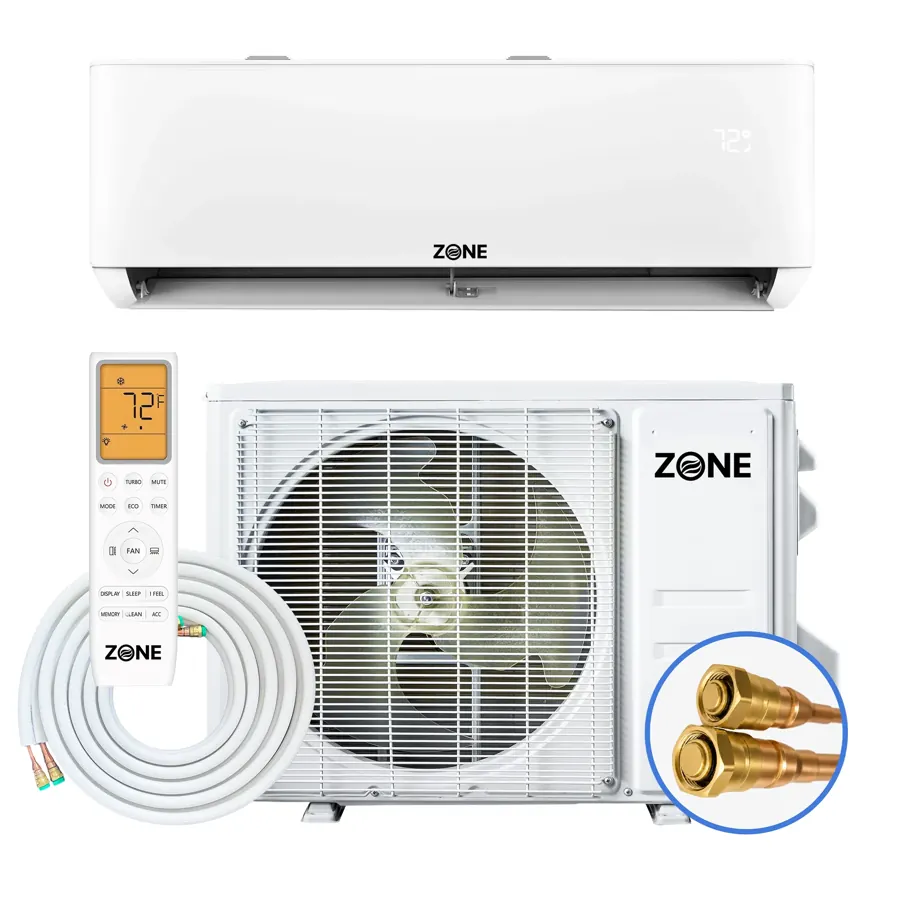
For 2026, the best 110v diy mini split is the Zone Air DIY 115V Plug-In Series. It has a plug-in outlet kit, the pre-charged line set can be cut to the exact length you need, and it can heat down to −13 °F.
If you've got a garage, bonus room, rental unit or older home without a 230V circuit, you already know how frustrating it is. Central air doesn't reach that space, window units are loud and ugly, and pulling new high-voltage wiring can cost as much as the cooling equipment itself. That's where 110V/115V DIY mini split systems come in. These ductless units run on the same standard household voltage you already have, they install without an HVAC contractor, and they deliver both heating and cooling with far better energy efficiency than portable or window alternatives.
Mini splits are more energy efficient than central AC, mostly because central systems lose about 30% efficiency through ductwork. A ductless mini split can get rid of that loss completely. And because 115V DIY mini split systems usually have 9,000 to 12,000 BTU capacities, they are built for individual rooms and small spaces up to about 550 square feet - you do not have to condition your entire house.
Quick answer: For 2026, the best 110V/115V DIY mini splits are:
Zone Air DIY 115V Plug-In Series - Best overall. Easiest install with a true plug-in kit, 23 SEER2, final assembly, testing, and inspection in the USA, custom line-sets, 4.8/5 customer rating.
Mirage / Budget 115V Systems - Best for warm-climate cooling on a tight budget.
Generic Online-Only 115V Units - Only if price is the thing you care about most and you are okay with significant trade-offs.
For comparison, the MRCOOL DIY 115V single-zone is not one of the picks. Its specs are laid out next to them below.
This article is about 110V/115V DIY systems you can buy in 2026. It is not about generic mini splits, or 230V-only models or units that need professional installation. Rankings are based on efficiency ratings, how easy the system is for a DIYer to put in, how it does in cold weather, reliability and the total cost of the project.
How We Chose the Best 110V / 115V DIY Mini Splits
We looked at 2026 models from DIY mini split brands that offer 115V options. These brands include Zone Air, MRCOOL, Mirage and various marketplace imports. Here's the standard we applied:
Performance: We looked at SEER2 and EER2 ratings, real-world heating output down to at least 5–14 °F, and how much cooling capacity the unit has across climate zones. High SEER ratings show good energy efficiency for mini split systems, and inverter technology contributes directly to those numbers.
Ease of DIY install: True DIY systems do not need a vacuum pump or HVAC certification. We put more weight on units that come with pre-charged line sets so you don't need specialized HVAC tools, along with plug-in kits instead of hardwired-only setups that have to be wired in.
Electrical compatibility: Genuine 110–120V / 115V operation, breaker requirements and the ability to use existing circuits where code-compliant.
Reliability and testing: Warranty terms that explicitly support DIY installation, where systems get their final assembly, and whether each unit is test-run before shipment. Zone Air's final assembly, testing, and inspection in the USA stood out here.
Flexibility: line-set length options, indoor unit form factors like wall, cassette and concealed, plus whether it can support multi-zone or future expansion.
Value for money: Equipment price, energy savings from higher SEER2, and typical payback period versus lower-efficiency budget units. Eco-friendly refrigerants like R-454B are increasingly used in newer models. That also factors into long-term value.
Support: how good the tech support is, and whether parts, returns and warranty claims get handled direct-to-consumer or through a third-party store you have to coordinate with.
Units that required professional-grade tools (like the Pioneer Diamante Ultra, which needs a vacuum pump for installation), had no clear warranty for DIY installs, or had no clear safety certifications were left out.
Best 110V & 115V DIY Mini Splits for 2026
The market for 115V DIY mini splits is relatively narrow compared to 230V options. Mini splits typically range from 9,000 to 36,000 BTU overall, but the 115V segment stays in the 9K–12K range. That said, a few genuinely distinct choices exist. Zone Air leads overall for 115V DIY systems due to its plug-in kit, custom line-sets, and final assembly, testing, and inspection in the USA, while other brands serve niche needs like ultra-low price or warm-climate cooling only.
1. Zone Air DIY 115V Plug-In Series - Best Overall 110V / 115V DIY Mini Split in 2026
The Zone Air DIY 115V line comes in 9,000 and 12,000 BTU sizes, both running on a dedicated 115V/15A circuit. Every system ships with factory pre-charged quick-connect refrigerant lines, all necessary mounting hardware, and the option to add Zone Air's unique plug-in cord kit. Zone Air does final assembly, testing, and inspection in the USA, so every system is checked before it ships to your door. DIY mini split installation typically takes 4–8 hours, and Zone Air's FAQ puts a first-time wall-mount install at 4–6 hours for two people.
Why It Stands Out
Zone Air is the only brand that offers a plug-in outlet solution for homeowners who want a system that plugs into an outlet (as of November 2026). Their plug-in kit for 115V DIY systems lets you plug it into a dedicated outlet where local electrical code allows, instead of hardwiring the outdoor unit. Combined with the 115V system, this makes Zone Air's units the easiest to install on the market.
The 115V systems are rated at 23 SEER2 (the 230V models reach 24 SEER2). For context, mini splits can save about 30% on energy compared to central AC. Heating performance reaches down to −13 °F, so these units work in cold climates for garages, bonus rooms, and workshops that need year-round comfort. For hot garages, they're rated to cool in outdoor temperatures up to 131 °F.
Zone Air does final assembly, testing, and inspection in the USA from globally-sourced components, and every system is test-run before shipment. That's why the company can stand behind its warranty, and its average customer rating sits at 4.8 out of 5 stars. The 5-year parts and 7-year compressor warranty has no registration deadline, and installing it yourself does not void it.
Zone Air is also the only DIY mini split brand that does custom line set fabrication (as of November 2026). They'll build your refrigerant line to the exact length you need, up to 75 feet in a single run. MRCOOL ships fixed 11.5, 16, 25, 35 and 50 ft line sets and reaches longer runs with a coupler that joins a second set to the first. Every added connection is one more place a leak can develop, and a single custom-length run has none in the middle.
Best For
Homeowners who want the simplest possible DIY installation and prefer to plug the unit into an outlet rather than run a new 230V circuit.
Garages, workshops, finished attics, small ADUs and offices up to about 450–600 sq ft that need both heating and cooling.
Buyers who value a strong warranty, a 4.8/5 average customer rating, and direct-to-consumer support so they don't have to deal with third-party retailers.
Key Strengths
A plug-in 115V kit that turns the unit into a true outlet-ready solution. This is unique in the DIY mini split market.
Custom, factory-precharged line-sets cut to exact length (any whole foot from 5 to 75 ft) in a single run, reducing possible leak joints.
Final assembly, testing, and inspection in the USA from globally-sourced components, plus a 5-year parts and 7-year compressor warranty that fully supports homeowner installation.
With a 23 SEER2 rating, the 115V models have heating down to −13 °F and cooling up to 131 °F outdoors.
You get Wi-Fi app control, plus voice control that works with Alexa and Google Home.
Installation needs you to drill a 3-inch hole through the wall for the line set, plus you do standard mounting. There is no specialized electrical work beyond your dedicated circuit.
Possible Limitations
So where can you find Zone Air? The direct-to-consumer model means you won't find Zone Air on big-box shelves. You have to order systems online, and you should plan for shipping lead times.
115V units work best for small to mid-size individual rooms. Larger spaces or an entire house will still need 230V equipment or multiple zones.
Plug-in use still has to comply with local building codes and outlet/breaker sizing. The kit goes into a dedicated GFCI outlet, and you should never use an extension cord. Some projects may need an electrician to update circuits, even though the install itself is DIY.
2. Mirage / Similar Budget 115V Mini Splits - Best 110V/115V Option for Warm-Climate Cooling on a Budget
Mirage Ventus-style and equivalent budget 115V mini splits put a low upfront cost first. These are sold through regional sellers and online, usually from 9,000 to 18,000 BTU. They deal primarily in air conditioning for warm-climate spaces.
Why It Stands Out
Pricing on 115V units is very competitive, and these units are often a lot cheaper than premium DIY brands.
Ideal for warm-climate cooling where heating is optional or limited to mild in-between seasons.
Some models can run on standard 115V circuits with small electrical upgrades. That makes it easy to add one in older homes.
Best For
Homeowners in Sun Belt or Southwest regions primarily needing cooling for workshops, garages or bonus rooms.
Buyers who want to keep the upfront cost low instead of paying more for the highest possible SEER2 or a longer warranty.
Projects where you already have supplemental electric or gas heat, so it doesn't matter as much how well the heat pump does at heating.
Key Strengths
The purchase price is lower than premium DIY systems, so you save money up front.
Compared to a window unit or a portable air conditioner, the efficiency is reasonable and it runs quiet.
Some 115V models are sold as DIY-friendly and they come with basic installation kits.
Possible Limitations
There is little heating performance below about 60 °F. Older mini splits may struggle in freezing conditions, and budget models are especially limited, so it is not suitable as a primary heat source in cold climates.
Warranties are shorter, often 5–6 years on compressors. The support networks are worse compared to other brands.
Fewer official provisions for DIY installs. Some warranties may need professional installation to stay valid.
The documentation quality is limited and there are fewer advanced features like smart controls or custom line-sets. Mini splits usually last 10 to 15 years, but budget units may fall short of that without strong build quality.
3. Generic Online-Only 115V Mini Splits - Best Only for the Lowest Price (Use Caution)
A wave of no-name or lesser-known 115V mini splits are sold through large online marketplaces in 2026. They are offering cooling at rock-bottom prices, and some are even advertising "DIY" installation.
Why It Stands Out
With ultra-low upfront prices, there are frequent flash sales for 115V splits.
They give you basic cooling for light-duty spaces where long-term performance isn't something you need to worry about.
Best For
If you are very budget-constrained and you fully understand the risks, and you're comfortable with little support.
Temporary spaces or short-term installations where you don't care about a long service life and you don't care about warranty coverage.
Key Strengths
Among 115V mini splits, you get the lowest purchase cost per BTU.
Some units come pre-charged and you can install them with basic tools if you're an experienced DIYer.
Possible Limitations
Unclear or weak warranties, often with poor enforcement and no local support. Compare this with Mitsubishi, which offers a 12-year limited warranty on its mini splits, or Fujitsu mini splits that have a warranty of up to 12 years. Even among non-DIY manufacturers, the length of the warranty signals confidence in the product, and generic units rarely come close.
Little to no custom line-set options, plus poor documentation and safety certifications.
Energy efficiency is usually well below what you get from premium systems, so your power bills add up over time. Hitting over 20 SEER2, the Senville LETO DIY models are decent, but a lot of generic units don't even publish verified SEER2 numbers.
I would not recommend them when you need reliable heating, safety or something that is going to last. With USA testing and inspection plus 4.8/5 reviews, the difference Zone Air makes is pretty clear.
How the MRCOOL DIY 115V Single-Zone Compares
MRCOOL's 115V single-zone DIY models come in 9,000 BTU (23.6 SEER2) and 12,000 BTU (23.5 SEER2) sizes, according to the MRCOOL catalog. MRCOOL is a more retail-availability-oriented company. It has no direct-to-consumer option, so you must purchase through a third party (distributors), and that means dealing with a third party for warranty, replacement parts, returns and exchanges.
Pre-charged R-454B quick-connect lines allow you to install it yourself without having to handle refrigerant or use a vacuum pump.
Efficiency at 115V is a bit higher than Zone Air's: 23.5–23.6 SEER2 versus 23.
Cold-climate rating: MRCOOL's standard DIY 5th Gen, including the 115V versions, is rated to about −13 °F, and that matches Zone Air's floor, while the higher-tier DIY models are actually rated lower. Its published cooling range is topped out at 122 °F.
MRCOOL DIY 5th Gen systems carry a 5-year parts and 7-year compressor warranty with no registration required, and they allow DIY installs. That is the same main term as Zone Air's.
No plug-in kit. The 115V models are hardwired to a dedicated circuit (20A max fuse), so that often means paying an electrician.
Standard pre-set line-set lengths. If you need a longer run, you need a coupler and a second set, and that means more connection points than Zone Air's single-run custom lines.
MRCOOL's Trustpilot profile sits at 3.0/5 across 94 reviews as of November 2026. Reviewers there mention slow support answers and getting charged shipping on warranty replacement parts.
MRCOOL's DIY multi-zone line has wall and ceiling cassette units, but there's no concealed-duct DIY unit that can go on the same condenser.
Quick Comparison of the Best 110V / 115V DIY Mini Splits (2026)
Here's a quick summary of the main picks if you're comparing options side by side:
Zone Air DIY 115V Plug-In Series - Best overall for 2026. Easiest DIY install with plug-in kit, 23 SEER2, final assembly, testing, and inspection in the USA, custom line-sets up to 75 ft, and strong cold-climate heating to −13 °F. Direct-to-consumer sales and support. 4.8/5 stars.
Mirage / Budget 115V Systems - Best for projects in warm climates where you care about cooling first and the low upfront price matters more than the heating capability or a long warranty.
Generic online-only 115V units are only for buyers who care a lot about price and want the cheapest option. You will get basic cooling, but you are giving up a lot in reliability and support and efficiency.
For comparison, the MRCOOL DIY 115V single-zone has 23.5–23.6 SEER2 and is rated to about −13 °F. It needs a hardwired circuit, it uses fixed line-set lengths, and you buy it and get support through third-party sellers.
How to Choose the Right 110V / 115V DIY Mini Split
Do not shop by price alone. Start with what your electrical setup can handle, what your climate is like, and how comfortable you are with DIY work. For most homeowners who want a 115V DIY system in 2026, a Zone Air 115V unit with the plug-in kit will be the simplest way to go. But here's how to make sure that's right for you, or if something else fits better.
Choose by Electrical Setup and Circuit Limits
Most 115V mini splits need a dedicated 15A or 20A circuit, so you can't just plug into the same outlet that you use for your shop vac and your table saw. Here's how to think about it:
Older homes with limited panel capacity that want to avoid new 230V circuits are a good fit for 115V plug-in solutions like the kit from Zone Air. A dedicated electrical line is required for mini split installation, but it is a standard 115V line and not a 230V upgrade.
If it's easy and cheap to add a new dedicated 115V or 230V circuit in your home, you have more options. What if it costs under $200 to run a 230V line in your situation? In that case, think about whether a 230V model might be better for a larger space.
Plug-in convenience does not beat code requirements. Unlike ad-hoc cord conversions from a hardware store, the plug-in kit from Zone Air is a 12 AWG, 15A cord that is made for the job. Always check local building codes and consult an electrician if you're unsure about your panel or outlet capacity.
A dedicated circuit also means you don't have to do any electrical work beyond what you'd do for a window unit on its own breaker. That is a big deal when you compare it to the full electrical upgrades that many central air systems demand.
Pick by Room Size, Climate and Use
Proper sizing matters more than most buyers realize. Oversizing leads to short cycling and humidity issues, and high humidity in a space defeats the purpose of air conditioning, since mini splits can dehumidify air continuously during operation only when they run in longer cycles.
Here are rough BTU sizing guidelines for 115V systems:
9,000 BTU covers about 300–450 sq ft with insulation that is about average.
12,000 BTU covers about 350 to 550 square feet, especially in warmer climates or rooms that are sun-exposed. Adjust upward if you have high ceilings or poor insulation.
Sizing is based on square footage and insulation quality. Plan on 20–30 BTU for each square foot if you have average insulation.
For cold climates where outside air regularly drops below 20 °F, choose systems with verified low-ambient heating capability - this is critical for winter performance. Mini splits can operate efficiently down to 5 degrees Fahrenheit in many cases. Zone Air's 115V units are rated to −13 °F for heating, the same floor as MRCOOL's standard DIY 5th Gen. LG mini splits, for reference, can retain heating capacity down to −31 degrees Fahrenheit, but those are pro-install 230V units - not DIY 115V models.
Budget 115V systems often perform poorly as primary heat pumps. They may be cooling-dominant or "light heat" options best suited for floor heating supplements or spaces that already have gas heat.
Pick by DIY Skill and Support Needs
True DIY installation means mounting the indoor unit on walls, installing the outdoor condenser on a pad or bracket, drilling a 3-inch hole through the wall for the line set, running the pre-charged refrigerant line, and making basic electrical connections. Most DIY mini splits use pre-charged line sets for easy installation, so you won't need to handle refrigerant directly. The line sets come already charged with refrigerant, so you do not have to deal with refrigerant yourself.
DIY installation can save about $1,500–$3,000 in labor costs, depending on your market - which matters when mini splits cost between $3,000 and $5,000 to install professionally. That savings alone will often cover the cost of the unit itself.
If you are a first-time DIYer, Zone Air's pre-inspection, test-run process and direct phone/email support are especially valuable to you. Every system arrives tested, and if you hit a snag, you're calling the company that inspected your unit - not a third-party store reading from a script. This is a difference in the operation of your purchase and your confidence during install.
Generic low-cost products, by contrast, often ship with a bare-bones manual in bad English and offer no real tech support. They don't work well for you if you're learning the process. If you're still learning how to do this kind of work, these cheap products are not a good fit for you.
Think about lifetime value: a higher SEER2 rating, a better warranty and solid customer service can save you serious money and hassle over the 10–15 year lifespan of your system. Mini splits need less installation complexity than central AC, and a well-chosen 115V unit will pay for itself in energy savings and avoided service calls.
Which 110V / 115V DIY Mini Split Is Best for You?
Here's a quick decision map based on common situations:
Choose Zone Air DIY 115V Plug-In Series if you want the easiest possible DIY install, outlet-ready power, a line set made to length, and the strongest combination of final assembly, testing, and inspection in the USA and warranty support. This is the best deal for most 2026 buyers.
Choose Mirage / Budget 115V Systems if you live in a warm climate, mainly need cooling and are willing to trade some efficiency and heating for a lower upfront cost.
Only consider Generic Online-Only 115V Units if what you care about most is getting the lowest purchase price and you can live with limited support and not knowing how reliable it will be over the long term.
For most 2026 homeowners searching for the best 110V 115V DIY mini split, a Zone Air 115V system with the plug-in kit will check the most boxes - from energy efficient operation to quiet comfort to hassle-free warranty support.
Final Thoughts
Matching your electrical constraints, room size, and climate to the right 115V DIY system is the single most important step you can take. A 110V/115V DIY mini split is a powerful alternative to window units, portable ACs, or space heaters - especially when you choose a high-efficiency, well-supported brand that won't leave you stranded after the sale.
Among 2026 options, Zone Air stands out as the all-around best 115V DIY choice. Its plug-in convenience, custom line-sets up to 75 feet, 23 SEER2 efficiency at 115V, direct-to-consumer support, and a 4.8/5 customer rating set it apart from the other brands compared here. Zone Air is the only DIY mini split brand compared here that does final assembly, testing, and inspection in the USA (as of November 2026), so every unit is checked before it ships.
Before you purchase, measure your space carefully, check your electrical panel for capacity, and verify that your local codes allow plug-in or cord-connected installations for specific rooms. Lean on manufacturer support during installation - that is what it's there for. And if you're on the fence between a cheap import and a system built to last, remember: the best mini splits offer energy savings, reliable heating in cold climates, and quiet cooling for a decade or more. That's a deal worth getting right.