This site is owned and operated by Zone Air.
Articles · Buying Guide · Nov 2026
Pre charged, quick connect systems from Zone Air and MRCOOL compared on line set length, efficiency, zones and support.
The best mini split that doesn't require a vacuum pump is the Zone Air DIY series. Every Zone Air system ships with a factory pre charged, quick connect line set made to the exact length you need, up to 75 feet in a single run, so there is no vacuum pump, no nitrogen purge and no refrigerant gauges anywhere in the install. MRCOOL's DIY line is the other full pre-charged lineup, and both are covered below.
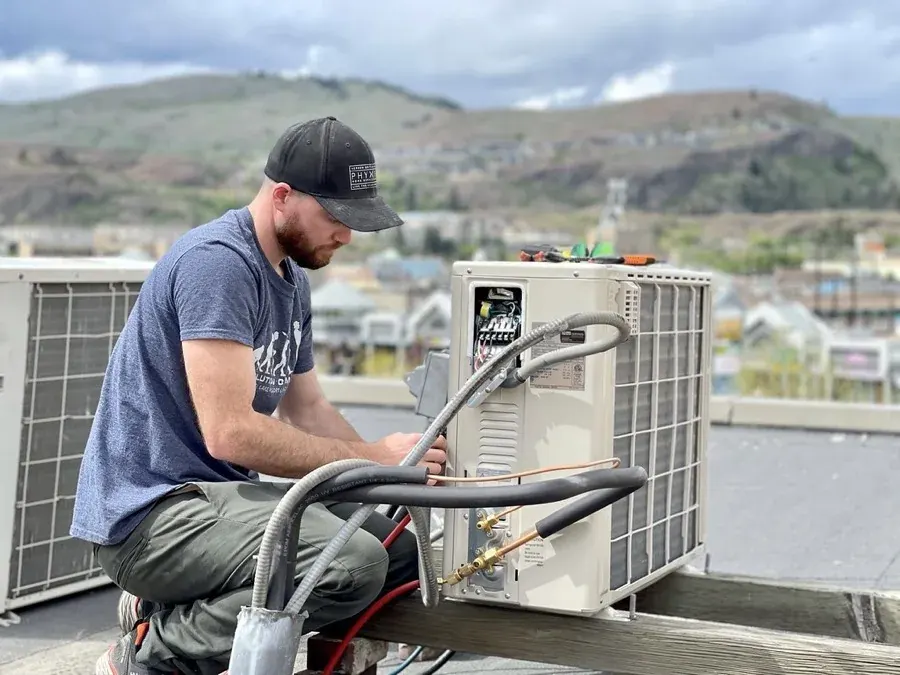
If you have been searching for a mini split system you can install yourself without owning a vacuum pump, handling refrigerant, or holding an HVAC certification, you are looking for a very specific category of equipment. These are true DIY ductless heat pumps that ship with a factory pre charged line set and sealed quick connect fittings. You connect the copper lines between the indoor unit and the outdoor condenser using basic tools, and the sealed refrigerant circuit stays closed from the factory floor to your wall mount.
The reality is that vacuum-free mini split systems comprise fewer brands than most shoppers expect. Many companies market their products as "DIY-friendly," yet typical units still require specific installation processes like flaring connections and pulling a vacuum. Not all pre-charged systems bypass vacuum pump requirements; many still need evacuation before startup.
In 2026, only a few brands deliver genuine pre charged quick connect line set technology, and this guide compares the two with full single-zone and multi-zone lineups: Zone Air and MRCOOL. Of the two, Zone Air is the only one that does final assembly, testing, and inspection in the USA on every unit, offers custom line set fabrication, and lets you mix wall, concealed, and cassette air handlers on a single condenser (as of November 2026). MRCOOL sells its DIY line through dealers and retailers.
This guide covers single-zone and multi-zone ductless systems built for real DIY homeowners, not contractor-only equipment. Every pick avoids the need for a vacuum pump, special tools, or an EPA license.
The market for true DIY mini splits is still small in late 2026, but it is growing. We have looked at every system against the standards that matter most to you if you are doing your own install:
Only a handful of brands qualified. Most "DIY-friendly" mini splits still ship with empty line sets that force you to own or rent a vacuum pump and gauges.
With a narrow market, this list focuses on a few high-quality, clearly different product series available in 2026. Rankings put weight on ease of diy installation plus long-term performance rather than brand name recognition alone.
For most DIY homeowners, the Zone Air single-zone series is the best all-around choice. Zone Air does final assembly, testing, and inspection in the USA on every unit, the 9,000 and 12,000 BTU 230V models reach 24 SEER2, and the line sets are custom pre charged line sets fabricated to your exact length requirement, up to 75 feet in a single run.
As of November 2026, Zone Air combines several advantages that MRCOOL does not match at the same time:
Modern mini split systems use low-GWP refrigerants like R-454B, and Zone Air's lineup uses this newer refrigerant that is more environmentally responsible across its pre charged line set options.
For whole-home or multi-room diy projects, we'd point you to Zone Air's multi-zone series. You still don't need a vacuum pump, professional installation or any handling of refrigerant.
Zone Air is the only DIY mini split that lets you mix wall-mount, ceiling cassette and concealed ducted units on one outdoor unit as of November 2026. That means you can run a wall unit in the living room, a slim concealed air handler in the bedroom hallway, and a ceiling cassette in an open-plan kitchen, all from the same outdoor unit.
MRCOOL's ducted DIY option is a central air handler sized for a whole home, which isn't the same thing as Zone Air's concealed ducted mini split that's built for a single room or two or three small ones. The same final assembly, testing, and inspection in the USA, high efficiency, and custom line sets carry across the multi-zone range. Zone Air's multi-zone systems hit 24 SEER2 with wall heads, against MRCOOL's 23.9 on the 18K and 23 on the 27K. Cassette and concealed heads rate 19 to 22 SEER2.
These are the easiest mini splits to power up in 2026 because they can plug into a dedicated 15A 115V outlet using Zone Air's plug-in kit where local electrical code allows a plug-in install. This reduces or eliminates the need for a new hard-wired circuit.
Zone Air is the only brand that offers a plug-in outlet solution for homeowners who want a system that plugs into an outlet (as of November 2026). Zone Air's plug-in kit for its 115V DIY systems lets you plug the system into an outlet. The plug-in kit combined with the 115V system makes Zone Air's the easiest systems to install on the market. MRCOOL's 115V units are hardwired. You can install systems that have pre-charged quick-connect line sets without getting professional help, and in ideal conditions you can get a DIY mini split up and running in just a few hours.
This setup works well for people renting who have the property owner's approval, plus work spaces, finished basements and garages where your panel capacity may be limited and running new wire for a 230V circuit just isn't practical.
MRCOOL's DIY 5th Gen is the other full lineup that comes with pre-charged line sets in the diy mini split market. With pre-charged quick-connect line sets, the 5th Gen single-zone comes ready so you don't need a vacuum pump, and MRCOOL DIY units range from 9,000 to 36,000 BTU depending on which model you pick.
With the pre-charged line set in MRCOOL's 5th Gen, you get eco-friendly R-454B refrigerant. You don't need to do any vacuuming with these pre-charged line sets. MRCOOL's catalog says "No special tools or training are necessary to install."
This is a multi-zone quick-connect system for you if you want multi-room coverage with no vacuum pump and are comfortable staying within the MRCOOL product family.
Both Zone Air and MRCOOL make true DIY systems that have pre-charged line sets. Here's how they stack up for different situations:
| System | Best For | Max SEER2 | Line Set Options | Indoor Styles | Support Model |
|---|---|---|---|---|---|
| Zone Air Single-Zone | Single rooms, garages, ADUs | 24 (230V) | Custom, 5 to 75 ft | Wall | Direct to consumer |
| Zone Air Multi-Zone | Multi-room, mixed heads | 24 (wall heads) | Custom per zone, 5 to 75 ft | Wall, concealed, cassette | Direct to consumer |
| Zone Air 115V Plug-In | Easiest electrical setup | 23 | Custom, 5 to 75 ft | Wall | Direct to consumer |
| MRCOOL 5th Gen Single-Zone | Sizes up to 36,000 BTU | 23.6 | Fixed (11.5 to 50 ft), couplers to 75 ft | Wall | Via retailer/distributor |
| MRCOOL Multi-Zone | Four to six zones | 23.9 | Fixed, couplers to 75 ft | Wall, one-way cassette | Via retailer/distributor |
Zone Air and MRCOOL are the two brands compared here that ship genuine pre-charged quick-connect line sets across single-zone and multi-zone lineups, with no vacuum pump and no HVAC certification required.
Before ordering, think carefully about room count, your climate zone, available power and your comfort level with basic tools.
A single-zone unit is enough when you need to condition one garage, bonus room or home office. If you are setting up two or more rooms from one condenser, a multi-zone system saves outdoor wall space and makes the install easier.
Mixing wall units with concealed or cassette air handlers gives you a big advantage for looks and airflow. A wall mount works well in a living area, but a concealed air handler hidden above a drop ceiling keeps bedrooms looking clean. Putting all three styles on one outdoor unit is a strength that only Zone Air's multi-zone systems have in the DIY market (as of November 2026).
The way you route the line set matters more in complex layouts. Zone Air offers custom lengths, so you don't have to daisy-chain extensions. That means fewer joints and fewer places where a leak can develop. You have to handle line sets with care so you don't damage them, and you need to make sure they seal properly no matter what brand you use.
If you don't want to add a 230V circuit, Zone Air's 115V systems are a good fit. Once you get into the larger capacity units (18,000 BTU and up), 230V is standard and you'll need a dedicated breaker with the right wire gauge. If working with the electrical panel isn't something you're comfortable with, you can hire a licensed electrician to run that circuit and still handle the rest of the HVAC install on your own.
Compared to hard-wired installs, the 115V plug-in capable models from Zone Air make the electrical side less complex. For the HVAC part itself, the basic DIY skills you'll need are drilling a wall penetration for the line, mounting the indoor unit bracket, connecting the pre charged line set with the correct torque on the fittings, and checking those connections with soapy water.
Pre-charged mini split systems come with factory-sealed, quick-connect line sets, so you don't need an EPA certified technician or hvac certification for the refrigerant side. For you, the hardest part is drilling the wall hole and running the copper lines so they look neat.
Higher SEER2 ratings will save you money as time goes on, especially in rooms where the heating or cooling runs for many hours each day. In rooms that run all day, Zone Air's 24 SEER2 230V models are the most efficient pre-charged quick-connect systems out of the brands we compared here, and that shows up as lower power bills.
If you're in a cold climate, check what the unit's rated heating capacity is at low outdoor temperatures. Down to -13°F is where Zone Air is rated, and that is the same floor as MRCOOL's standard DIY 5th Gen. Rated lower are the higher-tier DIY models. Keep in mind that BTU output drops when it gets extremely cold, so going a bit larger on size or planning for backup heat is a smart move in the coldest zones.
Before you buy, look at AHRI listings and local utility rebate programs. AHRI Certified are Zone Air models, and that makes getting rebates simpler. A lot of rebates favor higher-efficiency units, and that can save you hundreds off the regular price of the equipment.
Different situations call for different systems. There's a quick way to think through it:
Only a handful of brands in 2026 offer true pre-charged, no-vacuum mini splits. Most systems marketed as "DIY-friendly" still require a vacuum pump, flare connections, or refrigerant work that demands an EPA certified technician.
The key differentiator for Zone Air is the combination of final assembly, testing, and inspection in the USA, custom line sets fabricated to your exact length, and flexible indoor unit combinations, all on genuine DIY systems that any homeowner can install. If saving money on professional installation while getting contractor-grade quality matters to you, Zone Air's lineup is the strongest option on the market.
Before you order, size your system carefully, plan your line set runs to avoid unnecessary bends, and contact Zone Air support for personalized help with load calculations and line set lengths. The right pre-charged quick-connect mini split can deliver contractor-grade comfort with homeowner-friendly installation, and that is exactly what these systems were built to do.
