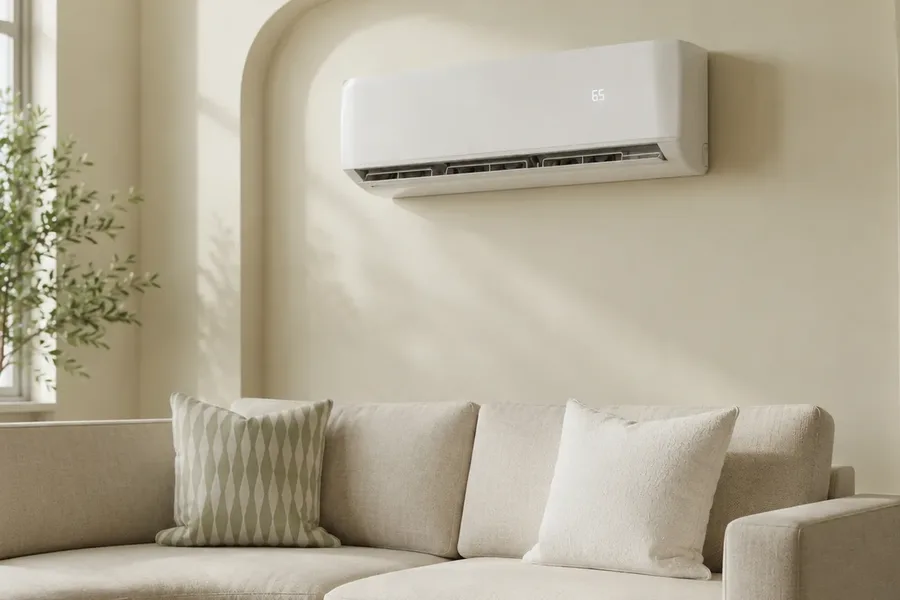
115V 9000 BTU Mini Split Heat Pump: Official Specs & DIY Install Guide (Zone Air)
Specs, sizing, wiring and a step-by-step install for a 9,000 BTU heat pump that runs on a dedicated 15A household circuit.
If you want a 115V 9000 BTU mini split heat pump to heat and cool a single room without tearing into your electrical panel or hiring an HVAC crew, this guide covers everything you need to know. Below you'll find official specs, a clear DIY installation overview, and a comparison of the top 115V 9,000 BTU mini split heat pump options available in 2026, with Zone Air leading the pack.
115V 9,000 BTU DIY Mini Split Overview
Zone Air's 9,000 BTU 115V DIY mini split is our top pick for single room climate control on 115V in 2026. It combines easy installation, 23.0 SEER2 efficiency and cold weather heating down to −13°F, all on standard household current. This is a ductless mini split heat pump system with an inverter-driven compressor, a pre-charged line set with sealed quick connect fittings, and no vacuum pump or refrigerant handling required.
Typical use cases include bedrooms, home offices, finished basements and garages that cover roughly 250–450 square feet and need year-round comfort. Because it runs on 115V, you don't have to pay for costly 208/230V panel upgrades, so this is a true DIY mini split project for most homeowners.
What you get in the box:
One outdoor condenser (R-454B, pre-charged)
One indoor air handler (wall mounted)
16 ft pre-charged line set that has quick connect fittings
Communication cable, plus condensate drain hose and tape
Wireless remote control that has full mode selection
Mounting hardware
You can get Zone Air's written DIY manual and you can get the install video library too.
What Is a 115V 9,000 BTU Mini Split Heat Pump?
A 115V 9,000 BTU ductless mini split heat pump has one outdoor unit (the condenser) and one indoor air handler, and these are connected by an insulated refrigerant line set and a communication wire. Together, the indoor and outdoor units transfer heat rather than generating it, and this gives you both heating and cooling through a single system that can go either way.
With the "115V" label, the system runs on standard North American household power, about 110–120V, 60 Hz. A 115V mini split runs on a standard household-voltage circuit without heavy-duty upgrades, unlike 208/230V systems that usually need new breakers, heavier gauge wire and sometimes panel modifications.
9,000 BTU capacity is about right for individual rooms, tiny homes, ADUs and studios.
Ductless means you get zoned climate control without any ductwork, so there are no air ducts to run and no ceiling tear-outs.
A heat pump is a single system that gives you both heating and cooling, and it uses the refrigerant cycle in reverse to give you ductless heating in winter.
115V vs 230V: 115V systems run on a dedicated 15A household circuit. 230V systems need dedicated double-pole breakers and often call for professional installation
Official Specs for Zone Air 9,000 BTU 115V Mini Split
DIY installation does not void the warranty when the manual and local building codes are followed
When a 9,000 BTU 115V Unit Fits
How big the room is and how well it's insulated determines the ideal size for a mini split heat pump. With a 9K 115V unit, Zone Air is going for rooms in the 250–450 sq ft range, which covers a bedroom that is 12×20, an office that is 15×20, or a single-bay garage that's well insulated.
There are several factors that can push you toward a larger 12,000 BTU system instead:
Ceiling heights above 8 ft increase air volume significantly
A lot of sun coming in through glass that faces south or west adds heat from the sun
Poor insulation or single-pane windows let the conditioned air leak out
High occupancy or lots of electronics generate extra internal heat
Systems that are sized right deliver better control of humidity, less short-cycling, operation that is quiet and longer life for the equipment. A 9K 115V unit draws less amperage than a 12K model, so it's a good fit when the capacity of your electrical panel is limited.
Common 9K 115V scenarios:
Nurseries and kids' bedrooms (200–350 sq ft)
Home offices with computer equipment (250–400 sq ft)
Finished basements and bonus rooms (300–450 sq ft)
Insulated workshops and garages (250–400 sq ft)
A simple rule of thumb is 20–30 BTU per square foot depending on climate, but if you want the most accurate answer, you should do a Manual J load calculation or use an online sizing calculator.
Why Choose 115V Over 230V for a 9K Mini Split?
Choosing 115V over 230V comes down to practical things that many homeowners face:
Older homes often lack spare 230V double-pole breaker spots
Rental spaces where panel upgrades aren't permitted
Detached structures like sheds, garages and ADUs already have 120V circuits wired in
Budget: avoiding an electrician for panel work saves hundreds of dollars
On efficiency, the 115V system at 23 SEER2 sits close to Zone Air's own 230V 9K at 24 SEER2. On a single room, the energy cost difference is small and usually not enough to make the added electrical work worth it.
With its optional cord kit, Zone Air offers a plug-in option for 115V systems, letting the outdoor condenser connect to a dedicated outlet instead of being hard-wired, where local electrical code allows a plug-in install. Most 230V systems have to be hard-wired by a professional. Our plug-into-outlet install guide walks through that setup step by step.
The one big limitation is that 115V caps practical capacity at roughly 9K–12K BTU in a single-zone configuration. Larger multi zone systems or 18K+ BTU setups still need 208/230V service. For a single room DIY mini split project, 115V at 9,000 BTU hits the best balance of capacity, easy installation and electrical ease.
Zone Air vs MRCOOL and Other 115V DIY Brands
For a 115V DIY mini split project in 2026, Zone Air is our pick over MRCOOL because it wins on the things that change the install itself: line set length, plug-in power and hot-weather range. More 115V models are ranked in our best 115V DIY mini split roundup.
Efficiency:
Both of Zone Air's 9K and 12K 115V units come in at 23.0 SEER2
In a single room, the real-world gap between 23.0 and 23.6 is small. On 230V, Zone Air has the efficiency lead: its 9K and 12K reach 24 SEER2, which is the highest of the pre-charged quick-connect DIY brands we compared here (the best single-zone from MRCOOL is 23.6).
Refrigerant:
Both MRCOOL and Zone Air use R-454B in their current 115V units (MRCOOL catalog), so there is no difference here.
MRCOOL sends fixed sets that are 11.5, 16, 25, 35 and 50 ft and they also send couplers (MRCOOL catalog). If your run is past 50 ft, you join two sets with a coupler. You coil the excess behind the condenser.
Electrical setup:
With the optional cord kit, Zone Air's 115V models can plug into a dedicated 15A outlet where local code allows that. MRCOOL's 115V 9K and 12K are hardwired instead.
This single difference saves hours of electrical work and it often means you don't need to get a licensed electrician at all.
Cold and hot weather performance:
Down to −13°F, Zone Air's 9K heats and that is the same floor as MRCOOL's standard DIY 5th Gen. Higher-tier MRCOOL DIY models are rated lower and they run on 208/230V.
For a 115V single-zone system, Zone Air matches what MRCOOL offers at the same voltage when it gets cold.
In summer, Zone Air is rated to cool in outdoor temperatures up to 131°F. MRCOOL publishes 122°F.
Warranty:
Zone Air clearly allows DIY installation without voiding warranty. It has direct tech support, a written DIY manual and a library of install videos.
Many brands offer warranties that are different for DIY and professional installations. With Zone Air, that confusion is gone completely.
Zone Air's warranty page spells out the terms clearly: 7-year compressor, 5-year parts, 1-year remote, with no registration deadline.
MRCOOL's DIY 5th Gen carries the same 5-year parts and 7-year compressor headline term. It also has no registration required.
At $1,999.99, Zone Air's 12K 115V costs less than MRCOOL's 12K 115V, which runs about $2,359 at Home Depot as of September 2026.
Zone Air sells direct, so you get accurate specs, genuine parts and access to custom configurations without paying a dealer markup.
Pre-Charged Lineset, Communication Wire & Accessories
The system includes a pre-charged line set: 16 ft of factory-sealed R-454B refrigerant lines with quick connect fittings. You don't need gauges, a vacuum pump or EPA Section 608 certification. This is what makes a DIY mini split genuinely achievable for homeowners.
With a single continuous run, Zone Air offers custom length pre-charged line sets from 5 to 75 ft. That gets rid of the need for couplers and it lowers leak potential.
The communication cable is the line that runs between the outdoor condenser and the indoor air handler, and it carries the low-voltage control signals. You don't need a third-party thermostat.
From the indoor unit, the condensate drain hose carries moisture to an exterior discharge point.
Included accessories:
Mounting hardware for the air handler
Condensate drain hose and tape
Optional line set covers if you want the outside to look clean (sold separately)
Planning tips:
Before you order a custom line set, measure the exact length from the indoor spot to the outdoor spot that you planned out.
Keep vertical lift under 33 ft
Don't make tight turns. You need to keep to the minimum bend radius in the manual.
Shorter runs work better: if you stay around 16–33 ft, most homes will get the best performance.
Electrical Setup for 115V 9,000 BTU Mini Split
All electrical work must follow NEC and local building codes. If you're not comfortable working with electrical wiring, it's a good idea to hire a licensed electrician for this portion.
Typical requirements:
115V, 60 Hz, single-phase power
For the 115V mini split, you need a dedicated 15A circuit. Don't share it with other loads.
14/2 copper NM cable (or outdoor-rated wiring that works for this job) from the breaker panel
A weather-rated disconnect box near the outdoor unit (required by most local codes)
You need a dedicated 15A circuit whether you hard-wire the unit or use the plug-in option.
A 9,000 BTU system from some other brands usually needs a 20A breaker, but Zone Air's 9K runs on a 15A single-pole breaker. That's the kind that's easier to find in most existing panels.
Plug-in vs hard-wire:
With Zone Air's optional cord kit, you can plug the outdoor unit into a dedicated 15A GFCI receptacle that has a weatherproof "in-use" cover, in areas where local code allows it
Hard-wiring is the other way: run cable from the breaker through conduit to the outdoor unit's electrical compartment
Extension cords are strictly prohibited
Power always goes to the outdoor condenser first. The indoor unit then gets its power and control signals through the communication wire
Common mistakes to avoid:
Using wire that's too small (never use 16-gauge for a 15A HVAC circuit)
Sharing circuits with other appliances
Skipping GFCI protection in garages, basements or exterior locations
Omitting the outdoor disconnect switch
Step-by-Step DIY Installation Overview (No Vacuum Pump)
This is a high-level summary. It does not replace Zone Air's official manual. DIY mini split systems mean no HVAC certification or vacuum pump is required. Installation usually takes 4–6 hours for two people. Proper installation ensures effective airflow and keeps operational issues down.
Planning:
Confirm the room size and that 9K BTU is enough
Select the indoor wall location: near studs, 6–8 inches below the ceiling, away from heat sources and obstructions
Pick a spot for the outdoor pad or wall bracket with at least 6–12 inches of clearance on the sides and 24 inches in front.
Figure out the route for the line set from the indoor unit to the outdoor unit, and note where you will go through the wall.
Indoor work:
Mount the air handler plate to the wall with a level. Getting this right helps the unit run quiet and drain condensate the way it should.
Drill a hole about 3 inches through the wall and angle it slightly downward so it slopes toward the outside.
Feed the pre-charged line set through the wall, along with the communication wire and the drain hose.
Once the plate is mounted, the indoor unit hangs on it.
Outdoor work:
Set the outdoor condenser on a level pad, or bolt it to a wall bracket and put vibration pads under it to cut down on noise.
In cold climates, elevate the unit above expected snow depth
Connect the refrigerant lines with the sealed quick connect fittings, then tighten them with a torque wrench set to the values Zone Air says to use.
With quick connect fittings, installation is easier because they only release the pre-charged refrigerant once they're tightened down right.
You don't need a vacuum pump because the line set is sealed at the factory.
Electrical and testing:
Complete the electrical setup, either hard-wiring it or plugging it into a dedicated outlet.
Turn the breaker back on or plug in the cord kit.
You can power it on, set the mode and temperature, and run it through test cycles in both heating and cooling.
Verify condensate drain slope and discharge location
Finishing:
Seal the hole in the wall with caulk or putty that is weatherproof.
Install line set covers if desired
Clean up the work area and take photos of the installation for your warranty records.
Heating and Cooling Performance Year-Round
For cold-weather heating, Zone Air's 9K 115V split heat pump handles both summer cooling and ductless mini split heat when it's cold outside. It's rated for heating down to −13°F outdoor temperature.
Inverter technology:
Running at whatever speed matches your heating or cooling load, the DC inverter compressor doesn't just turn full on and full off like a window AC. It speeds up and drops instead, so it uses less energy, keeps the temperature more even, and stays quiet even when it's running in sleep mode overnight.
Cold weather performance:
At moderate winter temperatures, the unit has strong heat output. Its rated COP2 is 3.81 at 47°F and it's still 2.1 at 5°F, which is well above what you'd get from electric resistance heat.
As outdoor temperatures drop toward −13°F, the amount of heat the unit can put out goes down. Backup heat may be needed below −13°F in regions that routinely see extreme cold
Both the 9K and 12K models are able to keep working in outdoor temperatures down to −13°F.
Defrost cycles:
Below about 40°F, the outdoor coil may accumulate frost. To melt the ice, the system periodically switches the direction of the refrigerant flow. This causes brief stops in heating, visible steam from the outdoor unit, and condensate water running off. This is normal and automatic.
Summer cooling:
With a range of 2,500–12,500 BTU/h, the cooling output changes across a wide range, maintaining steady temperatures without the annoying on-off cycling of window units. It is rated to keep cooling in outdoor temperatures up to 131°F. Thanks to the 23.0 SEER2 rating, the amount of electricity the unit uses for each BTU of cooling is a lot lower than window ACs or portable units.
Controls, Smart Features & Everyday Use
The full-featured remote control that comes with Zone Air lets you adjust temperature, select modes (cool, heat, dry, fan), set fan speed, control louver swing, turn on sleep mode and program timers.
App control: Wi-Fi lets you manage settings from a smartphone, set schedules and use Amazon Alexa or Google Home for voice commands
Display: the indoor air handler shows the current temperature and self-diagnostic codes. You can switch the display off if you want to use it in a bedroom
Sleep mode: it slowly changes the temperature overnight so you're more comfortable and it uses less electricity while you rest
Energy-saving features: ECO mode and the IFEEL (Follow Me) sensor, which changes the setpoint based on where the remote is instead of where the sensor on the wall unit sits
Maintenance: wash or vacuum the filters every 4–8 weeks, wipe down the cabinet, clean the indoor coil now and then, and keep leaves, snow and debris away from the outdoor unit
Homeowner installation done according to the official manual and local code does not void the warranty, which is a critical distinction from many non-DIY brands where professional installation is mandatory for coverage
To help you through installation and commissioning, Zone Air has live technical support (8 AM–6 PM MT), a written DIY manual, and an install video library
Zone Air systems get final assembly, testing, and inspection in the USA from globally-sourced components
Take photos of the electrical setup, the line set connections and the serial numbers to document your installation so any future warranty claims go easier
No licensed HVAC technician is required for installation or warranty activation. That said, if you're uncomfortable with any portion, especially electrical work, it's always a smart move to hire a professional for that specific step.
Cost, Operating Savings & Financial Value
As of November 2026, the 9,000 BTU 115V DIY kit from Zone Air runs $1,899.99. You get the indoor unit, the outdoor condenser, the 16 ft pre-charged line set, the remote control and the mounting hardware in the box. That price is in line with what other brands charge for similar 115V kits.
DIY installation cuts out most of the cost of labor, while a professional install puts a labor bill on top of the equipment price.
You'll save a lot on the cost of running the unit compared to window AC units and electric resistance heaters. With a 23.0 SEER2 cooling rating and a 10.0 HSPF2 heating rating, you get lower monthly utility bills.
In climates with hot summers and cold winters, energy savings plus going without ductwork can pay back the cost of the equipment over time. How fast that happens depends on your climate and your electricity rates.
A ductless mini split that is sized properly can improve comfort and potentially add value to your home compared to portable ACs or plug-in space heaters
Zone Air sells direct through their website, which keeps pricing transparent and ensures you receive genuine accessories and warranty coverage without third-party markups. No specialized HVAC tools are required beyond a torque wrench and basic hand tools, and no vacuum pump enters the picture.
9,000 BTU vs 12,000 BTU and Larger
Feature
Zone Air 9K 115V
Zone Air 12K 115V
18K+ BTU (230V)
Coverage
250–450 sq ft
350–600 sq ft
600–1,200+ sq ft
SEER2
23.0
23.0
Varies (20–24+)
Voltage
115V (15A)
115V (15A)
208/230V
Heating floor
−13°F
−13°F
Varies
Price (Nov 2026)
$1,899.99
$1,999.99
$2,500+
Best for
Single room DIY
Larger single room
Multi zone systems, open plans
Zone Air's 12K unit is $1,999.99 as of November 2026, just $100 more than the 9K. MRCOOL's 12K 115V unit runs about $2,359 at Home Depot as of September 2026, so that's a big gap. For both sizes reviewed side by side, see our 115V DIY mini split guide.
Both the 9K and 12K rate 23 SEER2, have the same climate control features, and both work down to −13°F. They both need a dedicated 15A circuit. Pulling more current is the only difference with the 12K.
Systems at 18,000 BTU and up almost always need 208/230V service. They're built for open floor plans or multi zone systems rather than single small rooms. If you want more rooms covered, Zone Air's 230V multi-zone systems are the only DIY mini splits that let you mix wall-mount, ceiling cassette and concealed ducted units on one outdoor unit as of November 2026. Their wall-mount heads rate 24 SEER2.
If you're stuck between 9K and 12K, think about whether your room has high ceilings, large windows or poor insulation. When you're not sure, check a sizing calculator or call Zone Air's support team. Oversizing is bad for dehumidification and causes short-cycling, so don't just go bigger to be safe.
Where to Buy a 115V DIY Kit
Zone Air sells direct through their official website, and that's the best place to get accurate specs, genuine pre-charged line sets, custom line set lengths and the optional cord kit. Zone Air offers free shipping to the lower 48, with 1–2 business days to process and 2–5 in transit. They also have 30-day returns on uninstalled units.
Pre-purchase checklist:
Confirm voltage: 115V
Confirm breaker size: 15A dedicated circuit
Choose indoor unit style: wall mounted air handler
Measure the line length you need and select it (the standard 16 ft or a custom exact length up to 75 ft)
Verify the climate rating: the unit heats down to −13°F for cold climates
Check what certification your local utility rebate asks for (Zone Air units are AHRI Certified)
You'll need to decide if you need the optional cord kit for plug-in connection
You have the equipment for a complete homeowner installation in the base kit from Zone Air. You'll need to supply the tools and the electrical materials. If you're ordering through a third-party store, verify that the listing includes quick connect fittings that are pre-charged and carries the official Zone Air warranty.
Inspect the shipment when it arrives. If you notice freight damage, take photos right away and contact Zone Air support within 48 hours before you go any further.
FAQs About 115V 9,000 BTU DIY Mini Splits
Can the outdoor unit plug into an outlet instead of being hard-wired?
Yes. Zone Air offers an optional cord kit that lets you plug the outdoor condenser into a dedicated 15A GFCI outlet where local code permits. Extension cords are never allowed.
What room size can a 9K 115V handle?
Roughly 250–450 sq ft with typical insulation and ceiling heights. Rooms with heavy sun exposure, poor insulation or high ceilings may need a 12K unit instead.
Do I need a vacuum pump?
No. Zone Air's pre-charged line set is factory-sealed with R-454B refrigerant. No vacuum pump, no gauges and no EPA Section 608 certification are needed for installation.
Is a 115V mini split less efficient than 230V?
Slightly. Zone Air's 9K is 23.0 SEER2 on 115V and 24 SEER2 on 230V. The small efficiency gap is typically outweighed by easier electrical setup and lower installation costs.
Will it heat in winter?
Yes. Zone Air's 9K 115V heat pump delivers heating down to −13°F. In regions that routinely drop below that range, consider adding a backup heat source like an electric wall heater. Heating output decreases as outdoor temperatures approach the −13°F floor.
What's the maximum line set length?
Zone Air supports custom runs up to 75 ft with up to 33 ft of vertical separation. Staying near standard lengths (16–33 ft) is best for optimal performance.
Is a 115V DIY mini split worth the investment?
For most single-room applications, yes. Between labor savings from homeowner installation, high-efficiency operation that cuts energy waste versus window units or space heaters, and room-by-room climate control without ductwork, the payback depends on your climate and electricity rates. A licensed HVAC technician isn't required, which takes the installer's labor bill out of the project.
How long does installation take?
Plan for 4–6 hours with two people, assuming the electrical circuit is already in place. An HVAC tech is not required for the refrigerant side of the job since the line set comes factory-charged and sealed.
Specs and warranty terms are manufacturer-published as of November 2026, subject to change. Verify before purchase. MRCOOL® is a trademark of its owner. Zone Air is not affiliated with or endorsed by MRCOOL.