Section 01
Best 24,000 BTU Mini Split
A 24,000 BTU mini split system cools or heats roughly 1,000 to 1,500 square feet under standard conditions. That makes a 2-ton ductless mini split a common choice for large open-concept living areas, whole small homes, or oversized single zones. But "standard conditions" is doing a lot of work in that sentence. Depending on your climate, insulation, window area, and ceiling height, 24K could be too much or not enough.
This guide pulls together the best 24,000 BTU mini split options for 2026, putting them in groups by buyer type and climate. Every pick is a single-zone heat pump that both cools and heats, since most people want year-round use from one outdoor unit and one indoor unit.
Section 02
How We Picked the Best 24,000 BTU Mini Splits
Key Evaluation Criteria
Sizing match and turndown ratio. A 24K unit rated at full capacity still needs to run comfortably on a mild 65°F day. That requires the compressor to ramp down to 20-25% of nameplate output via advanced inverter technology. If the minimum output is too high, the system short-cycles: it blasts cold air, shuts off, waits, then blasts again. Short cycling kills humidity control, wastes energy and wears the compressor. Premium models publish their minimum capacity; look for units that can drop to 5,000-7,000 BTU/h or lower.
SEER2 and HSPF2 efficiency. SEER2 measures seasonal cooling efficiency for air conditioners and heat pump systems under the updated M1 test procedure required since 2023. HSPF2 measures heating. For 24K units in 2026, a SEER2 around 17-20 is solid; above 20 qualifies as a high efficiency model. Higher SEER2 ratings mean lower monthly electricity bills. In heating, HSPF2 above 10 is decent; cold-climate leaders reach 12-14. Mini splits can have varied efficiency ratings based on brand and model, so checking AHRI-certified data matters more than marketing claims.
Cold-climate performance. Standard heat pumps lose efficiency when outdoor temperatures drop below freezing. Cold-climate models can maintain output well below freezing temperatures, sometimes to -13°F or -22°F, by using enhanced vapor injection compressors and pan heaters. If the 24K unit is your primary heat source in a northern state, you need published capacity figures at 5°F and 17°F, not just a rated low-temperature limit.
Noise levels. For a wall mounted 24K indoor head, expect roughly 25-30 dB at low fan speed (comparable to a quiet library) and 42-50 dB at high speed. Quiet operation matters if the unit sits in a bedroom or open living area. Some premium brands achieve ultra quiet operation at low speed, under 25 dB, which is near the threshold of hearing in a furnished room.
Reliability and warranty. Professional installation is often required for high-capacity mini split systems to maintain warranties. A reliable mini split brand typically backs its product with 10-12 years on the compressor and parts when installed by a licensed pro and registered. Shorter warranties (5-7 years) are common on value brands. For reference, Goodman offers a 5-year warranty on most mini splits, while premium brands extend coverage to 12 years. Most mini split systems require professional installation for safety and code compliance.
Installation path. Single-zone mini-splits are easiest to install and least expensive. Multi-zone systems require more complex installation and professional help. For a single 24K unit, you can go the professional installation route (custom line lengths, vacuum, pressure test, full warranty) or choose a DIY installation kit with pre-charged line sets. DIY mini-split units typically require no ductwork and simple wall drilling. The trade-offs: DIY saves $1,500-$3,000 in labor but limits line-set length, may constrain condenser placement and can affect warranty terms. Most 24,000 BTU systems require a dedicated 208/230-volt electrical circuit either way.
Value for money. Equipment-only pricing for a 24K mini split ranges from about $900-$1,400 for budget brands to $2,500+ for premium performance models. But upfront cost is only part of the picture. Verified HVAC Data shows that among certified 2-ton heat pumps, the cost of delivered heat ranges from about $13.95 per MMBtu (most efficient models) to $26.15 per MMBtu (least efficient). Over a 40 MMBtu heating season, that is $558 vs $1,046; a $488 annual difference in heating bills alone. Ductless mini splits often use inverter technology for energy savings and consistent performance, but the efficiency tier varies enough that a cheap unit can cost more over 10 years than a premium one.
Section 03
Best 24,000 BTU Mini Splits for 2026
1. Premium Cold-Climate 24,000 BTU Mini Split (Mitsubishi Hyper-Heat 2-Ton Wall Mount Example)
This category is the best mini split system choice when the 24K unit will be the main heat source in a cold-winter climate. Think about the Upper Midwest, New England and mountain West, where the temperatures that engineers use for winter design drop well below 0°F.
Why It Stands Out
Mitsubishi Electric's Hyper-Heat technology works down to -13°F with near-full heating capacity, and the FX-series outdoor unit is cold-climate certified to -22°F. The MSZ-FX24NL, for example, has a SEER2 of about 23.5 and HSPF2 of about 10.5. Even further, the higher-end MSZ-FH24NA Hyper-Heating model goes. Mitsubishi mini splits reach up to 33.1 SEER across their product range, though the 24K size usually ends up in the low-to-mid 20s for SEER2.
Running quietly at low speed, the indoor units keep temperatures steady without the blast-and-coast cycles you get with cheaper systems, and the inverter compressor changes smoothly across a wide range. Mitsubishi units last 15 to 20 years when they're maintained properly. That helps explain the premium price.
Best For
-
Homeowners in climates with winter design temps below 15°F who want to cut back on fossil-fuel backup heat or get rid of it completely.
-
Whole-home heating for about 900-1,200 square feet in homes with a tight envelope, or large open-plan zones in mixed climates.
Key Strengths
-
Cold-climate rating with published performance tables down to at least -13°F. Certified to -22°F, the outdoor unit is.
-
High SEER2 and HSPF2 are what give you low annual operating costs, so you pay less for both cooling and heating.
-
Excellent range of change (low minimum BTU output) so it doesn't short-cycle in spring and fall.
-
Mitsubishi offers a 12-year compressor warranty when you register it with professional installation.
Possible Limitations
-
Mitsubishi mini splits usually cost $3,500 to $5,500 installed. That is at the high end for a single-zone system.
-
You'll need professional installation through Mitsubishi's dealer network to get the full warranty.
-
It's too much if the 24K unit is just a bonus zone in a mild climate or a space you rarely use.
2. Hot and Humid Climate 24,000 BTU Mini Split (Daikin 2-Ton with Strong Latent Capacity Example)
This pick is built for the Gulf Coast, Southeast and mid-Atlantic, where humidity control matters as much as temperature. Daikin mini splits are a good fit for these regions.
Why It Stands Out
Daikin is best for hot, humid climates with superior dehumidification. Their coil design and control logic allow long, low-speed fan runs that pull moisture from indoor air without over-cooling the space. That steady moisture removal keeps indoor relative humidity around 45-55% even during hot, sticky summers. Daikin mini splits have SEER ratings above 18, and 24K models usually end up in the SEER2 20-21 range with HSPF2 around 10-11, enough for mild-winter heating.
Daikin mini splits can operate in temperatures as low as -13°F, so they handle the occasional cold snap in the mid-South, but their real strength is cooling performance in hot, sticky weather.
Best For
-
Homes in places like Houston, New Orleans, Orlando and the coastal Carolinas are where you'll find the 24K unit used for primary cooling and shoulder-season heat.
-
Large, open living areas or main floors of about 800-1,300 square feet in humid climates where your comfort and air quality depend on steady dehumidification.
Key Strengths
-
Excellent moisture removal with coil design tuned for latent load.
-
Energy-efficient part-load performance when it runs continuously at low speed. On moderate days, the compressor barely draws power.
-
Daikin gives you a 12-year compressor and 10-year parts warranty, so you're covered long-term.
-
Works with Wi-Fi apps for schedule control and diagnostics.
Possible Limitations
-
Not as strong as true hyper-heat models below about 10-15°F. If you're in a cold climate, look at the premium cold-climate category instead.
-
Costs more than basic foreign brands with similar nameplate SEER2 but worse humidity performance. Daikin mini splits come with a premium brand price tag.
3. DIY-Friendly 24,000 BTU Mini Split Kit (MRCOOL-Type 2-Ton DIY System Example)
MRCOOL makes DIY mini-split systems for you if you're comfortable with basic tools, drilling through walls and electrical work. This category gets rid of the need for a licensed HVAC tech to handle refrigerant.
Why It Stands Out
The key feature is pre-charged line sets. MRCOOL offers DIY-friendly mini splits with full warranty coverage, and the quick-connect fittings mean you don't need a vacuum pump, a gauge manifold or EPA Section 608 certification. Factory-sealed at both ends, the refrigerant side is. MRCOOL units usually have 17 SEER or more in the 24K size, with some 2026 models pushing into the low 20s for SEER2. Heating capacity is fine for moderate climates but doesn't match premium cold-climate units below about 20°F.
Best For
-
DIYers in moderate climates (design temps above about 15-20°F) who are upgrading a garage, bonus room, small shop or open main floor.
-
Homes where you can't find an installer or professional labor costs are high.
Key Strengths
-
No vacuum pump or gauges require. DIY mini splits don't need ductwork and only need simple wall drilling.
-
Kits usually include lines, brackets, communication cable and mounting hardware.
-
Competitive pricing compared to pro-only brands, plus you save $1,500-$3,000 in labor.
-
MRCOOL gives full warranty coverage for DIY installations. This is unusual among DIY units from other brands.
-
Built-in Wi-Fi and app control on most 2026 models.
Possible Limitations
-
Cooling performance and cold-climate output usually lag behind premium pro-only systems at the same rated capacity.
-
Following MRCOOL's specific DIY instructions and having code-compliant electrical work is what the warranty depends on. Skip the disconnect or use the wrong breaker and you might lose coverage.
-
Lineset length and path options are more limited than custom-cut, flared copper lines used in professional installs.
4. Budget 24,000 BTU Mini Split for Mild Climates (Senville/Pioneer/Gree Value-Tier 2-Ton Example)
When budget matters most and the climate is easy on equipment, a value-tier 24K unit gives you inverter-driven comfort at the lowest upfront price. Senville mini splits perform well at a budget price and represent this tier well.
Why It Stands Out
Senville's Aura Series can reach 28.1 SEER, and that is competitive efficiency for its price class. The Senville AURA and similar value-tier models carry SEER2 around 21 and HSPF2 as high as 13.5 in certain configurations. Budget-conscious buyers can find these online for $900-$1,400 equipment-only. On paper, Senville's AURA Series operates down to -22°F, giving it cold-climate credentials, though real-world capacity retention at extreme cold isn't as well-documented as with premium brands.
Best For
-
Supplemental cooling and heating for medium-sized spaces that already have a main system, like the upstairs of a central-air home in the Pacific Northwest, Mid-Atlantic or interior California.
-
Spaces you only use part of the year: shops, rental suites and sun rooms.
Key Strengths
-
Lower upfront price for 24K cooling capacity compared to premium brands.
-
The inverter compressor still improves comfort and efficiency over old on/off AC designs.
-
Reasonable noise levels for living areas if it's installed properly.
-
Many models come with Wi-Fi modules and basic comfort modes for remote control and scheduling.
Possible Limitations
-
Senville offers a 7-year compressor and 2-year parts warranty. That is shorter than premium competitors.
-
Not ideal as your only heat source in very cold climates because checked low-temperature capacity data is limited.
-
Dealer and service networks are thinner, so you rely more on installer skill for long-term reliability.
5. 24,000 BTU Ceiling Cassette Mini Split (For Finished Basements, Open Offices or Clean Aesthetics)
A ceiling cassette head connects to a standard ductless outdoor unit but sits flush in the ceiling, blowing air in four or eight directions. Fujitsu mini splits have some of the best energy efficiency ratings in the industry and offer strong ceiling cassette options in the 24K class.
Why It Stands Out
Fujitsu's Halcyon Series hits 26 SEER in certain configurations, and their ceiling cassette models provide 4-way airflow that covers wide, open plans with fewer hot and cold spots than a single wall-mounted head stuck in the corner. Most of the unit is hidden above the ceiling. You'll only see the grille and filter panel. Fujitsu mini splits work in cold conditions down to -15°F, so they're viable in mixed climates too.
Best For
-
Drop-ceiling basements, commercial suites and large open living/dining/kitchen combinations of about 900-1,500 square feet.
-
Rooms where wall mounting doesn't work because of windows, doors or built-in cabinetry.
Key Strengths
-
Excellent air mixing with multi-directional discharge and central room placement.
-
Similar SEER2/HSPF2 to wall-mounted units in the same product family.
-
Ties into condensate pumps more easily in some setups.
-
Fujitsu has a 5-year parts and 7-year compressor warranty.
Possible Limitations
-
Needs enough ceiling cavity (usually 10-12 inches) or a drop ceiling. Won't work in homes with solid joist ceilings and no access from above.
-
Installation costs are higher than wall-mount heads due to framing, condensate routing and electrical placement.
-
Filter access for regular cleaning is less convenient than reaching up to a wall unit.
Comparison
Quick Comparison of the Best 24,000 BTU Mini Split Types
Each category is built for a different mix of climate, budget and comfort priority. Here's the short version:
How To
How to Choose a 24,000 BTU Mini Split for Your Home
Choose Based on Actual Heating and Cooling Load
Rules of thumb like 20-25 BTU per square foot can easily oversize or undersize a 24K unit. Ceiling height, window area, orientation, air leakage and local design outdoor temperature can swing the recommendation by thousands of BTU.
On our calculator, a 400 square foot room with basic defaults (1990 house, 8 ft ceiling, two exterior walls, top floor, two people, no windows) is going to produce about 8,400 BTU/h in Seattle, 8,900 in Denver, 10,000 in Phoenix, 10,900 in Houston, and 11,100 in Miami. Scale that up and a 1,200 square foot open floor plan might need anywhere from 25,000 BTU in Seattle to 33,000 BTU in Miami. In Seattle, a 24K unit can handle it. In Miami, it might fall short or it might work if the home is well-insulated and shaded. The only way to know is a proper load calculation.
Our calculator counts each person at 230 Btu/h of sensible heat (80% of that for cooling diversity) plus 250 Btu/h of moisture. If you leave the people field blank, it's going to default to bedrooms plus one, with a minimum of two. It also adds 6 Btu/h per square foot for lights and plug loads in cooling. In Pro mode, you can add always-on appliances at 125, 300 or 750 Btu/h each, weighted by 1.5. These details add up fast, and that's why a load calculation beats guessing by square footage.
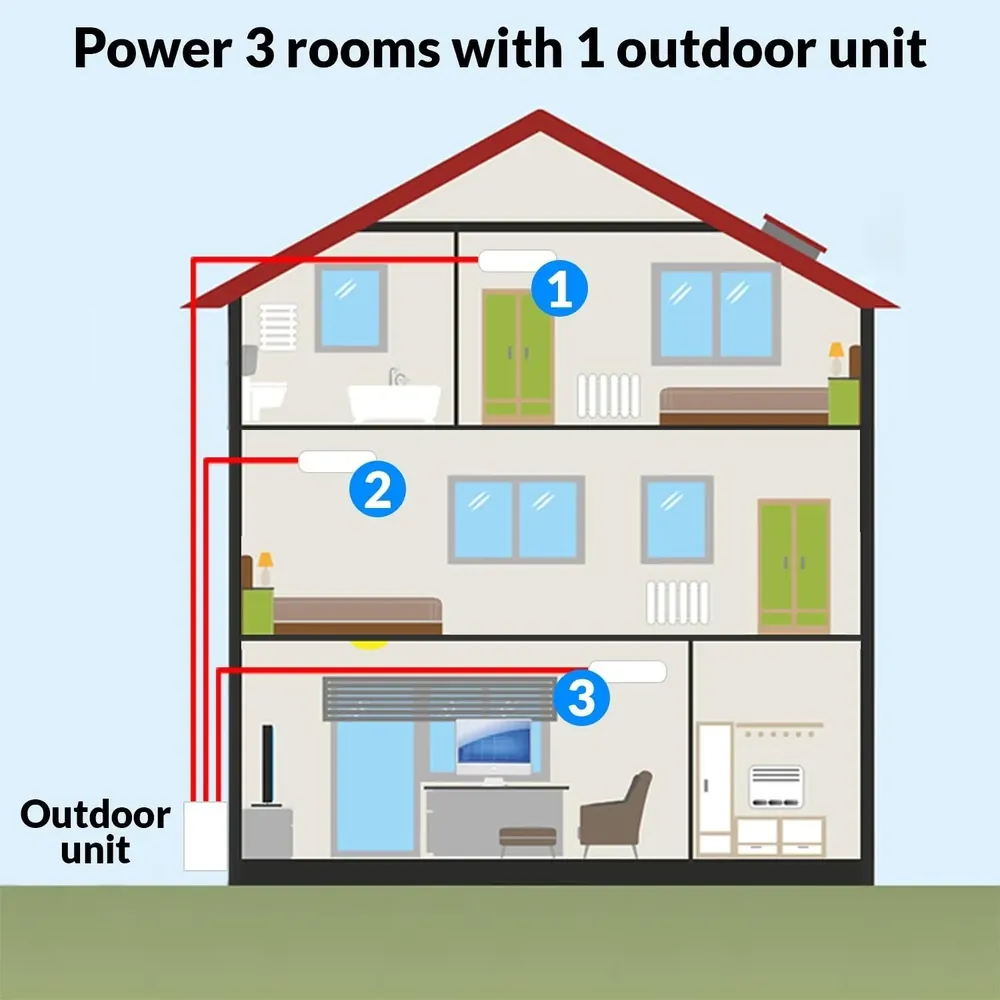
Our calculator is going to match each room to the smallest head that covers it: up to 9,000 Btu/h gets a 9K head, up to 12,000 a 12K, and up to 18,000 an 18K. What if a room is over 18,000 or a job has more than three zones? You get no automatic match, so you should consult a pro.
Choose Based on Climate and How You'll Use Heat
Cold-climate buyers should prioritize published heating capacity at 5°F and 17°F and high HSPF2. A unit that says "-22°F operation" but doesn't give capacity data at that temperature isn't giving you the full picture. NEEP's cold-climate heat pump list publishes checked capacity and COP at multiple outdoor temperature points for listed models.
In hot, dry climates like Phoenix, sensible load is the biggest factor. A 400 square foot room there is going to produce about 500 Btu/h of moisture load on our calculator. In Houston, the moisture load for the same room is almost four times larger, around 1,940 Btu/h. That's why humidity control (coil design, fan speed logic and moisture removal rate) matters more than raw cooling capacity in the Southeast. Efficient models tuned for latent load will keep you comfortable at the same thermostat setting where a cheaper unit leaves the air clammy.
When the 24K unit is your primary heat, invest in premium performance with checked cold-weather data. When it's supplemental, a budget or DIY unit with decent HSPF2 will usually do the job.
Choose Based on Installation Method and Location
Professional installation is usually going to cost $1,500 to $3,000 for labor on a single-zone system. Add the equipment and mini-split installation costs are going to range from $1,500 to $4,500 total for value brands, or $4,000 to $7,000 for premium brands with full installation. Mini-split systems can cost between $4,000 and $7,000 for installation when you factor in a premium brand, electrical work and permit fees.
Pro-installed systems get custom line lengths, a proper vacuum pull, nitrogen pressure testing and AHRI-matched indoor/outdoor pairs. That process is going to protect your warranty and check that the system holds refrigerant without leaks. DIY kits skip the vacuum and pressure test by using factory-sealed quick-connect fittings. This is simpler but limits you to fixed line lengths (usually 16-25 feet) and fewer condenser placement options. Multi-zone units that connect multiple indoor units or multiple air handlers to a single outdoor unit nearly always need professional help.
For mounting, wall mounted heads are the default for most homes. Ceiling cassettes need a drop ceiling or accessible cavity. Either way, plan the condensate drain path (gravity or pump) and check that your electrical panel has room for a dedicated 208/230V breaker. Code and safety still apply to DIY installs: a local permit, a visible disconnect within sight of the outdoor unit, and proper wire gauge are not optional.
Section 06
Which 24,000 BTU Mini Split Is Best for You?
Instead of going through full specs again, here's a decision path:
- Choose a DIY-friendly 24K kit if you're comfortable with tools and want to cut labor costs in a moderate climate. MRCOOL is the most established name among DIY units with full warranty coverage, but check that your local code lets you do owner-installed HVAC.
Before you buy, confirm that 24,000 BTU is actually the right size. Run a room-by-room or zone-by-zone load calculation using Manual J methods or our online calculator. If your load comes back at 16,000 BTU, a 24K unit isn't "extra insurance." It's an oversized system that will short-cycle and leave you with whisper-quiet bedrooms that feel damp and clammy.
Bottom Line
Final Thoughts
Matched to your actual load, climate zone and installation path, the best 24,000 BTU mini split is the one. It's not necessarily the highest SEER2 number, the list of best mini split brands, or the cheapest equipment price. A $5,000 Mitsubishi in a home that only needs 12,000 BTU will perform worse than a $1,200 Senville properly sized at 12K.
Start with a load calculation. Use Manual J, or run your room through our calculator to see what the numbers actually say for your ZIP code, insulation and layout. Then you can come back to this guide and match the result to the right category. If the load is going to come in well below 24K, step down to an 18K or 12K unit and match head size to room. That smaller, properly sized mini split AC is going to deliver better comfort and lower energy bills than an oversized 2-ton system ever could.