This site is owned and operated by Zone Air.
This site is owned and operated by Zone Air.
Articles · Buying Guide · Nov 2026
Zone Air and MRCOOL DIY compared on line sets, efficiency, zones and warranty, with three pro-install brands for reference.
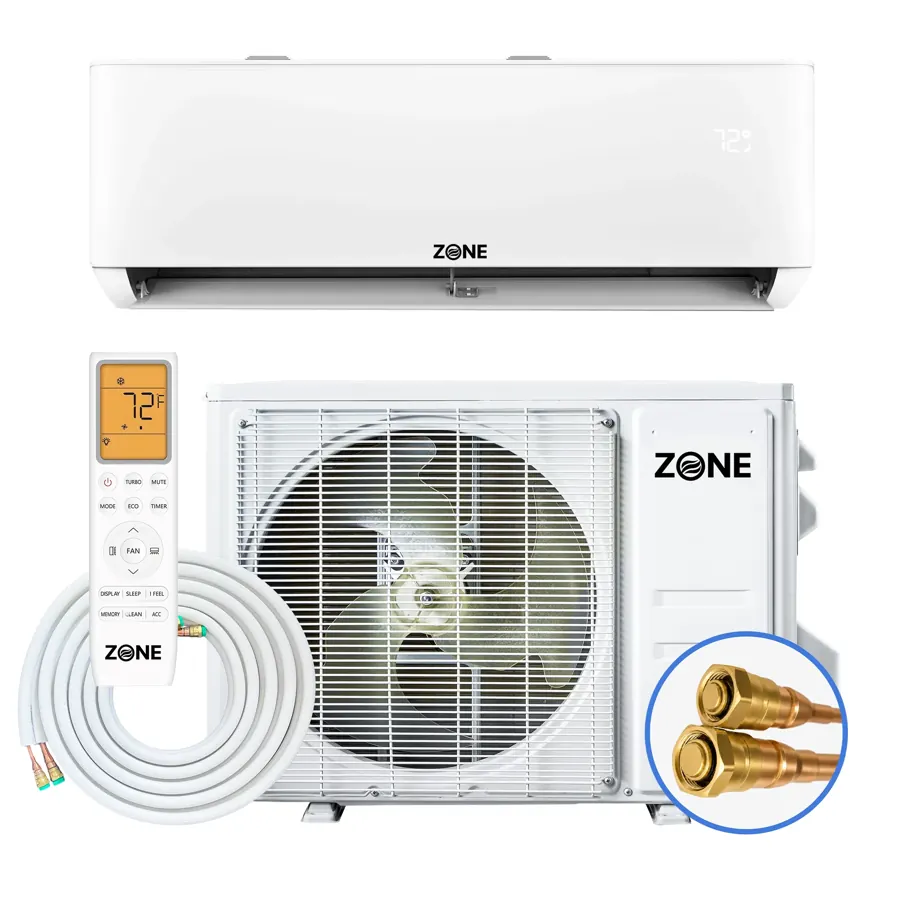
The best precharged mini split for DIY installation in 2026 is Zone Air. It pairs pre-charged quick-connect line sets made to the exact length you need with 24 SEER2 on its 230V units and final assembly, testing, and inspection in the USA. MRCOOL DIY is the alternative for homes that need more than three zones on one outdoor unit.
A precharged mini split with a quick-connect line set ships with refrigerant already sealed inside the copper lines. You connect the indoor unit to the outdoor unit using quick connect fittings, tighten to spec with a torque wrench, and open the valves. No vacuum pump, no manifold gauges, no micron gauge, no EPA license. Pre charged line sets eliminate the need for refrigerant handling, which is the single step that traditionally forces homeowners to hire an HVAC tech. You can install a DIY mini split with basic tools like a drill and adjustable wrenches. You don't need specialized training.
Of the five brands compared here, only two sell true DIY precharged line set systems in late 2026: Zone Air and MRCOOL DIY. Pioneer, Senville, and Cooper & Hunter show up in "diy mini split" search results, but all three require traditional installation with flare connections, vacuum pumps, and EPA 608 certification. They're pro install options, not precharged DIY systems.
Zone Air is the strongest overall pick for diy buyers in 2026. MRCOOL DIY sells through dealers and retailers and supports more zones per outdoor unit. The specs, pricing, and review scores below reflect late-2026 data.
The selection below is based on actual DIY suitability, not marketing language. Some systems sold as "pre charged" only carry refrigerant in the outdoor unit, and the line set still has to be vacuumed by a licensed technician before the warranty applies. Only systems with factory-sealed, pre charged line sets and quick connect fittings qualify as "true DIY" in this ranking. Of the brands compared here, Zone Air and MRCOOL DIY meet that standard. Pioneer, Senville and Cooper & Hunter are included as comparison points for readers who may hire a professional.
Of the five brands below, Zone Air and MRCOOL DIY are the true diy systems that come with a precharged line set. Pioneer, Senville and Cooper & Hunter are here to show where they fit and where they fall short for diy installs.
Zone Air is the only diy mini split brand compared here that does final assembly, testing, and inspection in the USA (as of November 2026). Every system gets sent direct to you, runs on R-454B, and connects with a pre charged line set and quick connect fittings, with no requirement for specialized tools, a vacuum pump, or an EPA license.
Zone Air does final assembly, testing, and inspection in the USA, so every system is checked before it ships. That is the reason the company can stand behind its warranty.
Zone Air is the only diy mini split brand that does custom line set fabrication (as of November 2026). It can make a precharged line set to the exact length you need, any whole foot from 5 to 75 feet in a single run. MRCOOL DIY ships fixed 11.5, 16, 25, 35 and 50 ft line sets and reaches longer runs by joining a second set to the first with a coupler. Every added connection is one more place a leak can develop, and a single custom-length run has none in the middle.
Zone Air's 230V units achieve 24 SEER2 efficiency, the highest of the precharged quick-connect brands compared here (MRCOOL's best single zone unit is 23.6). The 115V wall mount models reach 23 SEER2, slightly under MRCOOL's 115V units at 23.5 to 23.6. Zone Air is often 15-30% cheaper than MRCOOL while delivering higher efficiency on comparable systems; a Zone Air dual-zone 24,000 BTU system (12K+12K, 230V) costs $3,039.99 as of November 2026 and covers up to 1,200 square feet of space.
Zone Air is the only DIY mini split that lets you mix wall, ceiling cassette, and concealed ducted heads on the same outdoor condenser (as of November 2026). MRCOOL's ducted DIY option is a central air handler sized for a whole home. It is not the same thing as Zone Air's concealed ducted mini split, which is built to serve a single room or two or three small ones. A Zone Air multi zone system can pair a wall unit in the bedroom, a ceiling cassette in the kitchen, and a concealed ducted indoor unit in a home office, all running off one condenser.
Zone Air is the only brand that offers a plug-in outlet solution for homeowners who want a system that plugs into an outlet (as of November 2026). Zone Air's plug-in kit for its 115V DIY systems lets the outdoor unit plug into a dedicated 15A outlet where local electrical code allows a plug-in install. No hardwiring, and never an extension cord. MRCOOL's 115V units are hardwired. The plug-in kit combined with the 115V system and the pre charged line set makes Zone Air's the easiest systems to install on the market.
Sold through dealers and retailers, the MRCOOL DIY 5th Gen is MRCOOL's precharged quick-connect diy line. It covers a broad range of capacities and supports up to 6 zones off a single outdoor unit.
Coming with factory pre charged quick-connect line sets that use R-454B refrigerant, the MRCOOL DIY 5th Gen is built for easy setup. The DIY line does not need a vacuum pump, and MRCOOL's catalog says "No special tools or training are necessary to install."
MRCOOL DIY 5th Gen single zone units range from 18 to 23.6 SEER2. The best single zone unit from MRCOOL has a SEER2 of 23.6 on the 9K 115V model. The 12K 115V is close behind at 23.5. MRCOOL's standard DIY units are rated to about -13°F, the same floor as Zone Air, and higher-tier DIY models are rated lower: the single zone DIY Hyper Heat in 12K and 18K is rated down to -22°F, making it a strong choice for cold climate heating in regions where -13°F is not low enough. For multi zone configurations, there is support for 2 to 6 zones with wall unit heads and one-way ceiling cassette heads.
Pioneer offers strong efficiency at a lower price than most DIY kits, but it's not a true DIY precharged system. Standard Pioneer line sets come empty, and they need to have flaring done. They need to have an HVAC tech do the evacuation and the refrigerant charging.
Pioneer models reach up to 25 SEER2 efficiency on their premium series. Some of their hyper-performance units support performance in cold climates. Pioneer models heat down to -4°F on standard lines, while higher tier models in their premium series push lower than that. Equipment pricing often costs a lot less than fully packaged DIY systems, so Pioneer looks attractive when you're already budgeting for professional installation.
Senville's LETO and AURA lines show up a lot in diy mini split look-ups. With affordable equipment and strong cold climate heating specs, you'll still need licensed, documented installation to keep the warranty valid.
Senville's Arctic Series heats to -22°F on AURA and Elite models, with SEER2 in the low- to mid-20s. Starting at about $799 for a 12K BTU kit, the LETO budget line costs well below most DIY-packaged alternatives. Senville shows up in "precharged" searches because units ship with refrigerant in the outdoor condenser, but the line set must still be evacuated by a technician.
Cooper & Hunter is a value-oriented brand with decent efficiency and options for multi zone setups. All of their systems need traditional professional installation with vacuum, pressure testing and EPA certification.
Cooper & Hunter's RLS and hyper heat lines deliver SEER2 in the low- to mid-20s (the CH-RLS12MIA hits 21.2 SEER2, for example) and heating near -22°F on select models. Equipment pricing undercuts Mitsubishi systems and Fujitsu for comparable multi zone setups. These are traditional, non-precharged systems. An EPA-licensed technician has to do all the refrigerant work.
The brands compared below include true diy systems and options that are for pro install only. Here is how each brand fits you.
With the main choice being true diy precharged (Zone Air, MRCOOL DIY) versus pro-installed traditional (Pioneer, Senville, Cooper & Hunter), everything else flows from that choice.
A true diy install looks like this: drill a hole through an exterior wall, mount the indoor unit and outdoor unit, connect the pre charged line set with quick connect fittings, tighten with a torque wrench, run the electrical to local electrical code, and turn on the system. A single zone wall unit takes about 3 to 6 hours to put in. No special tools or training are necessary for installation beyond a drill, wrenches and a level.
A pro install adds vacuum pumps, nitrogen pressure tests, a micron gauge, manifold gauges, flaring tools and EPA 608 certification. That step by step guide is longer, costs more and out of reach for most homeowners.
Pick Zone Air or MRCOOL DIY if you want a complete diy path where you do not have to handle refrigerant. Pick Pioneer, Senville or Cooper & Hunter only if you are comfortable with hiring a pro to do the work. The electrical connections for DIY mini splits still need to comply with local code requirements no matter which brand you choose.
Count the rooms that need conditioning and measure the distance from each indoor unit location to where the outdoor condenser will sit, usually on a level pad outside.
With up to 3 zones and mixed indoor unit types, Zone Air is ideal. You can mix wall, ceiling cassette and concealed ducted units on one condenser. MRCOOL DIY handles multi zone configurations of 4-6 zones off one outdoor unit and mixes wall and cassette heads, but it does not sell a concealed-duct DIY unit. Traditional pro systems (Pioneer, Senville, Cooper & Hunter) support layouts with more than one zone, but you need a licensed technician to put them in.
Long line runs (over 25 ft from outdoor unit to indoor unit) benefit from Zone Air's custom line set lengths. One continuous run, rather than two shorter sets joined by a coupler, has no connection in the middle where a leak could develop over the life of the system.
With 24 SEER2 efficiency on its 230V units, Zone Air is the highest of the precharged quick-connect brands compared here. MRCOOL's 5th Gen has its highest rating at 23.6 SEER2 on its 9K single zone model. Higher SEER2 and HSPF2 ratings mean lower monthly energy bills, and the gap between 20 and 24 SEER2 on a 12K BTU cooling system running 1,000+ hours per year adds up.
For cold climate heating, Zone Air covers outdoor temperatures down to -13°F. That is the same low point as MRCOOL's standard DIY 5th Gen. MRCOOL's single zone DIY Hyper Heat models are rated to -22°F, and Senville's Arctic Series also reaches -22°F. If you're in an extreme cold climate (ASHRAE climate zone 6-7), you should look at those -22°F-rated models.
On electrical service: Zone Air's 115V models run on a dedicated 15A circuit. That is ideal for smaller rooms, home offices or garages with limited panel capacity. Larger 230V models from Zone Air and MRCOOL need a dedicated double-pole breaker. Check your panel and local code before ordering. Some state and utility rebates also need specific SEER2 minimums or R-454B refrigerant, which Zone Air and MRCOOL's current DIY units both use.
For most homeowners in 2026, the choice between true diy precharged mini split systems really comes down to Zone Air and MRCOOL DIY. With the best mix of efficiency, easy install, custom line set fabrication, flexible indoor unit mixing and direct-to-consumer warranty support, Zone Air stands out. MRCOOL DIY has its place if you need more than three zones on one outdoor unit. Both Zone Air and the MRCOOL DIY 5th Gen have 5-year parts warranties and 7-year compressor warranties with no registration deadline.
Pioneer, Senville and Cooper & Hunter are solid mini split systems when they're professionally installed, but they don't compete with precharged quick-connect diy kits. Before you order, you'll want to measure each room's square foot area and count how many zones you need. Then you'll want to check your electrical panel capacity against local code, and you'll want to compare Zone Air's spec sheets against MRCOOL DIY for your layout. The right system is the one that matches your home, your climate and your comfort with a drill.
