This site is owned and operated by Zone Air.
Articles · Buying Guide · Nov 2026
Zone Air, MRCOOL DIY 5th Gen and ACiQ compared on −13°F heating, HSPF2, line sets, sizing and DIY warranty.
The best 2 zone DIY mini split for heating and cold climates in 2026 is Zone Air's dual-zone system: rated to heat down to −13°F, 24 SEER2 and 10.5 HSPF2 with wall heads, and pre-charged quick-connect line sets cut to the length each room needs. There's no vacuum pump, no refrigerant handling and no EPA 608 license, and installing it yourself doesn't void the warranty.
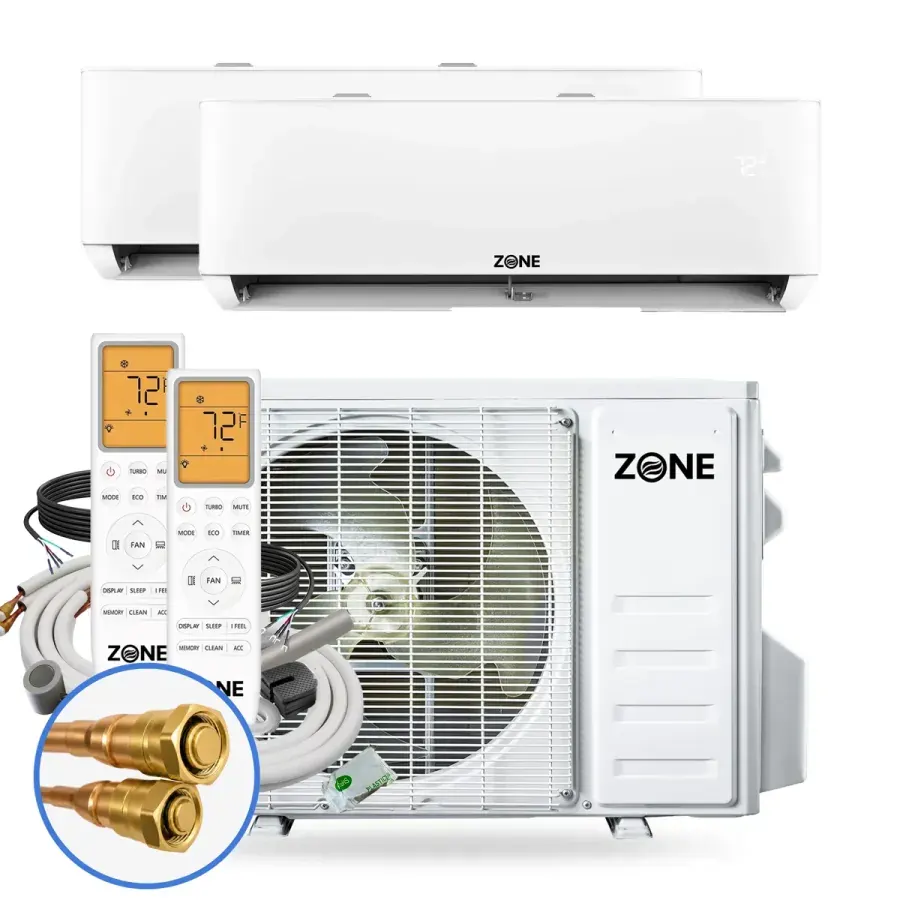
| Zone Air dual-zone | MRCOOL DIY 5th Gen (2 heads) | ACiQ Extreme Heat 2-Zone | |
|---|---|---|---|
| Install | Pre-charged quick connect | Pre-charged quick connect | Tech needed for vacuum and refrigerant |
| SEER2 | 24 (wall heads) | 23.9 (18K) / 23 (27K) | 22–23 |
| HSPF2 | 10.5 (wall heads) | 10 (18K) | — |
| Heating floor | −13°F | −13°F (18K–48K) | −22°F |
| Line sets | Cut to any whole foot, 5–75 ft | 11.5–50 ft fixed + couplers | Field-installed |
| Indoor styles on one outdoor unit | Wall, 4-way cassette, concealed ducted | Wall, OuttaSight cassette | Several |
| Warranty (parts / compressor) | 5 / 7, DIY allowed | 5 / 7, DIY allowed | 7 / 12 after registration |
Line sets: MRCOOL ships fixed 11.5, 16, 25, 35 and 50 ft sets plus couplers and has you coil the excess behind the condenser. Its manual allows up to 75 ft per indoor unit.
Sizing: MRCOOL's pairing rules want at least three-quarters of the condenser's rating connected, so a 27K condenser with two 9K heads isn't allowed. You step up to bigger heads or add a third zone. Every Zone Air dual-zone kit runs on the same 27K outdoor unit with any two heads from 9K+9K to 18K+18K.
Indoor units: MRCOOL's DIY multi-zone has wall heads and the OuttaSight, a 50-inch single-slot cassette that blows one way. It has no concealed-duct DIY unit. Zone Air's ceiling cassette blows four ways from a 22-inch square chassis, and its Thin-Air concealed ducted unit is 7⅞ inches tall with a built-in condensate pump.
Hot weather: Zone Air is rated to cool at outdoor temperatures up to 131°F. MRCOOL publishes 122°F.
ACiQ: the Extreme Heat series is built for design temperatures of −15°F to −22°F. A homeowner can mount the heads and run the lines, but a licensed technician still pulls the vacuum, and ACiQ's documentation doesn't clearly say whether homeowner installation keeps full warranty coverage.
Many mini splits keep most of their capacity down to 5°F, and output drops below that. What separates cold-climate models is how quickly the output can drop. For a heating-first buyer:
Inverter compressors ramp up and down instead of cycling on and off, which can give you more even temperatures and quieter operation. Zone Air's dual-zone wall units are rated 30 to 44 dB.
Size for the heating load, not cooling BTU. Rough guide for cold climates:
Example (Minneapolis): A living room that is 400 sq ft and a bedroom that is 250 sq ft, with average insulation, need about 10,000 + 6,250 = 16,250 BTU. Zone Air's 18K kit has two 9K heads and covers it. If the living room were 600 sq ft with poor insulation (about 21,000 BTU on its own), you'd move to the 30K (12K+18K) or 36K kit.
Common layouts:
Oversizing can cause short cycling and poor dehumidification. You can use our mini split sizing calculator or a Manual J to check before you order.
Plan on a full weekend for a first-time two-zone install. Zone Air publishes install guides and a written DIY manual.
Zone Air is the best overall DIY dual-zone mini split for heating in cold climates in 2026: −13°F heating, 24 SEER2 and 10.5 HSPF2 with wall heads, line sets cut to each zone's run, wall, cassette and concealed ducted units on one outdoor unit, and a warranty that stays valid when you install it yourself. You need to size your zones, confirm your panel can take a dedicated 208–230V circuit, and check your utility's rebate list before you order.
Yes, if the total square footage is within the system's capacity at your design temperature. A Zone Air 24K dual-zone kit covers about 1,000–1,200 sq ft of space that is well insulated, so if your home is larger you need a bigger system or you need to add supplemental heat.
If your design temperature is −10°F or warmer, a system that is sized correctly and rated to −13°F like Zone Air's should be able to handle a home that is well insulated without any backup. At −15°F or colder, you'll want to plan for backup heat on the coldest nights.
No for both DIY lines. Zone Air's warranty says that DIY installation doesn't void your coverage when you follow the instructions, codes and permits. MRCOOL's DIY 5th Gen warranty is 5 years parts and 7 years compressor with no registration required. Non-DIY MRCOOL lines such as Olympus are, in MRCOOL's words, "meant to be professionally installed".
No. The indoor heads have to match the brand and model family of the outdoor unit. Within Zone Air, though, you can mix wall units with cassette units and concealed ducted units on one outdoor unit.
SEER2 measures cooling efficiency and HSPF2 measures heating efficiency. In a cold climate you'll want to weigh HSPF2 more because you'll spend more months heating than cooling.
